TL;DR:
- Personalised skincare rooted in science offers a way to address the unique biological and environmental factors affecting your skin.
- While research shows potential benefits, current evidence is limited and often not representative of diverse skin tones.
- Practically, authentic personalization involves careful assessment, gradual ingredient introduction, and choosing artisanal formulations designed to support your skin’s real needs.
Your skin is not the same as your friend’s, your sister’s, or the influencer whose routine you bookmarked last Tuesday. Yet most skincare advice treats every complexion as if it were identical. The result? Routines that feel “close enough” but never quite deliver. The good news is that personalised skincare, rooted in science and supported by natural, artisanal ingredients, offers a genuinely different path. Understanding why your skin behaves the way it does, and building a routine around those real reasons, is how you move from guessing to glowing.
Table of Contents
- Why personalising skincare matters: Beyond surface-level differences
- What science says: Evidence and current limitations in personalised skincare
- Modern tools for personalised natural routines: From quizzes to genetic testing
- How to personalise your skincare routine using natural and artisanal approaches
- What most skincare advice misses: A caution for the personalisation trend
- Explore natural personalisation with ZenChemy Lab
- Frequently asked questions
Key Takeaways
| Point | Details |
|---|---|
| No one-size-fits-all | Your skin’s needs are shaped by genetics, lifestyle, and environment, so custom routines outperform generic advice for most people. |
| Evidence is emerging | Personalised skincare shows promise but still requires more robust, diverse research before claims are universal. |
| Tools need scrutiny | Not all personalisation tools are valid for every skin type, so choose approaches backed by independent evaluation. |
| Natural routines can be custom | Even with artisanal or plant-based products, you can apply personalisation for better results and sustainability. |
| Trust real feedback | Building a routine that responds to your actual skin changes is more effective than relying on trends or marketing. |
Why personalising skincare matters: Beyond surface-level differences
Having challenged broad skincare routines, let’s explore what makes each person’s skin genuinely different. Most people think personalisation simply means choosing “oily,” “dry,” or “combination” on a product label. That is a start, but it barely scratches the surface.
True personalisation addresses root causes. Your genetics influence how efficiently your skin produces antioxidants, how quickly your barrier repairs itself, and how intensely it reacts to UV radiation. Your diet affects lipid (fat) levels in the skin, which directly impact how plump and resilient your complexion feels. Your environment, whether you live in a cold, dry climate or a humid urban centre, shapes your transepidermal water loss (TEWL), which measures how much moisture evaporates through your skin each day.
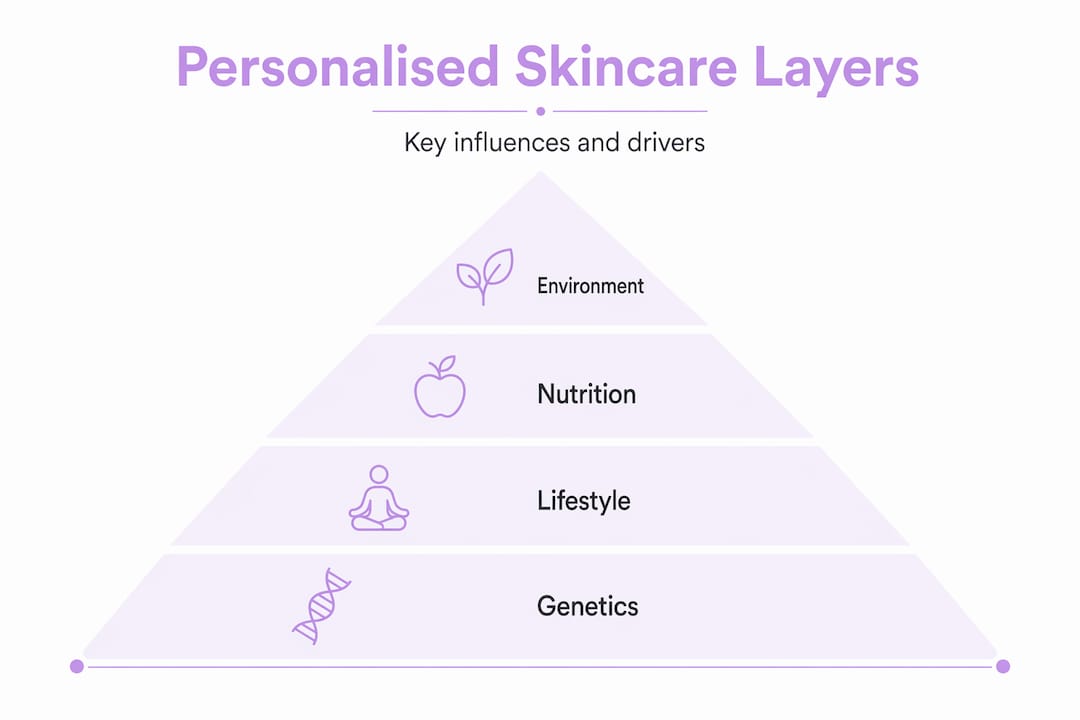
Skin needs vary meaningfully across individuals due to factors like genetics and nutrition, influencing pathways tied to UV sensitivity, inflammation, antioxidant capacity, and skin barrier function. That is not a marketing claim. It is biology.
Consider a few concrete examples:
- 🌿 UV sensitivity: Two people with similar skin tones can have very different capacities for melanin production and DNA repair. One may need stronger antioxidant support after sun exposure; the other may not.
- 💧 Antioxidant needs: If your diet is low in vitamin C or E, your skin’s natural defence against oxidative stress is compromised, regardless of your “skin type.”
- 🌬️ Barrier function: Those with a genetic tendency toward lower ceramide production are more prone to eczema flares and sensitivity, which means their ideal routine is very different from someone with a robust barrier.
“Personalisation is not about choosing the trendiest serum for your skin type. It is about understanding the underlying drivers of your skin’s behaviour and addressing those specifically.” — ZenChemy Lab
Nutrition and lifestyle also modify your skin’s moment-to-moment needs. Stress hormones like cortisol elevate inflammation. Poor sleep disrupts cellular repair. A diet low in omega-3 fatty acids can weaken the skin’s lipid barrier. These are not abstract concerns. They are everyday variables that shift what your skin requires week to week.
Exploring artisanal skincare benefits becomes far more meaningful once you understand that handcrafted formulations can be adjusted for these underlying drivers. Natural ingredients, carefully selected, can support barrier repair, antioxidant defence, or anti-inflammatory pathways without the synthetic load of mass-market products.
Learning more about plant-based skincare science helps bridge the gap between what nature offers and what your skin actually needs at a biological level.
What science says: Evidence and current limitations in personalised skincare
With a foundation on what makes your skin unique, let’s examine what research actually suggests about the benefits and caveats of custom skincare approaches.
The evidence for personalised skincare is promising, but it deserves an honest look. Some studies demonstrate that data-driven, customised approaches can produce measurable improvements in skin metrics over short timeframes. However, as one case study evaluation notes, many data sets are small or pilot-scale and not yet generalisable to broader populations.
Here is a breakdown of the types of evidence you will encounter:
| Evidence type | What it tells you | Key limitation |
|---|---|---|
| Randomised controlled trial | Strong causal evidence | Rare in personalised skincare |
| Observational study | Shows associations | Cannot prove causation |
| Case study / pilot study | Exploratory, generates ideas | Small sample, low generalisability |
| Expert opinion | Useful for emerging fields | Subjective, varies widely |
📊 Statistic spotlight: A 2025 systematic review found that AI and genomics-driven personalisation is an emerging area with a mixed evidence base. While some randomised trials exist, many studies are exploratory or lower-level. Evidence quality and coverage limitations remain key constraints.
Another critical gap is representation. Much of the research on skin biology and product efficacy has been conducted on lighter skin tones. This means personalised tools trained on such data may not serve people with deeper complexions as accurately, a significant concern given how profoundly melanin, barrier function, and inflammatory responses can differ across ethnicities.
So what should you, as a thoughtful consumer, look for? Here are signs of credible personalisation claims:
- ✅ Studies published in peer-reviewed journals, not just brand-sponsored white papers
- ✅ Sample sizes above 50 participants, ideally with a control group
- ✅ Outcomes measured with objective tools (e.g., corneometers for hydration, TEWL meters) rather than self-reported perception alone
- ✅ Diverse participant populations that reflect a range of skin tones and types
- ✅ Follow-up periods longer than 28 days to assess durability
Understanding skin hydration importance gives you practical context for why objective measures like TEWL are so important when evaluating whether any routine, personalised or standard, is working for you.
You can also learn how specific ingredients like humectants in skincare contribute to hydration in ways that are well-documented and can be tracked, giving you real feedback on your routine’s effectiveness.
Pro Tip: When a brand claims their personalised formula is “clinically proven,” ask for the full study. Check the sample size, who funded the research, and whether the outcomes were measured objectively. Transparency is a mark of genuine science.
Modern tools for personalised natural routines: From quizzes to genetic testing
Once you understand the evidence, the next step is choosing how to bring personalisation into your skincare practice. Several tools now exist on a spectrum from simple to sophisticated.

Digital skin quizzes are the most accessible entry point. They ask about your environment, lifestyle, concerns, and current routine, then recommend products or regimens. They are low-cost and quick, but their recommendations are only as good as the logic behind them.
AI-powered skin analysis uses smartphone cameras or dermatologist-grade imaging to assess texture, pore size, pigmentation, and moisture levels. Some systems analyse your results against large databases to suggest targeted ingredients.
At-home DNA test kits are the most advanced consumer option. They assess genetic variants linked to collagen production, antioxidant capacity, and inflammation tendencies, offering a biological roadmap for your skincare choices.
Mechanistically, true personalisation is intended to align choices with underlying drivers such as genetics, inflammation tendencies, hydration status, and TEWL, rather than superficial appearance alone. That is what separates genuine personalisation from simply swapping products based on how your skin looks on a given day.
Here is a quick comparison to guide your decision:
| Tool | Best for | Limitation |
|---|---|---|
| Digital quiz | Quick, low-cost starting point | Relies on self-report; no objective data |
| AI skin imaging | Objective skin metrics at home | Accuracy depends on lighting and training data |
| DNA test kit | Long-term, root-cause personalisation | Expensive; not all findings are actionable yet |
| Professional consultation | Comprehensive, expert-guided | Costly; not always accessible |
It is also important to note that personalisation tools relying on imaging or DNA summaries can fail when their training data does not reflect diverse skin tones and when clinical outcomes are not validated prospectively.
Checklist for safely integrating personalisation into your routine:
- Start with a structured self-assessment: document your skin’s current behaviour across seasons and after dietary changes.
- Choose one tool or method and use it consistently for at least 60 days before evaluating results.
- Track objective changes: photograph your skin in consistent lighting weekly.
- Cross-reference tool recommendations with credible ingredient research.
- Adjust gradually. Change one variable at a time to know what is working.
Pro Tip: The most underrated personalisation tool is a simple skin journal. Write down what you ate, your stress level, the weather, and how your skin responded. After 30 days, patterns will emerge that no algorithm can replicate.
How to personalise your skincare routine using natural and artisanal approaches
Now let’s turn principles and options into practical steps you can use to build and adapt an effective, truly personal regimen.
You do not need expensive technology to personalise your skincare routine. What you need is attention, consistency, and a willingness to treat your skin as a system that responds to inputs, not just products to buy.
Step-by-step framework for personalising naturally:
- Assess your baseline. Before adding anything new, spend one week using only a gentle cleanser and a fragrance-free moisturiser. This resets your skin and gives you a true starting point.
- Identify your primary concerns. Is it persistent dryness? Uneven tone? Sensitivity that flares seasonally? Rank your concerns in order of priority.
- Match concerns to ingredient categories. Dryness calls for occlusives and humectants. Sensitivity benefits from anti-inflammatory botanicals like calendula or oat extract. Uneven tone may respond to gentle exfoliation with lactic acid or vitamin C-rich plant extracts.
- Introduce ingredients one at a time. Wait two weeks between new additions. This is the only way to know what your skin actually likes.
- Adjust seasonally. Winter typically demands richer, more occlusive formulations. Summer may call for lighter, gel-based hydration. Your skin’s needs shift, and your routine should shift with it.
- Check in monthly. Reassess your skin’s current state and compare it to your baseline photos. Adjust your regimen based on what you see, not what a quiz told you six months ago.
Key checkpoints to keep you on track:
- 🌿 Look for natural ingredient claims backed by published research, not just tradition
- 💧 Avoid layering too many active ingredients at once, especially if your skin is sensitive
- ☀️ Always include sun protection as a non-negotiable foundation
- 🧴 Choose artisanal formulations that list full ingredients transparently
It is worth noting that personalisation can amplify expectations and perceived improvement when evidence is limited. Research from a case study evaluation advises consumers to look for independent, well-controlled validation before assuming a personalised approach outperforms standard evidence-based care. Manage your expectations and track real outcomes.
For a deeper guide on building a sustainable regimen, explore curating natural routines to see how thoughtful ingredient choices create long-term results. If you want to understand what goes into formulations at a deeper level, selecting pure ingredients is an essential read. And for a step-by-step application process, mastering natural workflows offers a clear, practical framework.
What most skincare advice misses: A caution for the personalisation trend
Here is something worth sitting with: the skincare industry has found that the word “personalised” sells. That is not a conspiracy. It is simply good marketing aligned with a real consumer desire. But it creates a problem. When everything is labelled “custom,” nothing actually is.
We have watched the personalisation trend grow rapidly, and we believe it contains something genuinely valuable, but only if you can separate real personalisation from what we call “personalisation theatre.” This is the performance of customisation without the substance. Think of a brand that asks you five questions and delivers the same three-product set to 90% of respondents.
Real personalisation requires two things that most products skip: a genuine mechanism for assessing your individual skin biology, and a formulation strategy that responds to what that assessment finds. Most brands have neither. They have a quiz and a pre-made kit.
The concern is not limited to marketing language. Evidence quality and coverage limitations remain key constraints, and personalisation hype can amplify expectations and perceived improvement when the underlying evidence is still thin. When you believe something is working specifically for you, the placebo-adjacent effect is real and measurable.
For those who prioritise natural and ethical skincare, the stakes are slightly higher. You are already investing thought and values into your purchases. You deserve formulations that actually reflect your skin’s needs, not just your aesthetic preferences.
Our advice: seek brands that offer genuine transparency about their formulation philosophy, ingredient sourcing, and the reasoning behind their recommendations. Explore artisanal skincare benefits with a discerning eye. The best artisanal products are inherently more adaptable than mass-market options because they are crafted with intention rather than optimised for scale. That is a real advantage, but only when paired with your own informed choices.
Explore natural personalisation with ZenChemy Lab
At ZenChemy Lab, we believe personalisation starts with understanding your skin’s real needs and reaching for ingredients that genuinely respond to them. Our artisanal formulations are built from raw, natural botanicals chosen for their documented benefits, giving you a foundation you can actually trust.

Whether you are just beginning to personalise your routine or refining a practice you have built over years, our natural skin collection offers thoughtfully crafted options across cleansers, moisturisers, and body care. Pair your product choices with our skincare routine tips to build a regimen that is responsive, sustainable, and rooted in real ingredient science. Your skin deserves more than a one-size-fits-all answer, and we are here to help you find yours.
Frequently asked questions
What are the main factors that influence how my skin responds to products?
Your skin’s response is shaped by genetics, nutrition, environment, and lifestyle, all of which affect inflammation, hydration, and UV sensitivity. Skin needs vary meaningfully across individuals, which is why the same product can produce very different outcomes for different people.
Are personalised skincare routines safe for sensitive or allergy-prone skin?
Personalised approaches can help you identify and avoid triggers, but you should look for routines supported by independent, controlled studies. Research advises consumers to seek well-controlled validation that a personalised approach actually outperforms standard care before committing fully.
Can natural and artisanal products be truly personalised?
Yes. You can personalise a natural routine by adjusting ingredients, textures, and application frequency based on your skin’s real-time feedback, without relying on synthetic formulations or expensive technology.
Should I trust online skin quizzes and DNA test kits?
Approach these tools critically and with realistic expectations. Personalisation tools relying on imaging or DNA summaries can fail when their training data does not reflect diverse skin tones or when outcomes have not been independently validated.
Is there strong scientific proof that personalised skincare works?
Some studies show positive results, but most are small or short-term. Measurable improvements have been observed in pilot studies, but the evidence is not yet generalisable enough to make broad claims, so approach any sweeping promises with healthy scepticism.