TL;DR:
- Clinical trials show plant extracts like prickly pear reduce sebum production and pore size effectively.
- Plant-based skincare relies on botanical ingredients that actively support antioxidants, barrier repair, and anti-inflammation.
- Modern research confirms plant formulations can be safe, efficacious, and ethically produced, opposing old biases.
A clinical trial found that Opuntia ficus-indica (prickly pear) extract reduced sebum by 21.1% and pore size by 9.6% in just 28 days. That is not a marketing claim. That is peer-reviewed, measurable skin transformation achieved with a plant. If you have ever been told that natural skincare is less effective than lab-made formulas, the evidence is starting to tell a very different story. This article walks you through what plant-based skincare actually is, how it works biologically, what the research confirms, and how to choose and use it wisely.
Table of Contents
- What defines plant-based skincare?
- How do plant ingredients affect your skin?
- Evidence-based results: What does research say?
- Choosing and using plant-based skincare products
- The overlooked truth: Nature and science can and should work together
- Build your artisanal plant-based skincare journey
- Frequently asked questions
Key Takeaways
| Point | Details |
|---|---|
| Measured science-backed results | Plant-based skincare shows real improvements in sebum control, skin texture, and hydration backed by modern trials. |
| Naturally safe and gentle | Human patch tests confirm high tolerability for plant-based products making them ideal for sensitive skin. |
| Powerful, multi-action benefits | Plant ingredients deliver antioxidants, anti-inflammatory action, and help build a healthy skin barrier. |
| Mindful choices matter | Authentic plant-based products emphasize quality, ethics, and sustainability for a holistic self-care routine. |
What defines plant-based skincare?
Plant-based skincare is a category of cosmetics and body care formulated primarily with ingredients derived from botanical sources. That includes roots, flowers, seeds, leaves, bark, and fruit. What separates it from conventional skincare is not just the ingredient list. It is a philosophy. These products are designed to nourish the skin using nature’s chemistry rather than relying heavily on synthetic compounds or animal-derived materials.
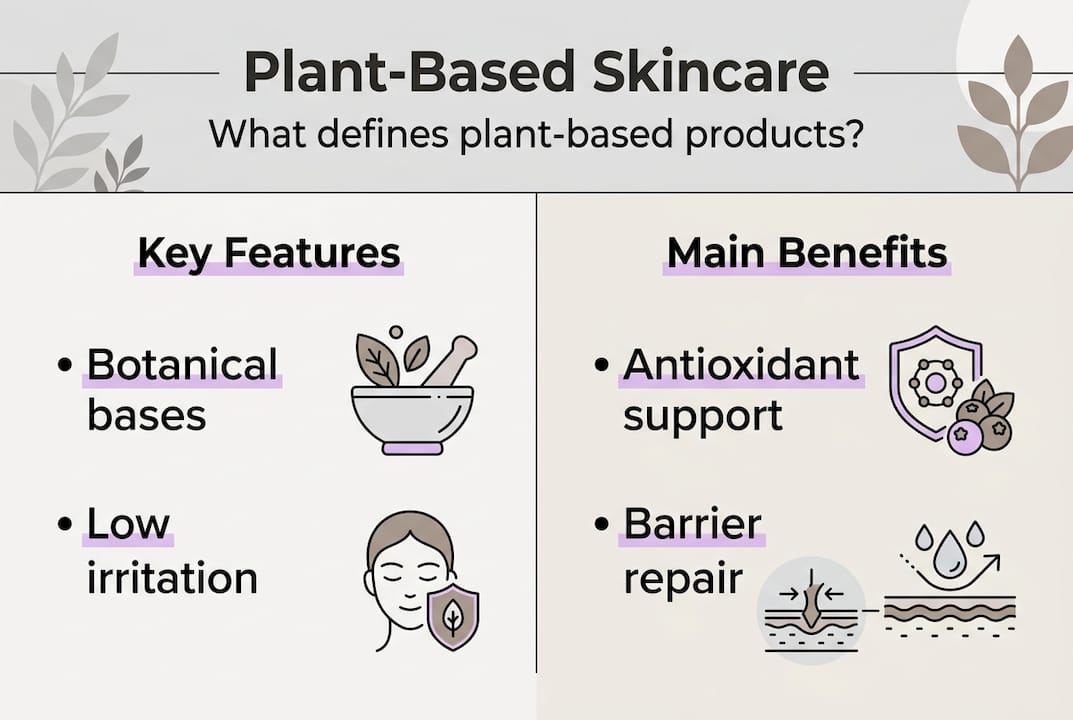
The movement grew out of broader wellness and eco-conscious thinking. Consumers began asking harder questions about what they were putting on their skin, where those ingredients came from, and what impact the whole process had on the planet. Plant-based skincare answered those questions with transparency, traceability, and ethical sourcing.
✔️ Main types of plant-based skincare ingredients:
- Plant extracts: Concentrated actives from leaves, flowers, roots, or fruit (e.g., green tea, chamomile, rosehip)
- Botanical oils: Cold-pressed or expeller-pressed oils rich in fatty acids and fat-soluble vitamins (e.g., jojoba, argan, sea buckthorn)
- Waxes: Plant-derived emollients and thickeners such as candelilla or carnauba wax
- Hydrosols: Steam-distilled floral waters that carry trace actives and are gentle on sensitive skin (e.g., rose water, lavender water)
- Butters: Solid plant fats that melt on contact with skin, creating a protective and moisturising layer (e.g., shea, mango, cocoa)
- Plant-based humectants: Natural moisture-attracting compounds like glycerine derived from plant oils
One of the strongest arguments for plant-based formulations is their safety profile. Research covering 50 plant-derived materials found no irritation in human patch tests, confirming that well-formulated botanical products are safe and well-tolerated across a range of skin types. This also supports the vegan skincare science argument that plant-derived alternatives perform safely without the ethical concerns tied to animal-derived ingredients. To explore how artisanal formulation elevates these ingredients, see our guide on artisanal skincare benefits.
How do plant ingredients affect your skin?
The short answer is: deeply, and in multiple ways simultaneously. Plant-based ingredients are biologically active. They contain phytochemicals (plant-made chemical compounds) that interact with skin cells, enzyme pathways, and inflammatory signals. This is not passive moisturising. It is active skin science.
Antioxidant defence is one of the most documented benefits. Your skin faces oxidative stress every day from UV exposure, pollution, and environmental toxins. These stressors generate free radicals, unstable molecules that damage cells, accelerate ageing, and break down collagen. Polyphenols and carotenoids found in plant extracts scavenge free radicals and inhibit matrix metalloproteinases (MMPs), enzymes that degrade collagen fibres. Less MMP activity means stronger skin structure over time.
Skin barrier support is another key function. Healthy skin operates like a “brick and mortar” structure. The corneocytes (skin cells) are the bricks, and the lipid matrix (fats between the cells) is the mortar. Certain plant-derived ceramides and fatty acids directly reinforce this mortar layer, reducing transepidermal water loss (TEWL) and keeping the skin hydrated and resilient. You can learn more about this through our article on the skin lipid barrier.
Anti-inflammatory action rounds out the core benefits. Chronic low-grade inflammation drives acne, redness, premature ageing, and conditions like eczema. Cytokine reduction through botanical actives like turmeric (curcumin), green tea (EGCG), and chamomile (bisabolol) helps calm these inflammatory cascades without aggressive synthetic agents.
| Phytochemical | Skin benefit | Example source |
|---|---|---|
| Polyphenols | Antioxidant, anti-inflammatory, collagen support | Green tea, pomegranate |
| Carotenoids | Free radical scavenging, UV defence | Rosehip, carrot seed oil |
| Ceramides (plant-derived) | Barrier repair, TEWL reduction | Wheat germ, rice bran |
| Flavonoids | Anti-inflammatory, soothing | Chamomile, calendula |
| Phytosterols | Hydration, skin softening | Shea butter, avocado |
| Retinoids (plant-source) | Cell turnover, anti-ageing | Rosehip, sea buckthorn |
For a deeper look at specific ingredients, our guide to top natural body care ingredients covers the most effective actives you should know about.
🌿 “Polyphenols, carotenoids, and other phytochemicals have demonstrated measurable efficacy in scavenging free radicals, inhibiting collagen-degrading enzymes, reducing inflammatory cytokines, and reinforcing the skin barrier — all within well-formulated, plant-based topical products.”
Pro Tip: When reading an ingredient list, look for plant-based oils and extracts listed in the top half of the formula. Ingredients are listed in descending order of concentration, so placement matters. A chamomile extract listed near the top delivers far more benefit than a trace amount buried at the bottom.

Evidence-based results: What does research say?
Research is no longer a weak point for plant-based skincare. It is becoming one of its strongest advantages. The science has caught up, and the results are impressive when you look at what controlled clinical trials are actually measuring.
The most compelling recent evidence comes from a multi-ingredient study that evaluated several botanical actives in real clinical settings. Opuntia ficus-indica extract delivered a 21.1% reduction in sebum production, a 9.6% reduction in pore size, and a 7.4% decrease in TNF-α (a key inflammatory marker) after just 28 days of use. Rose petal extract, tested over 12 weeks, improved wrinkles, skin elasticity, and hydration. Plant adaptogens reduced dryness and erythema (redness) in participants recovering from laser treatments. These are measurable, clinically observed outcomes.
How researchers evaluate plant-based formulas: Here is the typical process used in rigorous clinical trials:
- Ingredient standardisation: Researchers identify and quantify the specific active phytochemicals in the botanical extract to ensure consistency.
- Formulation development: The extract is incorporated into a stable, tested base at a therapeutic concentration.
- Participant selection: Volunteers with defined skin types or concerns are recruited to match the intended use case.
- Baseline measurement: Skin parameters like sebum, hydration, TEWL, and elasticity are measured using validated instruments at the start of the trial.
- Controlled application: Participants apply the product consistently for a defined period, typically 4 to 12 weeks, under monitored conditions.
- Post-trial assessment: The same skin parameters are measured again and compared against placebo groups or baseline data.
- Statistical analysis: Results are evaluated for significance to confirm that improvements are real and not due to chance.
📊 Plant-based vs. conventional skincare: A comparison
| Factor | Plant-based skincare | Conventional synthetic skincare |
|---|---|---|
| Ingredient source | Botanical, renewable | Synthetic, petroleum-derived |
| Skin tolerability | High (confirmed by patch test data) | Variable, potential for sensitisation |
| Clinical efficacy | Growing body of evidence | Well-established but often tested on narrow demographics |
| Environmental impact | Lower, biodegradable | Higher, non-renewable inputs |
| Ethical alignment | Typically vegan/cruelty-free | Often tested on animals |
| Cost | Variable, often reflects ingredient quality | Often lower due to synthetic cost efficiencies |
The comparison matters because many consumers assume they must choose between results and ethics. That is a false trade-off. For a thorough look at this question, our article on natural vs synthetic skincare breaks down the evidence without bias. You can also review how formulation purity affects safety and performance in our guide to natural ingredient safety.
Choosing and using plant-based skincare products
Knowing the science is only half the equation. The other half is practical: how do you find genuinely good plant-based products and build a routine that works for your skin?
Start with the ingredient list. This is your most reliable tool. A trustworthy plant-based product will list botanical ingredients prominently, ideally with their INCI names (International Nomenclature of Cosmetic Ingredients) so you can verify their origin. Be cautious of products that use “natural” as a marketing label while burying botanical actives far down the list behind fillers and synthetic preservatives.
Look for certifications. Third-party certifications such as COSMOS Natural, ECOCERT, or Leaping Bunny provide an additional layer of verification that a brand’s claims have been independently assessed. They are not perfect, but they do reduce guesswork.
Consider the brand’s ethos. Artisan and botanical brands that formulate in small batches, use traceable sourcing, and publish transparent ingredient information are generally more trustworthy than mass-market products riding the “green” trend. Sustainability and purity often go hand in hand. Our guide to sustainable skincare can help you align your purchasing choices with your values.
✔️ Key plant-based ingredients matched to common skin concerns:
- Dryness and dehydration: Shea butter, hyaluronic acid (plant-fermented), rosehip oil, glycerine
- Sensitivity and redness: Chamomile extract, oat-derived compounds (beta-glucan), centella asiatica, aloe vera
- Oiliness and breakouts: Willow bark extract (natural salicylate), jojoba oil (mimics sebum), tea tree oil, Opuntia ficus-indica
- Signs of ageing: Rosehip oil (natural retinoids), sea buckthorn (carotenoids), peptide-rich plant proteins, bakuchiol
- Dullness and uneven tone: Vitamin C from kakadu plum, niacinamide (plant-derived), turmeric, liquorice root extract
Building your ritual. Consistency is everything in skincare. A simple, well-chosen routine performed daily outperforms a complicated one used sporadically. Start with cleansing, follow with a toner or hydrosol mist, apply an active serum or oil, and seal with a plant-based moisturiser. Artisanal products often layer beautifully because they are formulated to work with skin biology rather than override it.
Regarding 50 plant-derived materials tested without any irritation responses, it is worth noting that even gentle botanicals can cause reactions in some individuals, particularly those with pollen allergies or specific sensitivities.
Pro Tip: Before fully incorporating any new botanical product, apply a small amount to the inside of your wrist or behind your ear for 24 to 48 hours. This patch test step is especially important with potent actives like essential oils, AHAs from fruit sources, or concentrated herbal extracts.
The overlooked truth: Nature and science can and should work together
There is a stubborn misconception in the beauty industry. On one side, you have “natural” brands promoting purity and wellness. On the other, you have “clinical” brands promoting efficacy and precision. Too many consumers feel they must choose between them. We do not believe that is true, and we think this false dichotomy holds the industry back.
The scepticism toward natural skincare is understandable. For decades, many “natural” products were poorly formulated, unstable, and inconsistent in potency. A chamomile extract with no standardised active percentage delivers unreliable results. That shaped the perception that natural means weak. But that era is ending.
Today, botanical skincare is being formulated with the same rigour applied to pharmaceutical-grade products. Ingredient sourcing is documented. Active concentrations are tested. Clinical trials are designed and peer-reviewed. Brands like ZenChemy Lab’s botanical cosmetic innovations demonstrate what happens when time-honoured plant wisdom meets modern formulation science. The results speak clearly.
What we would encourage you to seek out is not simply “natural” or “clinical” but both simultaneously. A rosehip oil standardised for retinoic acid content and tested in a trial. A chamomile extract confirmed to reduce cytokine expression. A shea butter formula whose barrier-repair properties have been measured against a placebo. That is where plant-based skincare is heading, and it is where results and integrity converge.
The brands worth trusting are the ones who do not ask you to choose.
Build your artisanal plant-based skincare journey
You now have the science, the evidence, and the practical guidance to make confident, informed decisions about your skincare. The next step is finding products that honour all of it: formulated with care, crafted in small batches, and built around botanical actives that genuinely work.

At ZenChemy Lab, we approach every formula as an intersection of traditional plant wisdom and current cosmetic science. Whether you are starting with natural skincare routine tips to build your daily ritual, discovering our handcrafted artisanal soap collection made in Canada, or exploring the full range of our top botanical cosmetics, every choice you make is a step toward a more intentional, nourishing self-care practice. Your skin deserves ingredients that are both effective and honest.
Frequently asked questions
Are plant-based skincare products suitable for sensitive skin?
Yes, plant-based formulations are well-tolerated and generally safe for sensitive skin, as confirmed by human patch test research showing no irritation across 50 botanical materials. Always patch test new products individually, especially those containing essential oils or potent herbal extracts.
Do natural plant-based products work as well as synthetic skincare?
Clinical evidence demonstrates that plant-based ingredients like Opuntia ficus-indica and rose petal extract deliver measurable improvements in skin texture, sebum control, and hydration comparable to many synthetic actives. Efficacy depends on formulation quality and standardised ingredient concentrations.
Can plant-based skincare help with ageing signs such as wrinkles?
Yes, certain plant extracts have been shown in trials to improve wrinkles, increase elasticity, and boost skin hydration. Rose petal extract demonstrated visible improvements across all three markers over a 12-week clinical trial.
Are plant-based products always vegan and cruelty-free?
Not always, but most reputable plant-based brands prioritise vegan and cruelty-free formulations. Research confirms that plant-derived materials perform comparably to animal-derived alternatives, making ethical formulation a practical and principled choice.