
TL;DR:
- Vegan skincare contains no animal-derived ingredients, unlike cruelty-free or plant-based labels.
- Scientific evidence supports the effectiveness and safety of plant-based ingredients in skincare.
- Third-party certifications are essential to verify genuine vegan products and avoid greenwashing.
The term “vegan skincare” is everywhere right now, yet genuine understanding of what it means remains surprisingly rare. Many shoppers assume vegan automatically means cruelty-free, or that plant-based and vegan are interchangeable. They are not. These distinctions matter enormously when you are choosing products for your skin, your values, and the planet. This article cuts through the noise with science-backed clarity, walking you through what vegan skincare actually is, what the clinical evidence shows about its effectiveness, how to spot greenwashing, and how to make confident, informed choices every time you shop.
Table of Contents
- What vegan skincare really means
- Plant power: Evidence-based benefits of vegan skincare
- Navigating labels: Certifications, regulation, and greenwashing
- Challenges and innovations in vegan skincare
- What most skincare guides miss about going vegan
- Take your natural skincare further
- Frequently asked questions
Key Takeaways
| Point | Details |
|---|---|
| Strict ingredient standards | Vegan skincare excludes all animal-derived components, not just those tested on animals. |
| Evidence-based benefits | Plant-powered vegan products are clinically proven gentle and effective for skin health. |
| Certification is crucial | Official vegan and cruelty-free certifications help avoid greenwashing and ensure authenticity. |
| Innovation over imitation | Biotech and plant science drive vegan skincare to deliver results matching or surpassing traditional methods. |
| Empower your choices | Ingredient knowledge and trusted brands enable ethical, high-performing self-care routines. |
What vegan skincare really means
At its core, vegan skincare is straightforward: it contains no animal-derived ingredients or by-products whatsoever. That means no beeswax, no lanolin (from sheep’s wool), no carmine (a red pigment from crushed beetles), no squalene sourced from shark liver, and no collagen from animal hides. If an ingredient originates from an animal or is produced by one, it has no place in a vegan formula.
Where things get genuinely confusing is in the overlap, or rather the lack of it, between three commonly misused labels.
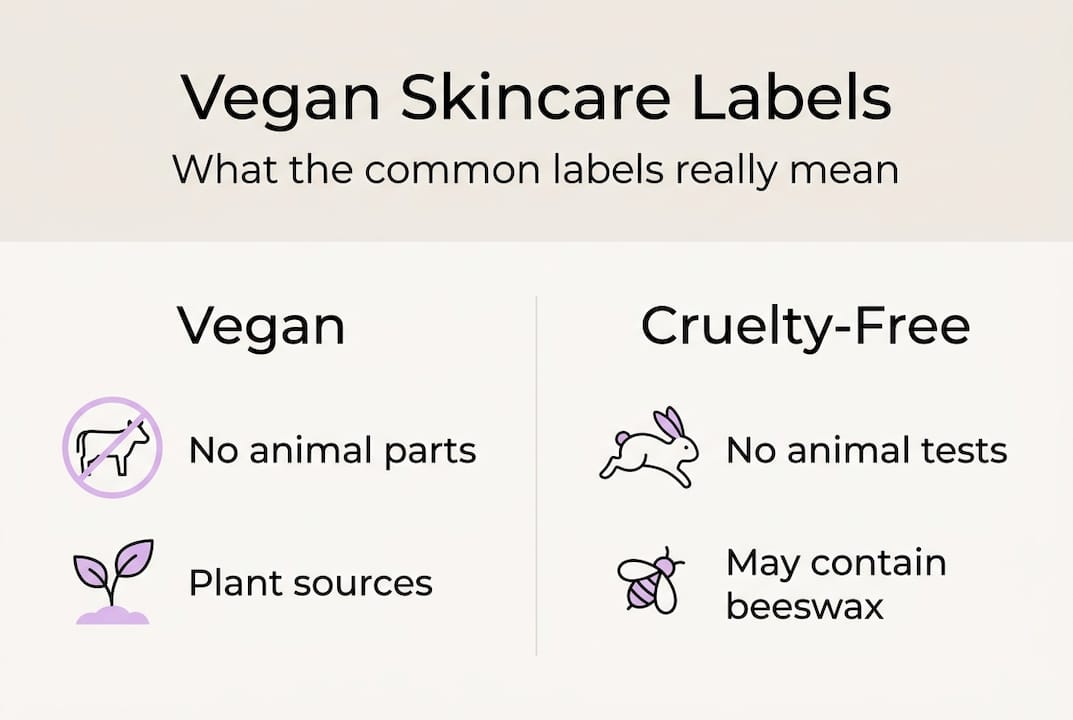
| Label | What it means | What it does NOT guarantee |
|---|---|---|
| Vegan | No animal-derived ingredients | Not tested on animals |
| Cruelty-free | Not tested on animals | Free from animal ingredients |
| Plant-based | Primarily plant ingredients | Fully free from animal by-products |
As the Vegan Society explains, vegan does not equal cruelty-free, and plant-based does not equal vegan. A product labelled plant-based could still contain honey or beeswax. A cruelty-free product could still use lanolin. Understanding this triangle is the foundation of smart vegan skincare shopping.
Common animal-derived ingredients to watch for on labels:
- 🐝 Beeswax (Cera Alba) — used as a thickener and emollient
- 🐑 Lanolin — a wax secreted by sheep’s skin, used in moisturisers
- 🦈 Squalene — often shark-derived, used for its skin-softening properties
- 🐛 Carmine (CI 75470) — a red colourant from cochineal beetles
- 🐄 Collagen and keratin — proteins from animal hides or feathers
- 🍯 Honey — used in masks and balms for its humectant properties
- 🐟 Gelatin — derived from animal bones and connective tissue
“Many products marketed as natural or plant-based still contain animal-derived substances, and without independent verification, consumers have no reliable way to distinguish them from genuinely vegan formulas.”
This is where certification becomes essential. Because there is no universal legal definition of “vegan” in cosmetics regulation, brands can use the term loosely. Greenwashing, where brands use eco-friendly language without the credentials to back it up, is widespread. Certifications from recognised bodies provide the third-party verification that a product’s ingredient list and supply chain have actually been audited. We explore the natural vs synthetic skincare science behind these choices in more depth if you want to go further on ingredient sourcing.
Plant power: Evidence-based benefits of vegan skincare
Sceptics sometimes question whether vegan skincare can genuinely perform. The clinical data is increasingly clear: it can, and in some cases it outperforms conventional alternatives.
A peer-reviewed study found that plant-derived materials used in vegan cosmetics demonstrated strong safety profiles, caused no irritation in testing, and showed measurable wound-healing benefits. That is not marketing language. That is laboratory and human trial data.
One of the most compelling recent findings involves isorhamnetin, a flavonoid found in prickly pear. A clinical evaluation showed that isorhamnetin reduced sebum, pore size, and inflammation in participants within just 28 days. For anyone dealing with oily or blemish-prone skin, that is a meaningful result from a single plant-derived active.
Top-performing plant ingredients and what they do:
- Aloe vera — accelerates skin repair, soothes redness, and supports the skin barrier
- Rosehip seed oil — rich in linoleic acid and vitamin A, it supports cell turnover and fades hyperpigmentation
- Green tea extract (EGCG) — a potent antioxidant that neutralises free radicals and reduces UV-related inflammation
- Bakuchiol — a plant-based retinol alternative shown to reduce fine lines without the irritation associated with synthetic retinoids
- Centella asiatica — clinically shown to stimulate collagen synthesis and calm sensitised skin
- Sea buckthorn oil — exceptionally high in omega-7, it supports skin elasticity and skin hydration at a cellular level
- Oat extract (Avena sativa) — well-documented for its anti-inflammatory and barrier-supporting properties, especially for sensitive skin
📊 Statistic to know: In the isorhamnetin clinical trial, participants saw a statistically significant reduction in sebum production and visible pore size after 28 days of consistent use, with zero reported irritation events.
Beyond individual actives, the broader category of natural body care ingredients offers a rich library of botanicals that work synergistically. Many vegan formulas combine multiple plant actives to address hydration, barrier repair, and inflammation simultaneously, something single-ingredient animal-derived products rarely achieve.
Pro Tip: When evaluating a vegan product’s efficacy, look for clinical study references on the brand’s website or product page. If a brand cites peer-reviewed research for its key actives, that is a strong indicator of formulation integrity.
Navigating labels: Certifications, regulation, and greenwashing
Here is the uncomfortable truth: the word “vegan” on a skincare label means almost nothing without third-party verification. There is no universal regulation governing vegan cosmetic claims in most markets, including Canada and the United States. Brands can self-declare without independent audit, and many do.
Greenwashing in this space is sophisticated. It often looks like:
- ✗ Using “natural” or “botanical” imagery while including animal-derived emulsifiers
- ✗ Displaying leaf icons or green packaging without any certification
- ✗ Listing mostly plant ingredients while burying a single animal-derived one deep in the INCI list
- ✗ Claiming “not tested on animals” while sourcing from suppliers who do test
- ✗ Using the word “vegan” in marketing copy but not on the product label itself
The certifications worth trusting are those backed by rigorous auditing processes:
- ✅ The Vegan Society Trademark — one of the most recognised globally, covering ingredients, processing, and cross-contamination
- ✅ Leaping Bunny — focuses on cruelty-free supply chains, often paired with vegan certification
- ✅ PETA’s Beauty Without Bunnies — covers both vegan and cruelty-free designations
- ✅ Choose Cruelty Free (CCF) — particularly relevant in the Australian and Canadian markets
Pro Tip: Do not just look for a logo on the packaging. Visit the certifying body’s official database and search for the brand directly. Logos can be replicated; database listings cannot.
The Vegan Society’s guidance on certifications is an excellent starting point for understanding what each mark actually audits and guarantees.
Challenges and innovations in vegan skincare
Vegan formulation is genuinely harder than conventional formulation. That is worth acknowledging openly.
Animal-derived ingredients like beeswax, lanolin, and shark-sourced squalene have been used for decades because they work exceptionally well. They have unique textural, emollient, and film-forming properties that are difficult to replicate with plant alternatives. Formulators working in the vegan space face real challenges:
- Beeswax replacement — plant waxes like candelilla or carnauba can substitute, but ratios and textures differ significantly
- Squalene sourcing — olive-derived squalane (the stable, saturated form) is now widely available but costs more to produce
- Emulsification — many traditional emulsifiers are derived from animal fats; vegan alternatives require careful reformulation
- Preservation — some animal-derived ingredients have natural antimicrobial properties that vegan formulas must replicate synthetically or through plant actives
“Formulation difficulties in replicating the functional properties of animal-derived ingredients, combined with higher raw material costs and a fragmented regulatory landscape, remain the primary barriers to mainstream vegan skincare adoption.”
Regulatory inconsistency adds another layer of complexity. The EU has stricter cosmetic ingredient regulations overall, but neither the EU nor North America has standardised vegan labelling requirements. This creates a patchwork where the same product might carry different claims in different markets.
The good news is that innovation is moving fast. Biotechnology is enabling fermentation-derived alternatives that match or exceed the performance of animal ingredients. Plant-derived squalane, fermented hyaluronic acid, and lab-grown ceramides are already in commercial formulas. Brands investing in natural vs synthetic innovation are closing the performance gap quickly, and clinical data is helping address consumer scepticism in a way that marketing alone never could.
What most skincare guides miss about going vegan
Most guides on vegan skincare focus on what to avoid. They hand you a list of banned ingredients and call it done. But that misses the deeper point entirely.
The real power of choosing vegan skincare is not just about exclusion. It is about the quality of knowledge you bring to every product decision. When you understand where ingredients come from, how they are processed, and what the clinical evidence actually says, you stop being a passive consumer and start making genuinely informed choices.
We believe that purity and safety with natural ingredients should not be a marketing claim. They should be verifiable facts. The brands worth your trust are those that cite clinical data, hold independent certifications, and are transparent about their supply chains. Buzzwords fade. Science and ethics do not.
Choosing vegan skincare thoughtfully is one of the clearest ways to align your self-care practice with your values, without compromising on results.
Take your natural skincare further
You now have the knowledge to read labels critically, spot greenwashing, and understand what clinical evidence actually supports in vegan skincare. The next step is finding products that live up to these standards.

At ZenChemy Lab, we formulate with plant-based, ethically sourced ingredients and back our choices with transparency. Whether you are exploring plant-based essentials, browsing our artisan soap collection, or building your natural skincare routine, every product we offer is crafted with the same commitment to purity and care that this article reflects. Your skin, and the planet, deserve nothing less.
Frequently asked questions
What ingredients are not allowed in vegan skincare?
Vegan skincare excludes all animal-derived substances, including beeswax, honey, lanolin, carmine, shark-sourced squalene, keratin, collagen, and gelatin. If an ingredient originates from or is produced by an animal, it is not vegan.
Are vegan skincare products always cruelty-free?
No. “Vegan” refers strictly to ingredient origin, not animal testing practices. A product can be vegan but not cruelty-free if it was tested on animals during development or sourced from suppliers who do so.
Do vegan skincare products actually work?
Yes. Plant-derived vegan ingredients have demonstrated safety and efficacy in clinical testing, and specific actives like isorhamnetin have shown measurable improvements in sebum control and pore size within 28 days.
How can I tell if a product is truly vegan?
Look for certifications from reputable bodies like The Vegan Society, review the full ingredient list carefully, and verify the brand’s certification status directly in the certifying body’s official database rather than relying on packaging claims alone.
Is plant-based the same as vegan in skincare?
No. Plant-based means a product is primarily derived from plants, but it may still contain animal by-products like beeswax or honey. Vegan strictly excludes all animal-derived ingredients without exception.