TL;DR:
- Organic body care must meet strict certification standards and avoid synthetic pesticides and GMO ingredients.
- Certification seals like USDA Organic ensure transparency and genuine organic sourcing.
- Organic formulations tend to be gentler on sensitive skin and support environmental sustainability.
Most people assume that “natural” and “organic” mean the same thing on a body care label. They don’t. This distinction matters far more than marketing language suggests, especially when you’re choosing products for sensitive skin, supporting sustainable farming, or simply wanting to know exactly what goes on your body. Organic body care carries specific certification requirements, ingredient standards, and farming protocols that genuinely separate it from loosely labelled “natural” alternatives. This guide breaks down what organic body care truly involves, how to read labels with confidence, and how to make choices that align with both your wellness goals and your values.
Table of Contents
- Defining organic body care: Standards and ingredients
- Why organic matters: Wellness, environment, and luxury
- Certification and edge cases: Reading labels wisely
- Organic vs synthetic: Which is right for your skin?
- What most guides miss about organic body care
- Discover organic body care with ZenChemy Lab
- Frequently asked questions
Key Takeaways
| Point | Details |
|---|---|
| Organic is distinct | Organic body care relies on certified ingredients, unlike unregulated natural products. |
| Certified benefits | Official certification means stricter safety, purity, and sustainability standards. |
| Wellness impact | Studies show organic body care can be gentler and reduce skin flare-ups for many consumers. |
| Labels matter | Always check for certification and ingredient percentages to avoid misleading claims. |
Defining organic body care: Standards and ingredients
Organic body care essentials rest on a straightforward principle: ingredients must be grown and processed without synthetic pesticides, genetically modified organisms (GMOs), or other prohibited substances. According to one clear overview, organic body care products are certified by recognisable standards like USDA Organic, meaning the agriculture behind the ingredients meets strict regulated requirements, not just brand promises.
Two major certifying bodies shape the organic body care world:
- USDA National Organic Programme (NOP): Governs products sold in North America. For a product to carry the USDA Organic seal, at least 95% organic ingredients must be present by weight (excluding water and salt). Products with 70 to 94% organic content can only state “made with organic ingredients.”
- COSMOS Standard: A European certification used widely in premium body care. It covers both organic and natural cosmetics, auditing the full supply chain from farming to processing.
These certifications aren’t just paperwork. They verify the absence of harmful residues and support supply chain transparency.
Organic vs. natural vs. wild-harvested: What’s the real difference?
Many brands blur the lines between these three categories. Here’s how they actually compare:
| Category | Regulated? | Certification required? | Key characteristic |
|---|---|---|---|
| Organic | ✅ Yes | ✅ Yes (USDA, COSMOS) | Grown without synthetics, GMOs |
| Natural | ❌ No | ❌ No | Derived from nature, no standard |
| Wild-harvested | Partially | ❌ Not certifiable | Harvested from wild ecosystems |
Wild-harvested ingredients like rosehip and sea buckthorn are potent and genuinely free from agricultural inputs, but they cannot carry an organic certification because they grow outside regulated farm conditions. That doesn’t make them inferior; it simply means you’re relying on the brand’s sourcing ethics rather than a third-party audit.
When you explore natural vs synthetic skincare, you’ll find that the sourcing and processing of ingredients often tells you more about product quality than any single label claim.
✔ Pro Tip: Always look for a visible certification seal on the packaging, not just the word “organic” in the product name. The seal means an independent body has actually verified the claim.
Why organic matters: Wellness, environment, and luxury
With a clear definition in place, it’s important to understand why organic body care is increasingly valued across wellness, sustainability, and premium self-care communities.

The wellness case
Organic body care ingredients tend to be gentler on the skin’s surface and less likely to trigger inflammation, particularly for those with reactive or compromised skin barriers. Research published in the International Journal of Research and Peer Review found that 65% of consumers regularly use organic skincare for its gentleness and quality, and that empirical studies point to a 22% reduction in eczema flare-ups among regular users of certified organic formulations.
This makes sense when you consider skin biology. Your skin’s outermost layer, the stratum corneum, functions like a brick-and-mortar wall. Harsh synthetic additives, like certain preservatives, synthetic fragrances, and petrochemical emollients, can erode this barrier over time. Organic ingredients rich in natural lipids, plant antioxidants, and botanical actives tend to reinforce rather than disrupt this structure.
“Choosing organic isn’t just about what you leave out. It’s about the quality, integrity, and biocompatibility of what you put in.”
Here’s a quick look at where organic body care typically makes the most visible wellness difference:
| Skin concern | Relevant organic ingredient | Benefit |
|---|---|---|
| Dryness | Shea butter (organic) | Deep moisture, lipid replenishment |
| Eczema or sensitivity | Calendula extract | Anti-inflammatory, barrier support |
| Uneven tone | Rosehip seed oil | Rich in vitamin A and C precursors |
| Dullness | Aloe vera (organic) | Hydration and brightening |
You can learn more about which botanicals perform best in our guide to top natural body care ingredients.
The environmental case
Certified organic farming supports biodiversity, reduces chemical runoff into watersheds, and builds healthier soil ecosystems. Key botanicals used in body care, like aloe vera and shea, thrive under sustainable cultivation practices that don’t depend on synthetic inputs. When you buy certified organic, you’re effectively voting for farming systems that preserve wildlife corridors, protect pollinators, and reduce the pesticide burden in local ecosystems.
This matters beyond the product itself. Conventional cosmetic agriculture contributes to soil degradation and water contamination in many growing regions. Choosing organic redirects purchasing power toward producers who operate with long-term environmental accountability.
The luxury angle
There’s a quiet luxury in knowing exactly where your ingredients come from and how they were grown. Organic body care isn’t just about avoiding harmful chemicals; it’s about the quality and intention behind every formulation. Premium organic ingredients like cold-pressed argan oil, certified organic coconut butter, and steam-distilled essential oils carry a richness that reflects genuine craftsmanship.
For a deeper look at what sets responsibly sourced ingredients apart, our guide on the purity and safety of natural ingredients walks through the science and sourcing behind ingredient selection.
Certification and edge cases: Reading labels wisely
Understanding the benefits naturally prompts careful label reading. Here’s how to navigate certification claims and the marketing language that often surrounds them.
The labelling landscape
The word “natural” is completely unregulated. Any brand can print it on a product regardless of what the formula actually contains. “Organic,” however, must be substantiated by certification. And “made with organic” is a middle-ground phrase used when a product contains 70% or more certified organic ingredients but doesn’t qualify for the full organic seal.
Here’s a breakdown of the main label categories you’ll encounter:
- ✅ Certified organic: 95%+ certified organic ingredients. Official seal present.
- 🔶 Made with organic: 70 to 94% certified organic. Partial certification, still meaningful.
- ⚠️ Natural: No regulation, no minimum threshold, no verification.
- 🌿 Wild-harvested: Potent but uncertifiable. Depends entirely on brand sourcing ethics.
Certification is also expensive for small producers. Many genuinely clean, small-batch brands use certified organic ingredients without obtaining the formal seal because the audit costs are prohibitive. This is worth knowing; it doesn’t make their products less authentic, but it does require you to do a bit more due diligence.
Pro Tip: When evaluating products without a certification seal, look for full ingredient transparency, including country of origin and percentage disclosures. Brands committed to integrity are usually proud to share this information.
How to scrutinise a label: A step-by-step approach
- Check for a recognised certification seal (USDA Organic, COSMOS, Ecocert) on the front or back panel.
- Read the INCI list (International Nomenclature of Cosmetic Ingredients). Organic ingredients are sometimes listed with an asterisk and a footnote confirming certification.
- Note where organic ingredients appear in the list. Ingredients are listed in descending order of concentration. If the only certified organic ingredient is near the bottom, the product’s organic profile may be minimal.
- Watch for greenwashing signals. Terms like “botanical,” “eco-inspired,” or “nature-derived” carry no certification weight.
- Research the brand’s sourcing policy. Reputable brands publish supplier information or sustainability reports.
For a fuller picture of what goes into a trustworthy product, our guide on the natural body care process and another on handmade cosmetic standards cover the production side in detail.
Organic vs synthetic: Which is right for your skin?
Decoding labels and certifications leads to the crucial question: how does organic body care actually compare to synthetic formulations?
A side-by-side comparison
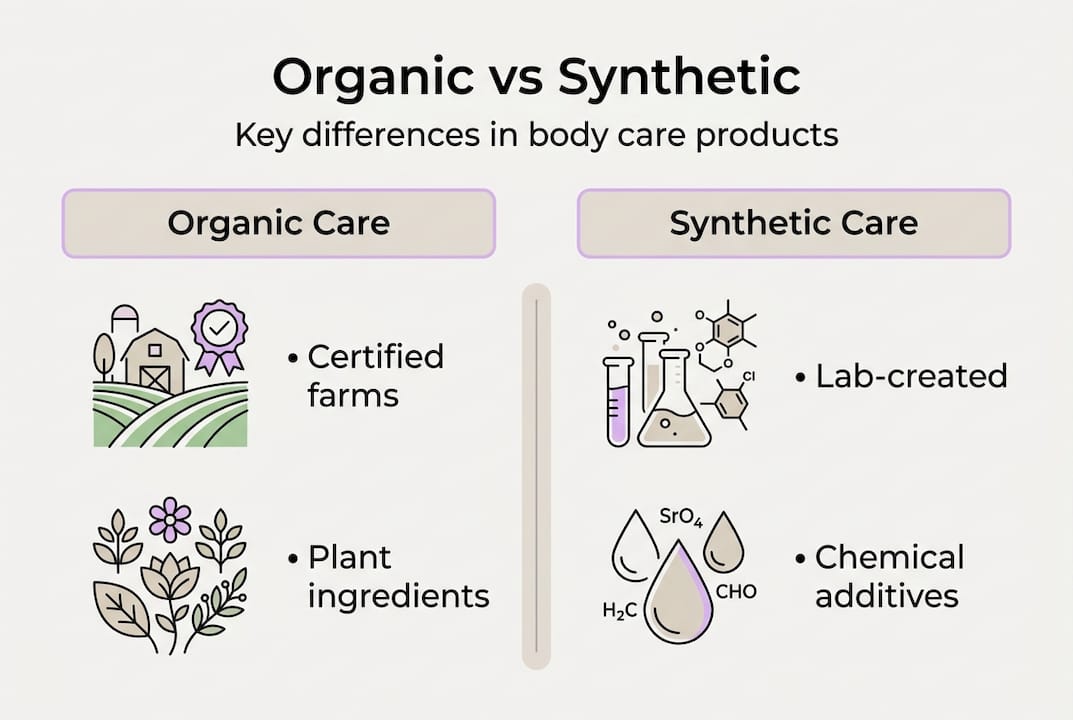
| Feature | Organic body care | Synthetic body care |
|---|---|---|
| Ingredient source | Plant-based, certified farms | Lab-derived, petroleum-based |
| Skin sensitivity | Better for reactive skin | May irritate sensitive skin |
| Shelf stability | Shorter shelf life | Longer shelf life with preservatives |
| Environmental impact | Lower, supports biodiversity | Higher, more chemical waste |
| Cost | Often higher | Generally lower |
| Regulatory oversight | Certified by NOP or COSMOS | Not ingredient-specific |
The reality, as noted in USDA organic certification analysis, is that organic formulations genuinely support sensitive skin and reduce environmental impact, but synthetics can offer advantages in stability and cost. Critically, product formulation matters more than the organic label alone. A poorly formulated organic product won’t outperform a well-crafted synthetic one.
The pros and cons, honestly
Organic body care:
- ✔ Gentler on sensitive and reactive skin types
- ✔ Biodegradable ingredients, lower eco-impact
- ✔ Transparency in sourcing and certification
- ✘ Higher price point due to certification costs
- ✘ Shorter preservation window without synthetic preservatives
Synthetic body care:
- ✔ Often more affordable and widely available
- ✔ Highly stable, longer shelf life
- ✔ Some synthetic actives are clinically tested and effective
- ✘ May contain petrochemicals or endocrine-disrupting compounds
- ✘ Less transparency in ingredient sourcing
“The question isn’t always ‘organic or synthetic?’ It’s ‘what is this product actually doing for my skin, and where did every ingredient come from?’”
If you’re exploring plant-based alternatives, our guide on botanical body care essentials is an excellent starting point for understanding how plant actives function in modern formulations.
What most guides miss about organic body care
Most articles on organic body care follow the same script: organic good, synthetic bad, look for the seal, done. That oversimplification does you a disservice. Here’s what actually matters once you get past the basics.
First, some synthetic ingredients are genuinely safer or better tolerated than their “natural” counterparts. Synthetic vitamin C (ascorbic acid) is more stable than plant-derived vitamin C. Certain naturally occurring allergens in essential oils, like linalool and limonene, can trigger reactions that a carefully formulated synthetic fragrance might not. Organic certification tells you about agriculture. It doesn’t automatically guarantee skin compatibility.
Second, the luxury of organic body care isn’t really in the label. It’s in knowing the full story of an ingredient, from the soil it grew in, to how it was extracted, to the formulator who chose it. Brands that charge a premium purely for the certification seal, without offering real ingredient transparency or superior formulation, are selling you a marketing story.
Third, self-education is genuinely your best tool here. Understanding what ingredients do, why they were chosen, and how they interact with your skin type will serve you far better than any single certification. The science behind skincare choices helps bridge the gap between certification and actual skin performance.
Prioritise brands that share formulation rationale, not just buzzwords. That’s where real quality lives.
Discover organic body care with ZenChemy Lab
Ready to take the next step? At ZenChemy Lab, we believe that understanding what goes into your body care is just as important as how it feels on your skin.

We’ve built a library of natural skincare routine tips to help you build a practice rooted in ingredient knowledge and intentional self-care. Whether you’re transitioning to certified organic formulations or simply looking to clean up your current routine, our curated organic care essentials bring together the purity, luxury, and transparency you deserve. Each product is crafted with traceable botanicals and honest formulation, because at ZenChemy Lab, the label is never just marketing. It’s a commitment.
Frequently asked questions
Are organic body care products always safe for sensitive skin?
While organic body care is generally gentler, some botanical ingredients contain natural allergens that can cause reactions. Always patch-test a new product and review the full ingredient list, since not all natural ingredients are without risk.
How can I tell if a product is truly organic?
Look for a recognised certification seal like USDA Organic or COSMOS on the packaging, and check the ingredient list for certified organic declarations. USDA Organic certification requires at least 95% certified organic ingredients by weight, excluding water and salt.
Is “natural” the same as “organic” in body care?
No. “Natural” is completely unregulated and carries no certification requirement, while “organic” must meet verified farming and processing standards. The terms are not interchangeable, and “natural” remains unregulated in most markets.
Can organic body care help with eczema?
Research suggests that certified organic formulations can support skin barrier health, with studies showing a 22% reduction in eczema flare-ups among regular users, though individual responses will vary depending on skin type and specific triggers.