

TL;DR:
- Genuine ethical skincare involves safe ingredients, humane sourcing, environmental responsibility, and transparency.
- Certifications like Leaping Bunny and COSMOS Organic provide trustworthy verification of ethical claims.
- Building an ethical routine starts with conscious product choices focused on ingredients, sourcing, and packaging.
Most people assume that slapping a “natural” label on a product makes it ethical. It doesn’t. True ethical skincare runs far deeper than ingredient lists and green packaging, touching on how ingredients are sourced, how workers are treated, how waste is managed, and whether brands are honest about all of it. 63% of consumers now rate clean and ethical beauty as extremely or very important, yet many still struggle to separate genuine commitment from polished marketing. This guide breaks down exactly what ethical skincare means, how to verify it, and how to build a routine you can feel genuinely good about.
Table of Contents
- Defining ethical skincare: Beyond the label
- Spotting ethical brands: Standards and certifications that matter
- Ethical ingredients: What to look for and what to avoid
- Building your ethical self-care ritual
- Why true ethical skincare is about more than a label
- Find your ethical skincare essentials
- Frequently asked questions
Key Takeaways
| Point | Details |
|---|---|
| Ethical goes beyond natural | Ethical skincare involves transparent sourcing, cruelty-free methods, and sustainability—not just the use of natural ingredients. |
| Certifications matter | Seek out recognised certifications and transparent claims to avoid greenwashing in your skincare choices. |
| Read ingredient lists carefully | Many ‘ethical’ claims rely on marketing; always verify ingredient sources and efficacy before you buy. |
| Self-care can be ethical and luxurious | You can enjoy indulgent rituals while making conscientious choices that reflect your values. |
Defining ethical skincare: Beyond the label
“Ethical” is one of the most overused words in modern beauty. You’ll find it on everything from mass-produced body washes to boutique artisanal bars, often with no supporting evidence whatsoever. So what does it actually mean?
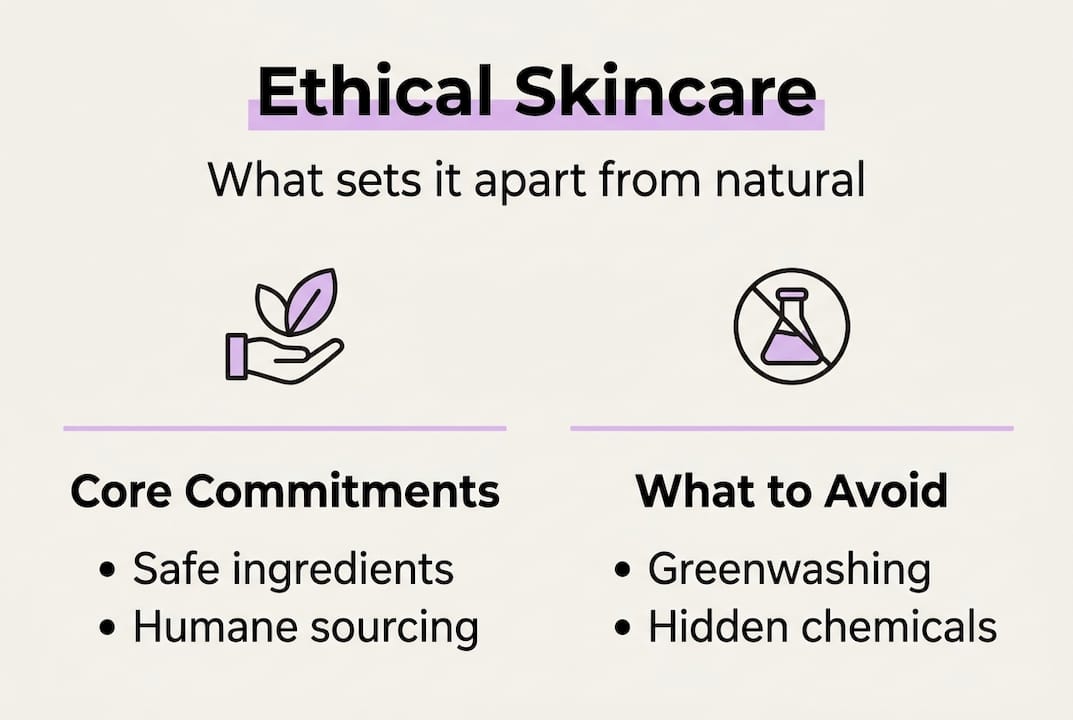
Ethical skincare sits at the intersection of four core commitments: safe and transparent ingredients, humane sourcing and testing practices, environmental responsibility, and fair and honest business conduct. When a brand genuinely meets all four, you experience the benefits of artisanal skincare that extend far beyond what any single ingredient can deliver. Strip away even one pillar, and the ethical claim starts to crack.
Here’s where many shoppers get tripped up: “natural” and “ethical” are not synonyms. An ingredient can be naturally derived and still be harvested through exploitative labour practices, or extracted in ways that damage fragile ecosystems. Palm oil is the most cited example. It’s plant-based, but its mass cultivation has driven deforestation across Southeast Asia. Being natural says nothing about being responsible.
The four pillars of truly ethical skincare include:
- ✅ Cruelty-free formulation and testing — no animal testing at any stage of production or in any supply chain territory
- ✅ Sustainable sourcing — ingredients grown, harvested, or synthesised in ways that protect biodiversity and reduce carbon impact
- ✅ Ingredient transparency — full disclosure of what is in the product and where it comes from, not just the hero ingredient
- ✅ Fair trade and worker equity — fair wages, safe conditions, and equitable relationships with farming or harvesting communities
- ✅ Mindful packaging — biodegradable, recyclable, or reduced-waste packaging that doesn’t contradict the product inside
A shift is clearly underway. 67% of consumers now prefer ethical beauty products over conventional ones, pushing brands to either genuinely transform their practices or get increasingly creative with their language. This is precisely why critical reading matters more than ever.
“Ethical skincare isn’t a destination. It’s a standard held consistently across every decision a brand makes, from farm to bathroom shelf.”
Pro Tip: Next time you pick up a product, flip it over and read the full INCI (International Nomenclature of Cosmetic Ingredients) list, not just the front-of-pack claims. If you cannot find that list online or on the label, that alone is a red flag. Transparent brands welcome scrutiny. Visiting a natural skincare routine tips resource can also help you recognise which ingredient names to look out for as you build your practice.
For those ready to put structure around it, exploring 5 steps for a natural skincare routine is a strong starting point for aligning daily habits with these values.
Spotting ethical brands: Standards and certifications that matter
Knowing what ethical skincare means leads naturally to the question of how to check if a brand really measures up. Certifications exist precisely for this purpose. They provide independent, third-party verification that a brand’s claims have been audited and confirmed, rather than self-declared.
Here are the certifications and labels worth trusting, compared with terms that are frequently abused:
| Legitimate certification / label | What it verifies | Common greenwashing equivalents to question |
|---|---|---|
| Leaping Bunny (cruelty-free) | No animal testing at any supply chain stage | “Not tested on animals” (no third-party audit) |
| COSMOS Organic or USDA Organic | Certified organic ingredient percentage and process | “Made with natural ingredients” |
| Fair Trade Certified | Fair wages, safe conditions for producers | “Ethically sourced” (self-declared, no audit) |
| Vegan Society trademark | No animal-derived ingredients or by-products | “Vegan-friendly” (unverified) |
| FSC-certified or PCR packaging | Responsibly sourced or recycled packaging materials | “Eco-friendly packaging” (no standard cited) |
The distinction between a certified claim and a self-declared one is enormous. Self-declared claims carry no audit trail, no accountability, and no consequences for inaccuracy.
This is not just theory. Brands like Ulta and Nivea have faced lawsuits for false “clean” claims, illustrating how real the stakes are for consumers and brands alike. The Body Shop, once celebrated as a pioneer in ethical beauty, quietly dropped its “100% vegan” claim without clearly communicating the change, which significantly eroded consumer trust. These examples are reminders that even well-established brands can let ethical standards slip without fanfare.
Our eco-friendly skincare guide walks through the full landscape of green beauty standards in more detail. It’s worth pairing that with our overview of vegan skincare explained if plant-based formulations are central to your values.
Red flags to watch for when evaluating a brand:
- 🚩 Vague language: “clean,” “green,” “pure,” “conscious” with no certification to back it up
- 🚩 No published ingredient sourcing information or supplier transparency
- 🚩 Certifications listed on marketing materials but not independently searchable in the certifying body’s database
- 🚩 Packaging that looks sustainable but uses mixed materials that cannot actually be recycled
- 🚩 Animal welfare claims limited to finished product testing, ignoring the supply chain
For Canadians seeking rigorous standards, our resource on handmade cosmetic standards is particularly useful for understanding what small-batch, artisanal producers must meet to be considered genuinely safe and transparent.
Pro Tip: Before purchasing, search the certifying body’s website directly. Leaping Bunny, the Vegan Society, and COSMOS all maintain searchable brand databases. If a brand claims certification but doesn’t appear in that database, trust your instincts and keep looking.
Ethical ingredients: What to look for and what to avoid
With certifications and marketing claims clarified, let’s dig into what goes inside the bottle: the ingredients themselves. This is where things get genuinely complex, and where the most sophisticated greenwashing tends to live.
Ingredient transparency means more than publishing an INCI list. It means disclosing the sourcing region, the extraction or processing method, and whether any third-party testing has been conducted for efficacy and safety. Very few brands go this far, which is exactly why those that do stand apart. Referencing a guide to natural vs synthetic skincare helps clarify that “natural” is not automatically superior, and “synthetic” is not automatically harmful.
Here’s a practical breakdown of commonly marketed ethical ingredients:
| Ingredient | Marketed as | Sustainability reality | Efficacy evidence |
|---|---|---|---|
| Shea butter | Fair trade, natural moisturiser | Strong when sourced from cooperative-certified farms | Well-supported: rich in fatty acids and vitamin E |
| Coconut oil | Natural, eco-friendly | Mixed: high demand drives monoculture farming | Good as an occlusive; not ideal for all skin types |
| Beef tallow | “Traditional,” sustainable by-product | By-product use can reduce waste, but ethics are complex | Limited clinical data for skincare efficacy |
| Salmon sperm extract | Cutting-edge, natural anti-ageing | Environmental sourcing concerns; largely experimental | Minimal peer-reviewed evidence for topical use |
| Jojoba oil | Plant-based, sustainable | Grown in arid regions, low water demand; genuinely sustainable | Strong evidence as a skin-barrier-supporting lipid |
| Rosehip seed oil | Natural, anti-ageing | Low-impact cultivation; supports smallholder farmers | Good evidence for hyperpigmentation and hydration |
The animal-based ingredients in the table deserve particular attention. Some animal-based ingredients are marketed as sustainable but lack meaningful efficacy evidence according to dermatologists, making them a category to approach with informed scepticism rather than trend-driven enthusiasm. Marketing something as “traditional” or a “by-product” does not automatically make it ethical or effective.
Steps for decoding any skincare label ethically:
- Read the full INCI list — the ingredient present in the highest quantity appears first
- Look up unfamiliar names — EWG Skin Deep or the CosDNA database provide safety and sourcing information
- Search the brand’s sustainability page — if one doesn’t exist, that absence says something
- Cross-reference certifications — verify them on the certifying body’s own website
- Check for animal-derived ingredients — if vegan matters to you, the Vegan Society’s trademark is your most reliable shortcut
- Assess packaging — look for PCR (post-consumer recycled) content percentages or compostable material disclosures
The good news is that awareness is rising fast. 70% of consumers now research a brand’s sustainability and eco-credentials before buying, which is pushing brands toward greater disclosure than ever before. Our resource on botanical cosmetics for skincare is an excellent follow-up for understanding which plant-derived ingredients genuinely earn their place in an ethical routine, backed by both science and sustainable sourcing. You can also read more about the natural body care process to understand how ethical production translates from ingredient to finished product.
Building your ethical self-care ritual
Now that the fundamentals are clear, it’s time to bring it all together into rituals and choices that genuinely support both your wellbeing and the wider world.
Building an ethical routine in Canada doesn’t require perfection. It requires intention. Start with what you use most often and work from there. Here’s a practical blueprint:
- 🌿 Cleanser — choose a soap or wash that is certified cruelty-free, uses plant-based surfactants, and comes in minimal or compostable packaging; artisanal cold-process soaps retain natural glycerin and are typically the most transparent option available
- 💧 Toner or mist — look for botanical hydrosols (rose water, witch hazel) sourced from certified organic farms; avoid alcohol-heavy formulas in plastic spray bottles
- 🧴 Moisturiser — prioritise products with sustainably sourced plant oils or butters like jojoba, shea, or rosehip; check for fair trade sourcing of any African- or tropical-origin ingredient
- ☀️ Sun protection — mineral sunscreens using non-nano zinc oxide are the most reef-safe and skin-friendly option; look for reef-safe certification where it exists
- 🛁 Body care — body butters, scrubs, and bath soaks made with food-grade, certified organic ingredients deliver a luxurious experience without compromising your values
For Canadians specifically, seeking out local or regional makers offers a practical advantage. Shorter supply chains mean greater traceability. When you purchase from a Canadian artisan who sources ingredients domestically or from certified co-ops, you reduce transport emissions and can often speak directly with the maker about sourcing decisions.

The ethical beauty market is not a niche trend. Ethical beauty is set to reach $27.4 billion by 2033, driven by exactly the kind of conscious choices you’re making right now. That growth signals that the industry is paying close attention, which means your purchasing decisions carry real influence.
Pro Tip: Create a short “ethical criteria” list that matters most to you, whether that’s cruelty-free testing, vegan ingredients, Canadian-made, or zero-waste packaging. Rank them by priority so that when a brand meets three out of four, you can make an informed choice rather than an all-or-nothing decision. Ethical shopping is a practice, not a purity test. You can also explore eco-conscious self-care steps for a guided approach to building this ritual progressively.
Luxurious self-care and ethical choices are not in tension. The most nourishing routines often involve fewer, better-chosen products. Quality over quantity is itself an ethical stance.
Why true ethical skincare is about more than a label
Here’s something worth sitting with: even brands that genuinely try to be ethical make mistakes. Supply chains are long and complex. Certifying bodies have differing standards. A brand can be cruelty-free and still use palm oil from a non-certified supplier. Pursuing ethics in business is an ongoing, imperfect process, not a status you achieve once and hold forever.
This is why we encourage you to support progress rather than demand perfection. When a brand acknowledges a supply chain issue and publicly works to resolve it, that is more meaningful than a brand with a perfect certification record and zero transparency about how they got there.
Your role as a consumer is not to become an enforcement agent. It’s to stay curious, ask questions, and reward honest dialogue. Brands that welcome scrutiny and share their journey, including the difficult parts, deserve your attention more than those with flawless but hollow marketing. Our perspective on handmade standards reflects this same belief: genuine craft and ethical intention leave a trail you can follow.
Collective consumer choices are quietly reshaping industry standards. Every purchase is a signal.
Find your ethical skincare essentials
Ready to move from understanding to action? At ZenChemy Lab, we’ve built our entire collection around the principles explored in this guide: transparent ingredients, sustainable sourcing, artisanal craftsmanship, and the belief that self-care should feel as good as it does right.

Whether you’re just beginning to build a natural body care routine or refining an already mindful practice, our curated guides and handcrafted products are designed to support every step. Dive into the science behind natural vs synthetic ingredients to make decisions grounded in real evidence, or follow our skincare routine for healthy skin to put these principles into everyday practice. Ethical and luxurious are not opposites. We’re here to show you exactly that.
Frequently asked questions
What makes a skincare brand truly ethical?
A truly ethical skincare brand uses cruelty-free methods, prioritises sustainable and transparent sourcing, and holds recognised certifications from independent auditing bodies, since 67% of consumers now prefer ethical products over conventional ones.
How can I spot greenwashing in skincare products?
Look for vague terms like “clean” or “natural” with no certification to back them up, and verify any claimed certification directly through the certifying body’s database, especially given that Ulta and Nivea have faced legal action for misleading “clean” claims.
Are animal-based ingredients in skincare ethical or sustainable?
Some animal-derived ingredients are positioned as sustainable, but many lack meaningful efficacy evidence and may not align with the environmental or ethical priorities held by most conscious consumers.
Why are ethical skincare products becoming so popular?
Growing awareness around personal health, ingredient transparency, and environmental impact is driving strong demand, with the ethical beauty market projected to reach $27.4 billion by 2033, nearly tripling its 2024 value.


4 Comments