
TL;DR:
- “Purity” in skincare lacks a legal definition, making ingredient order, active levels, and certification crucial indicators of quality. Reading INCI labels systematically, verifying preservatives, and consulting third-party standards help consumers distinguish genuinely safe products from marketing claims. Transparency and understanding ingredient roles empower individuals to select skincare that aligns with their values and skin needs.
Walking into a beauty aisle or scrolling a skincare website can feel overwhelming when every product claims to be “pure,” “clean,” or “naturally derived,” yet the ingredient list reads like a chemistry exam. You deserve to know exactly what you’re putting on your skin, and more importantly, how to separate genuine quality from clever marketing. This guide gives you the practical tools to read ingredient labels with confidence, verify purity claims against real standards, and build a skincare selection method that honours both your skin and your values.
Table of Contents
- What does purity really mean in skincare?
- Step-by-step checklist: How to read and decode ingredient lists
- Best practices for verifying purity and safety
- Common mistakes to avoid when selecting ‘pure’ skincare
- A fresh perspective: What purity means for real, luxurious self-care
- Explore natural, pure ingredients with ZenChemy Lab
- Frequently asked questions
Key Takeaways
| Point | Details |
|---|---|
| Decode ingredient lists | The first five ingredients reveal most about a skincare product’s purity and base composition. |
| Check for certifications | True purity is supported by third-party standards like ISO 16128 and COSMOS, not generic buzzwords. |
| Balance purity and safety | Functional ingredients, including safe synthetics and preservatives, are sometimes essential for clean, stable skincare. |
| Don’t trust buzzwords alone | Always verify ‘natural’ and ‘pure’ claims by checking labels and supporting evidence. |
What does purity really mean in skincare?
With the challenge laid out, let’s start by clarifying what “purity” actually means in the context of skincare ingredients.
The word “pure” sounds reassuring. But here’s the honest truth: it has no legal definition in the cosmetics industry. Neither does “clean” or “natural.” Marketing terms like “clean” and “pure” lack standardised legal definitions, which means any brand can use them without meeting a specific standard.
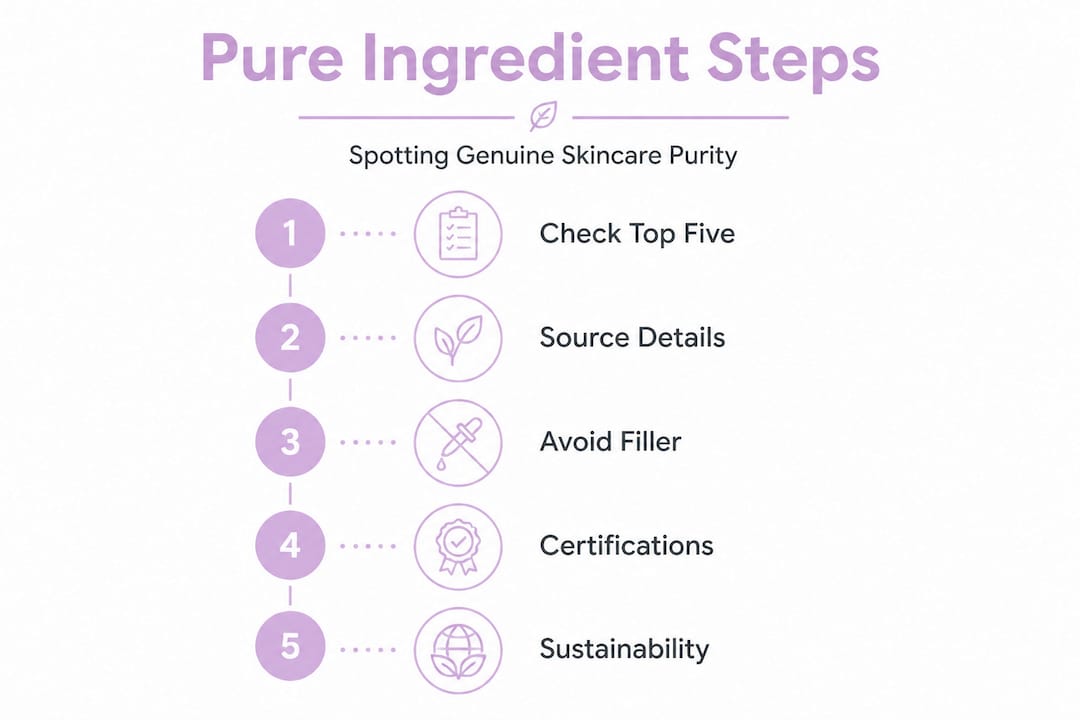
So what does matter when it comes to real purity? It comes down to four key factors:
- ✅ Ingredient order: Ingredients are listed from highest to lowest concentration, so the first few ingredients form the product’s true identity
- ✅ Meaningful actives: Are the beneficial ingredients present in amounts that actually do something, or are they sprinkled in for label appeal?
- ✅ Functional ingredients: Preservatives, emulsifiers, and stabilisers keep products safe and effective; their presence is a sign of quality, not compromise
- ✅ Third-party certification: Independent verification tells you far more than a brand’s self-applied “pure” label
Understanding clean beauty meaning is a strong starting point, but purity goes deeper than any single buzzword suggests.
“The first 5 to 7 ingredients in a formula reveal what the product is truly made of. Look for sensitivity triggers like fragrance and confirm the formula has an effective preservative system to remain microbiologically safe.”
True purity, then, is not the absence of all synthetic components. It’s about ingredient quality, sourcing transparency, and formulation integrity. Knowing the difference between “pure” as a marketing label and “pure” as a formulation standard helps you make choices that are genuinely good for your skin. To learn more about what distinguishes genuinely safe products from merely labelled ones, exploring handmade cosmetic standards gives useful context for artisanal and small-batch products.
Step-by-step checklist: How to read and decode ingredient lists
Understanding what purity means is only the beginning. Next, let’s walk through the practical steps to decode ingredient lists and identify truly pure options.
Every skincare product sold in Canada must carry an INCI (International Nomenclature of Cosmetic Ingredients) ingredient list. This standardised naming system lists ingredients in descending order by concentration. Once you understand the mechanics, you can read any label like a formulator would.
Here is a step-by-step process to follow every time you evaluate a product:
-
Find the INCI list. It’s typically on the back or bottom of the packaging. Online, it should be clearly visible on the product page. If it isn’t, that alone is a red flag.
-
Read the first 5 to 7 ingredients first. INCI order reveals the formula’s base and tells you whether actives are present at meaningful levels. If a product claims to be a “rosehip oil serum” but rosehip seed oil appears near the bottom after a dozen water-based fillers, its concentration is likely negligible.
-
Confirm your actives are present early. Ingredients like hyaluronic acid, niacinamide, or plant extracts should appear within the first half of the list to be considered effective. If they appear below 1% on a label, they’re more likely decoration than function.
-
Scan for fragrance and potential irritants. Fragrance (listed as “parfum” or “fragrance”) is one of the most common causes of skin sensitivity. If you have reactive skin, look for products where fragrance is absent or appears at the very end of the list. Similarly, watch for high concentrations of essential oils, which carry their own sensitisation risk.
-
Verify the preservative system. A product without any recognisable preservative (such as phenoxyethanol, sodium benzoate, or a natural equivalent like rosemary extract in an anhydrous formula) is either unstable or misrepresenting itself. Microbiological safety matters, especially in water-containing products.
-
Look for natural ingredient results that align with your skin type. Cold-pressed oils, plant butters, and botanical extracts at meaningful concentrations signal true intention behind the formula.
-
Ask for a Certificate of Analysis (COA) if unsure. Reputable brands, especially those producing artisanal or natural solutions for sensitive skin, will readily share COAs or full ingredient sourcing details on request.
Pro Tip: If a brand advertises a hero ingredient in their product name but that ingredient appears past the midpoint of a long INCI list, the concentration is almost certainly under 1%. Don’t hesitate to contact the brand directly and ask for the percentage or a COA before purchasing.
Here is a quick reference table to help you decode what you’re seeing:
| INCI position | What it signals | What to check |
|---|---|---|
| 1st to 5th ingredient | The product’s base; highest concentrations | Is this the ingredient type you want? |
| 6th to 10th ingredient | Supporting actives and secondary ingredients | Are marketed actives appearing here? |
| 11th to 20th ingredient | Functional additives, preservatives | Look for a preservative system |
| Last 5 ingredients | Colourants, fragrance, trace botanicals | Check for potential irritants |
Best practices for verifying purity and safety
Once you’re familiar with label reading, it’s essential to verify whether the ingredients and purity claims stand up to real scrutiny.
Reading the label is step one. Verifying the claims is where many consumers stop short, and it’s where brands with genuine standards distinguish themselves.
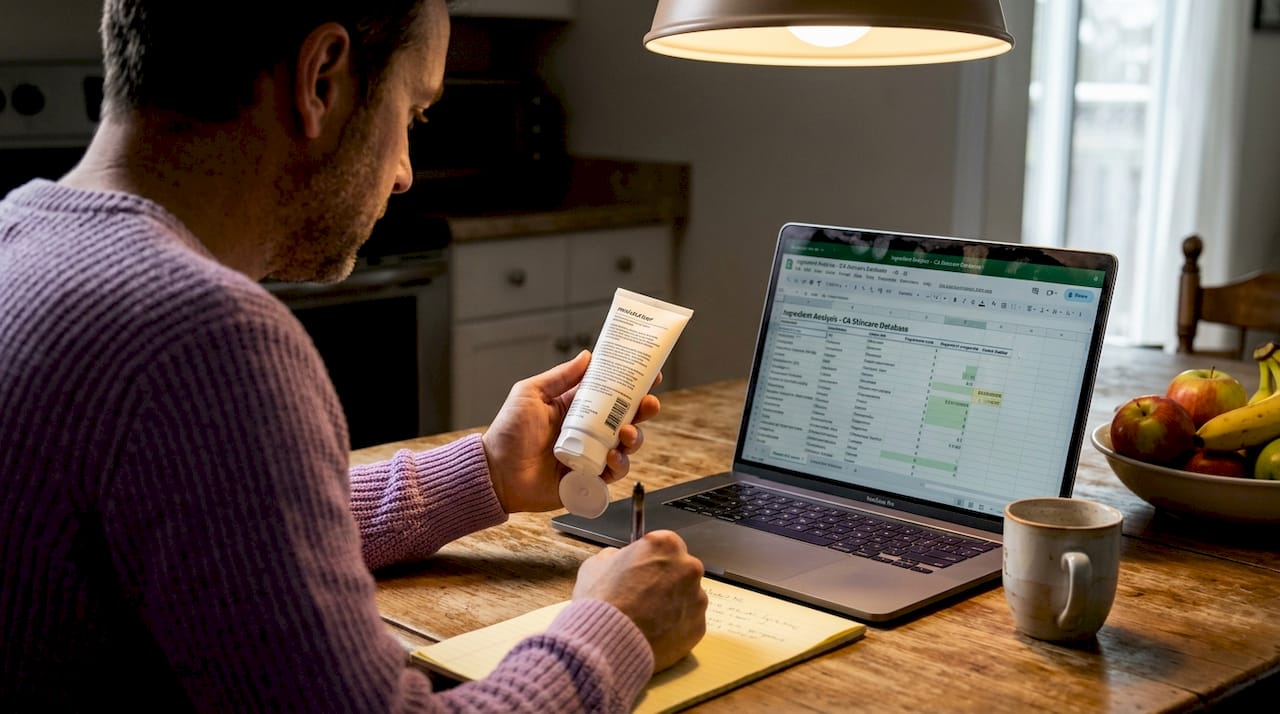
Use ingredient databases as a screening tool, not a final verdict. Platforms like EWG’s Skin Deep help you validate ingredient safety by rating hazard potential by endpoint. This is genuinely useful for flagging known irritants or toxicological concerns. However, these scores reflect hazard potential, not real-world skin tolerance. An ingredient rated a “3” on a hazard database may be completely safe at the concentration used in your serum.
Look for recognised certification schemes. For products making natural or pure claims, ISO 16128 for natural-origin indexing combined with certification schemes that include process and sourcing requirements provides meaningful independent verification. Keep in mind that ISO 16128 standardises naturality methodology but is not a full end-product sustainability or ethics certification on its own.
Here’s a comparison of common standards to help you interpret what they actually cover:
| Standard or certification | What it certifies | End-product claim supported |
|---|---|---|
| ISO 16128 | Natural-origin index for ingredients | Naturality percentage calculation |
| Ecocert | Organic and natural ingredients, sourcing ethics | “Natural” and “organic” product claims |
| COSMOS | Formula composition, biodegradability, packaging | “Certified natural/organic cosmetic” |
| NATRUE | Natural origin, minimal processing, no synthetics | “Natural” and “organic” with processing rules |
| EWG Verified | Ingredient safety scoring, formulation transparency | “EWG Verified” product label |
Understanding ethical skincare standards helps you see how these certifications interact with sustainability, sourcing, and fair-trade practices. A product bearing one of these marks has been assessed beyond the brand’s own claims.
Pro Tip: Don’t avoid a product simply because it contains safe synthetics or a synthetic preservative. A well-formulated natural product with phenoxyethanol is safer and more effective than an “all-natural” product that is microbiologically unstable. Stability is part of purity.
Sustainability claims are another area worth scrutinising. Biodegradable packaging and ethical sourcing are meaningful, but they’re separate from ingredient purity. An eco-friendly skincare guide can help you understand how to align environmental values with your ingredient choices without sacrificing product safety or performance.
Common mistakes to avoid when selecting ‘pure’ skincare
Even with strong habits, it’s easy to fall into traps or overlook key factors. Let’s highlight what to skip, what not to fear, and errors to avoid when choosing pure skincare.
Here are the most common mistakes consumers make, and how to avoid them:
-
❌ Assuming “natural” always means safe. Poison ivy is natural. So is lead. Natural ingredient purity is not the same as overall product safety, and ingredient score apps may penalise necessary components depending on how they’re configured. Always evaluate ingredients in context, not in isolation.
-
❌ Over-relying on ingredient scoring apps. Apps like Yuka are useful for a first scan, but they can mislead. A preservative essential for keeping a water-based product safe might score low in an app that doesn’t account for formulation context or realistic use concentration.
-
❌ Avoiding preservatives out of fear. Preservative-free claims sound reassuring, but a water-containing product without adequate preservation is a microbial risk. Effective preservation is not a sign of impurity; it’s a sign of responsible formulation.
-
❌ Ignoring microbiological stability. A product can contain every “pure” ingredient on your wish list and still grow harmful bacteria if not properly formulated. This is especially relevant for DIY or small-batch natural products without challenge testing.
-
❌ Treating marketing buzzwords as proof of quality. Words like “botanical,” “holistic,” “green,” or “farm to face” are not regulated. They signal intent at best. Always come back to the INCI list and third-party verification.
“The gap between what a label says and what a formula delivers is often widest when brands rely on buzzwords rather than transparent ingredient disclosure. Your best tool is always the ingredient list itself.”
Refer to research on natural vs synthetic skincare to understand how both categories contribute to formulation safety and efficacy without needing to be adversaries.
A fresh perspective: What purity means for real, luxurious self-care
Looking beyond the evidence and steps, here’s an honest take on what ingredient purity really means when self-care, luxury, and sustainability all matter.
We’ll say something that most skincare content won’t: there is no single definition of “pure” that works for everyone. And honestly, that’s not a problem. It’s actually the most liberating truth in skincare.
For someone with highly reactive skin, purity might mean a fragrance-free, minimal-ingredient formula with only three or four verified actives. For someone else, purity is about sourcing, knowing that their shea butter is cold-pressed, unrefined, and traded fairly. For others still, it’s about trusting that every ingredient in their favourite serum has been third-party tested. All of these are valid definitions, and none of them require you to be a cosmetics chemist to apply.
What we’ve noticed in formulating at ZenChemy Lab is that the consumers who feel most confident and satisfied with their skincare are not the ones who follow the strictest “no synthetics ever” rules. They’re the ones who understand why each ingredient is in their product. Transparency creates trust. And trust is the foundation of any luxurious self-care experience.
The tension between nature, safety, and luxury is mostly artificial. A beautifully crafted artisan soap made with cold-pressed oils can also carry a properly validated preservative system. A botanical face oil can be sourced sustainably and still deliver clinical results. Science and nature are not competing forces; they’re partners in well-made skincare.
Building a routine for radiant results is really about building a routine that reflects your values and works for your skin. Start with transparency. Prioritise ingredient integrity. And give yourself permission to choose products that feel as good as they perform.
Explore natural, pure ingredients with ZenChemy Lab
If you’re ready to experience purity and luxury first-hand, ZenChemy Lab offers curated, transparent, and truly natural skincare solutions.
At ZenChemy Lab, every formula starts with one question: does each ingredient deserve its place? From our cold-pressed botanical oils to our hand-poured artisan soaps, we list every ingredient openly and source with intention. Whether you’re looking for foundational skincare tips for healthy skin or want to explore the depth of plant-based beauty through our luxurious botanical skincare collection, you’ll find products that align with everything this guide has outlined. Our artisan soap collection is a perfect starting point, crafted in Canada with naturally sourced ingredients and full ingredient transparency.
Your skin deserves honesty. We’re here to deliver it.
Frequently asked questions
How can I tell if a skincare ingredient list is trustworthy?
Look for full INCI disclosure with ingredients listed in descending concentration, and confirm that key actives and preservatives are clearly identified. The INCI list reveals formula mechanics and whether marketed ingredients are present at effective levels.
Are natural skincare ingredients always safer?
Not always. Some natural ingredients trigger sensitivity reactions, and safe synthetics are often essential for product stability and microbial safety. Natural purity does not equal overall product safety, especially when formulation context is ignored.
Which certifications should I trust for ingredient purity?
ISO 16128, Ecocert, COSMOS, and NATRUE are among the most credible. Independent verification through these schemes goes well beyond a brand’s own “pure” or “natural” claim by assessing sourcing, processing, and formulation requirements.
How can I check if a product’s purity matches its claims?
Cross-reference the INCI list with a third-party ingredient database, look for recognised certification logos, and contact the brand directly for sourcing details or a COA. Ingredient databases rate hazard by endpoint and are most useful when used as a screening tool alongside label verification.
Do “clean” and “pure” always mean natural in skincare?
No. These terms lack standardised legal definitions in Canada and most markets, so brands can apply them freely. Always verify claims through the ingredient list, third-party certifications, and transparent sourcing disclosures rather than relying on label language alone.
1 Comments