

TL;DR:
- Sensitive skin has a weakened barrier, leading to increased moisture loss and reactivity.
- Many “natural” ingredients can contain allergens, making labels misleading for sensitive skin.
- Choosing fragrance-free, hypoallergenic products with minimal ingredients offers better protection and healing.
If you have sensitive skin, you already know the frustration: you reach for something labelled “natural,” and your skin still reacts. Redness, tightness, itching. The problem is not your skin being difficult. The problem is that the word “natural” has been stretched so thin it barely means anything anymore. Sensitive skin often has a compromised barrier, making it more reactive to irritants, allergens, and environmental stress than typical skin. Understanding what your skin actually needs, beyond the marketing, is the first step toward real, lasting relief.
Table of Contents
- What makes sensitive skin different
- The pitfalls of synthetic ingredients for sensitive skin
- How natural ingredients help the skin barrier
- Navigating the truth: ‘natural’ label pitfalls and practical choices
- Our take: The uncomfortable truth and what actually works
- Discover curated natural skincare built for sensitive skin
- Frequently asked questions
Key Takeaways
| Point | Details |
|---|---|
| Sensitive skin needs purity | Minimally processed, fragrance-free ingredients support sensitive skin best. |
| More than just ‘natural’ | 94% of natural products contain allergens; look for hypoallergenic and artisanal formulas. |
| Synthetic triggers | Preservatives and fragrances—whether synthetic or natural—are leading causes of irritation. |
| Science-backed repair | Empirical studies show select botanicals outperform synthetics for barrier recovery and hydration. |
| Practical product selection | Choose skincare by ingredient transparency, minimalism, and patch testing, not marketing. |
What makes sensitive skin different
Think of your skin barrier as a “brick and mortar” wall. The skin cells are the bricks, and the lipids (fats, oils, ceramides) are the mortar holding everything together. In sensitive skin, that mortar is thinner, less consistent, and easier to breach. The result? Moisture escapes more readily, and irritants get in more easily.
This process is measured as transepidermal water loss, or TEWL. Higher TEWL means your skin is losing moisture faster than it can retain it. That leads to dryness, tightness, and a lowered threshold for irritation. Even mild exposures to fragrance, heat, or harsh surfactants can trigger a visible reaction.
Sensitive skin’s compromised barrier creates a cycle: irritation damages the barrier further, which increases sensitivity, which makes the next reaction worse. Breaking that cycle requires understanding what triggers it in the first place.
Common triggers for sensitive skin include:
- ✗ Synthetic fragrances and parfum
- ✗ Sulphate-based surfactants (like sodium lauryl sulphate)
- ✗ Alcohol-based toners and astringents
- ✗ Preservatives such as parabens and methylisothiazolinone
- ✗ Environmental stressors: cold air, UV exposure, hard water
Here is how sensitive skin compares to resilient skin in real terms:
| Factor | Sensitive skin | Resilient skin |
|---|---|---|
| Barrier integrity | Weakened, thin lipid layer | Strong, intact lipid layer |
| Reaction threshold | Low, reacts to mild irritants | High, tolerates most exposures |
| Recovery time | Slow, days to weeks | Fast, hours to a day |
| TEWL rate | Elevated | Normal |
| Ingredient tolerance | Narrow, needs minimal formulas | Broad, tolerates complex formulas |
“Sensitive skin is not a flaw. It is a signal that your barrier needs more support, not more products.”
Understanding your skin lipid barrier repair needs is the foundation for choosing ingredients that genuinely help rather than harm.
The pitfalls of synthetic ingredients for sensitive skin
Synthetic ingredients are not inherently evil, but for sensitive skin, certain categories carry a well-documented risk. Synthetic ingredients disrupt the skin barrier, triggering contact dermatitis and allergic reactions in a significant portion of users.

The biggest offenders fall into a few key categories:
Preservatives: Parabens, methylisothiazolinone (MI), and methylchloroisothiazolinone (MCI) are widely used to extend shelf life. MI and MCI in particular are among the most common causes of allergic contact dermatitis in rinse-off and leave-on products alike.
Surfactants: Sodium lauryl sulphate (SLS) strips the skin’s natural oils aggressively. Even one wash with an SLS-heavy cleanser can elevate TEWL for hours afterward.
Synthetic fragrances: “Fragrance” or “parfum” on an ingredient list can represent a blend of dozens of undisclosed chemicals. These are the single most frequent cause of cosmetic-related skin reactions.
Here is a direct comparison of how synthetic and natural ingredients typically behave on sensitive skin:
| Ingredient type | Risk level | Common reaction | Example |
|---|---|---|---|
| Synthetic fragrance | High | Contact dermatitis, redness | Parfum, linalool |
| Synthetic preservatives | Medium-High | Allergic sensitisation | Methylisothiazolinone |
| Sulphate surfactants | Medium | Dryness, barrier disruption | Sodium lauryl sulphate |
| Natural plant oils | Low | Rare, usually mild | Calendula, oat oil |
| Natural botanical extracts | Low-Medium | Occasional (esp. essential oils) | Lavender, tea tree |
For a deeper look at how these categories compare in clinical research, our guide on natural vs synthetic skincare breaks it down with evidence.
Pro Tip: When scanning a label, search for “fragrance-free” and “hypoallergenic” before you look for “natural.” These two terms offer more practical protection for sensitive skin than any marketing claim.
How natural ingredients help the skin barrier
The right natural ingredients do something synthetics often cannot: they work with the skin’s own biology. Many plant-derived oils and herbal extracts share a molecular structure similar to the skin’s own lipids, which means they integrate into the barrier rather than sitting on top of it.
Natural herbal ointments and extracts improve hydration, reduce TEWL, decrease EASI (Eczema Area and Severity Index) scores, and support barrier recovery. In some clinical trials, eczema patients using herbal-based formulas saw up to a 50% reduction in EASI scores. That is a meaningful, measurable result.
Here is how the key mechanisms work:
- Occlusion: Oils like shea butter and calendula create a breathable seal over the skin, slowing moisture loss without blocking the skin’s natural processes.
- Hydration: Humectant-rich ingredients such as aloe vera and oat extract draw water into the skin’s upper layers, plumping and softening dry, reactive skin.
- Anti-inflammatory action: Calendula, chamomile, and indigo naturalis contain compounds that calm redness and reduce the inflammatory response at the cellular level.
- Antioxidant protection: Alpha-linolenic acid (found in flaxseed and rosehip oil) neutralises free radicals that degrade the barrier over time.
- Microbiome support: Some herbal extracts favourably shift the skin’s bacterial balance, which plays a direct role in barrier integrity and immune response.
📊 Statistic to know: Studies on natural ingredient mechanisms show herbal formulas can reduce TEWL and improve barrier function within weeks of consistent use.
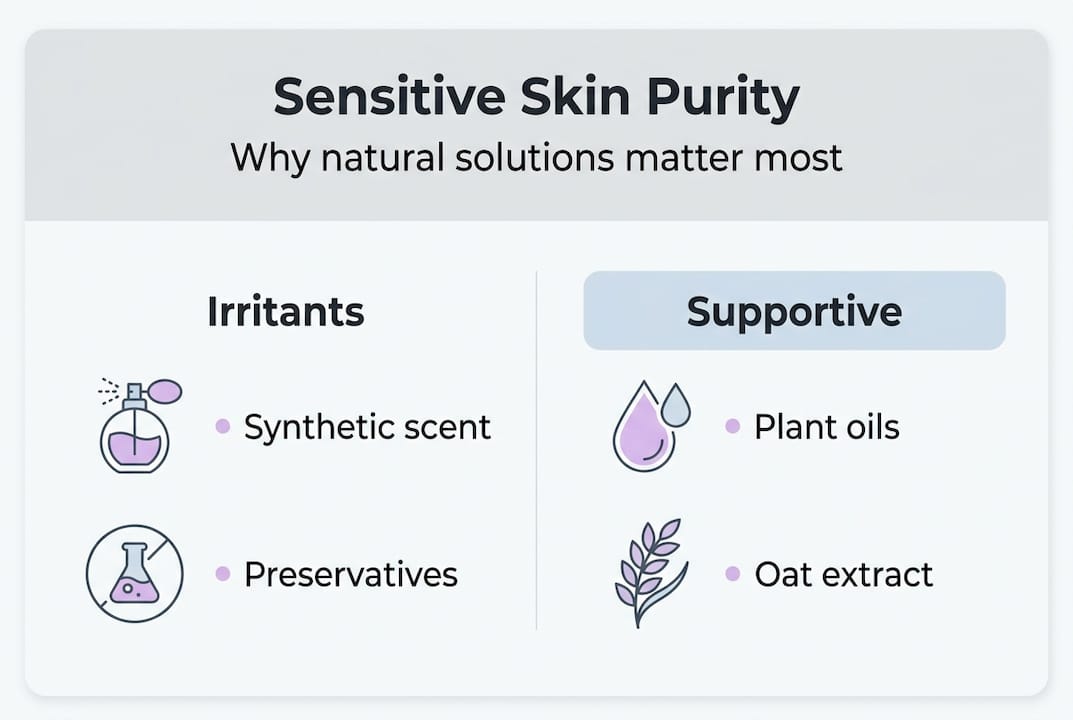
For a detailed look at how moisture retention works at the skin level, the guide on humectants and hydration is worth reading alongside this. And if you are actively repairing your skin barrier, knowing which natural ingredients to prioritise makes all the difference.
Pro Tip: Stick to simple formulas with five to eight ingredients when your skin is reactive. Fewer ingredients means fewer variables, and it is much easier to identify what works (or what does not).
Navigating the truth: ‘natural’ label pitfalls and practical choices
Here is the uncomfortable reality: 94% of ‘natural’ skincare products contain known allergens, primarily natural fragrances like limonene and linalool. The “natural” label, on its own, offers no protection for sensitive skin.
Essential oils are a perfect example. Lavender, eucalyptus, and tea tree are all natural. They are also among the most common causes of allergic contact dermatitis in people with sensitive skin. “Natural” does not mean non-reactive. It just means the source is botanical rather than synthetic.
So what should you look for instead? Here is a practical framework:
✅ Prioritise these when choosing natural products for sensitive skin:
- Fragrance-free (not just “unscented,” which can still contain masking fragrances)
- Hypoallergenic formulations with minimal ingredient lists
- Artisanal or small-batch products where ingredient sourcing is transparent
- Patch-tested formulas with documented safety data
- Products free from essential oils unless specifically listed and tested
✗ Be cautious of:
- Products labelled “natural” with long ingredient lists
- Botanical extracts from high-allergen plants (balsam of Peru, ylang ylang, citrus)
- Vague terms like “botanical blend” or “plant-derived complex” without specifics
- Products marketed as “gentle” without hypoallergenic certification
For a fragrance-free option that is formulated with sensitive skin in mind, ZenChemy Lab’s fragrance-free deodorant is a good starting point for body care.
Pro Tip: For very sensitive, eczema-prone, or pregnant skin, always patch test even products labelled “natural” or “gentle.” Apply a small amount to your inner arm for 48 hours before using it on your face or body. Purity matters, but individual reactivity is personal.
Our take: The uncomfortable truth and what actually works
Let’s be direct: the skincare industry has made “natural” do a lot of heavy lifting it was never designed to do. We have spoken with many people who spent years rotating through “natural” products, frustrated that their skin kept reacting. The issue was rarely the natural-versus-synthetic divide. It was allergens hiding behind good marketing.
Here is what we have come to understand: the label “natural” can be misleading, especially for sensitive skin. Ceramides, for example, are often synthetic but can be profoundly healing and hypoallergenic. Lavender oil is natural but is a documented allergen. The binary thinking of “natural good, synthetic bad” does not serve your skin.
What actually works is transparency: knowing exactly what is in your product, why each ingredient is there, and whether it has been tested for reactive skin. Artisanal craftsmanship matters because small-batch production allows for greater ingredient control. And patch testing is non-negotiable, regardless of what the label says.
Our perspective is that science-based skincare choices and natural ingredients are not in conflict. The best approach uses evidence to select natural ingredients that are genuinely safe, minimally processed, and free from hidden allergens.
Discover curated natural skincare built for sensitive skin
If this article has shifted how you think about the “natural” label, you are ready to make smarter choices for your skin. At ZenChemy Lab, every formula starts with the question: is this ingredient genuinely safe for sensitive skin, or just marketed that way?

Our artisan soap collection is crafted in small batches with full ingredient transparency, prioritising fragrance-free and hypoallergenic options. If you want to understand the science behind what we make, our guide on science-backed skincare is a great companion read. Ready to explore? Browse our handmade skincare and find formulas built around purity, not promises.
Frequently asked questions
What natural ingredients are safest for sensitive skin?
Plant oils like calendula, oat, and those rich in alpha-linolenic acid are among the safest options when fragrance-free and minimally processed. Natural herbal extracts improve hydration and support barrier recovery with a lower risk of sensitisation than most synthetic alternatives.
Are ‘natural’ skincare products always better for sensitive skin?
No. 94% of ‘natural’ products contain known allergens, so fragrance-free and hypoallergenic formulations offer more reliable protection than the “natural” label alone.
How can I patch test a new natural product for sensitive skin?
Apply a small amount behind your ear or on your inner arm and leave it for 24 to 48 hours. Check for any redness, itching, or irritation before applying the product more widely.
What is the difference between hypoallergenic and natural products?
Hypoallergenic products are specifically formulated to minimise allergic reactions, a standard that “natural” products are not required to meet. Experts prioritise hypoallergenic formulas with minimal ingredients over the “natural” label for sensitive skin care.
Recommended
- Natural vs Synthetic Skincare: What Science Actually Says – ZenChemy Lab
- Birch Tar Soap: The Science Behind a Traditional Skin Remedy – ZenChemy Lab
- The Importance of Skin Hydration – ZenChemy Lab
- Understanding pH Levels in Handmade Soap: What Your Skin Really Needs – ZenChemy Lab
- How to Prep Skin for Treatments Naturally and Safely
- Safe Alternatives: Are Dupes Better for Sensitive Skin?

5 Comments
bmy88
I have tried quite a few platforms over the years and this one finally made me feel confident