TL;DR:
- Fragrance-free labels only mean no intentionally added fragrance, but products can still contain masking fragrances and botanical allergens. Fragrance sensitivity affects a significant portion of the population, and eliminating fragrance reduces but does not eliminate skin irritation risks. An informed approach involves checking full ingredient lists, avoiding common irritants, and working with professionals for persistent reactions.
Most people assume that if a product smells pleasant, it must be safe. That assumption is behind a lot of unnecessary skin trouble. Understanding why fragrance free skincare deserves a spot in your routine, particularly if you have sensitive or reactive skin, requires sorting through some genuinely confusing labelling, marketing claims, and half-truths. This article cuts through that confusion with evidence-based explanations and practical guidance so you can make informed choices about what you apply to your skin every day.
Table of Contents
- Key takeaways
- Why fragrance free skincare is more complex than it looks
- How common fragrance sensitivity really is
- Fragrance-free does not mean irritation-free
- How to choose fragrance-free products that actually work
- Benefits that go beyond allergy prevention
- My honest take on the fragrance-free movement
- Gentle skincare without compromise, from Zenchemylab
- FAQ
Key takeaways
| Point | Details |
|---|---|
| Fragrance is a leading allergen | Fragrance accounts for 30–45% of cosmetic allergy cases, making avoidance a sound prevention strategy. |
| Labels can mislead | Products labelled “fragrance-free” may still contain fragrant botanicals or masking fragrances not declared as fragrance. |
| It is a risk reduction step | Choosing fragrance-free reduces irritation risk but does not guarantee a reaction-free experience on its own. |
| Other irritants still matter | Preservatives, surfactants, drying alcohols, and high-pH formulas can all trigger flares in sensitive skin. |
| Holistic ingredient reading is key | Checking the full ingredient list, not just the fragrance claim, gives you the most reliable protection. |
Why fragrance free skincare is more complex than it looks
The phrase “fragrance-free” sounds simple. It means no fragrance, right? Not quite. The reality of cosmetic labelling is more complicated, and that gap between expectation and fact is exactly where skin reactions happen.
What fragrance-free actually means
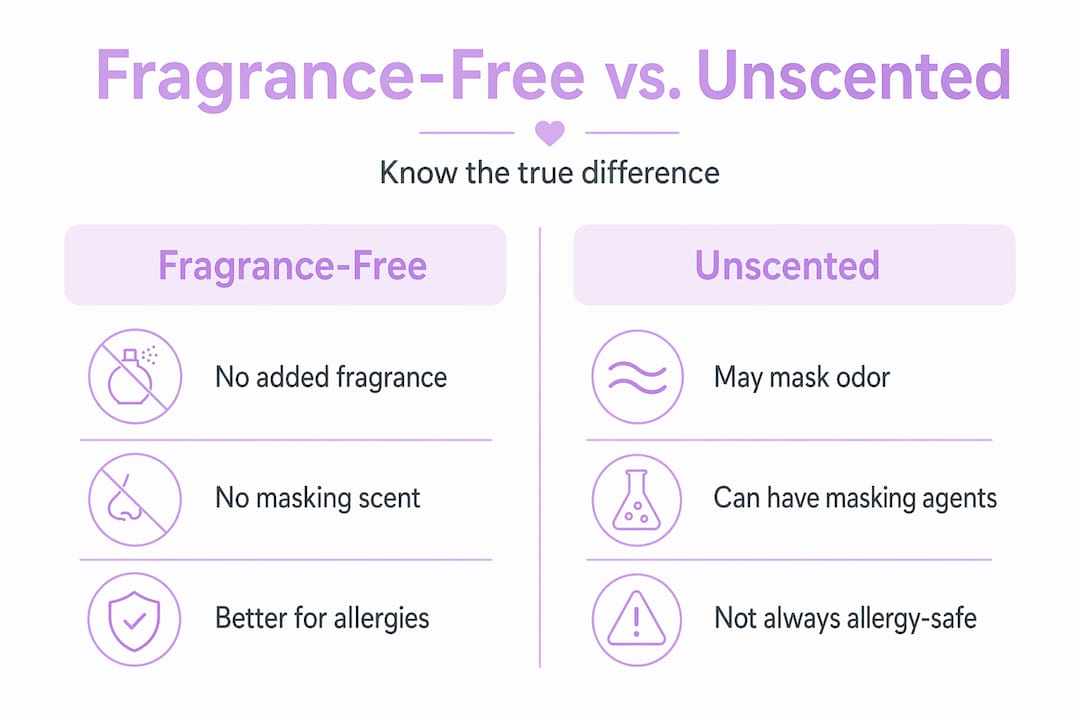
Fragrance-free means no intentionally added fragrance ingredient. However, products labelled “unscented” are different. Unscented products may still contain what are called masking fragrances, which are added to neutralise the natural odour of a base formula. These masking fragrances may contain fragrance allergens that never appear on the label as “fragrance.”
“Hypoallergenic” is another term worth understanding. It has no standardised regulatory definition in Canada or the United States. A company can label any product hypoallergenic without clinical proof. It signals marketing intent, not guaranteed safety.
Why fragrance is a problem ingredient
Fragrance is not one chemical. It is a catch-all term that can represent hundreds of individual synthetic and natural compounds. Under current regulations, manufacturers are not required to disclose every component of a fragrance blend, only the word “fragrance” or “parfum” on the label. This single word can represent dozens of potential allergens.
Fragrance allergens include well-known compounds like linalool, limonene, geraniol, cinnamal, and eugenol. The European Union requires these 26 specific allergens to be individually listed on cosmetic labels when they exceed certain concentration thresholds. Canada and the US have less prescriptive labelling requirements, which means consumers here face a less transparent picture.
When fragrance compounds penetrate the outer layer of skin, they can trigger an immune response. This is contact dermatitis, and it can show up as redness, itching, swelling, or a burning sensation, sometimes days after first exposure. For people who develop sensitisation, even trace amounts of a fragrance compound can provoke a reaction.

Pro Tip: Read the ingredient list starting from the bottom up for leave-on products like moisturisers. Ingredients at the end appear in the lowest concentrations and often include fragrance components, preservatives, and stabilisers worth scrutinising.
How common fragrance sensitivity really is
If you have experienced unexplained skin redness or irritation from a lotion or cream, you are not alone. Fragrance sensitivity is one of the most widespread skin issues in the general population.
Clinical research places fragrance-mix sensitisation at a median prevalence of approximately 2.3% in adult populations. That figure climbs considerably among people already dealing with dermatitis, where rates of fragrance sensitisation are substantially higher. For context, 2.3% of the Canadian population represents hundreds of thousands of people experiencing measurable immune reactions to fragrance compounds in everyday products.
“Fragrance sensitisation impacts a meaningful portion of the population, making fragrance avoidance in skincare a reasonable preventive strategy, not an overcaution.” — Epidemiological insight on fragrance allergy
The health impact extends well beyond itchy skin. Research on fragranced product exposure found that 49.5% of survey respondents in the United States reported health effects from fragranced products that met criteria associated with disability. Symptoms included migraines, respiratory difficulty, and difficulty concentrating, all triggered by exposure to fragranced personal care and household products.
This data reframes the conversation. Choosing fragrance free beauty products is not just a preference for people with particularly reactive skin. For a significant share of the population, it is a practical health measure that supports daily function and quality of life.
Fragrance-free does not mean irritation-free
This is the nuance that most articles skip, and it is the most useful thing you can understand about fragrance free skincare for sensitive skin.
Removing fragrance from a product is a meaningful step. It eliminates one of the most common trigger categories. But skin reactions do not only come from fragrance. A fragrance-free label tells you only that one category of ingredients was left out. It says nothing about the rest of the formula.
Here are the most common non-fragrance irritants still found in fragrance-free products:
- Preservatives such as methylisothiazolinone (MI) and formaldehyde-releasing agents are among the most frequently flagged contact allergens in modern skincare.
- Botanical extracts like tea tree oil, lavender oil, and eucalyptus contain naturally occurring fragrance compounds. A product free of synthetic fragrance can still contain these plant-sourced irritants.
- Surfactants in cleansers, such as sodium lauryl sulphate (SLS), disrupt the skin barrier by stripping lipids. This increases transepidermal water loss (TEWL) and makes skin more vulnerable to irritants.
- Drying alcohols like ethanol and isopropyl alcohol can compromise the skin barrier, particularly in toners and treatment serums.
- pH imbalance in a product, especially overly alkaline formulas, can interfere with the skin’s natural acid mantle, triggering irritation that has nothing to do with fragrance.
The sensitive skin barrier behaves like a brick-and-mortar wall with missing mortar. Gaps in the barrier mean irritants penetrate more readily and at lower concentrations than in healthy skin. This is why people with eczema often react to products that most people tolerate without issue.
Pro Tip: When trialling a new product, apply a small amount to the inside of your forearm for five to seven consecutive days before full use. This simple patch test can reveal delayed reactions that a single-day test would miss.
Dermatologists consistently advise treating “fragrance-free” as part of a broader approach to choosing gentle skincare. Products should be evaluated holistically, checking preservatives, botanicals, surfactants, and pH considerations alongside the fragrance claim.
How to choose fragrance-free products that actually work
Knowing what to avoid is half the battle. The other half is knowing what to look for.
✔ Read the full INCI list, not just the marketing claims. Every ingredient must be listed by its International Nomenclature of Cosmetic Ingredients name. “Parfum” and “fragrance” are the obvious ones to avoid, but also watch for individual fragrance chemicals listed separately, such as linalool or benzyl alcohol.
✔ Choose shorter ingredient lists. Fewer ingredients generally means fewer opportunities for reaction. A basic fragrance-free moisturiser with 10 to 15 ingredients is often safer for reactive skin than a 35-ingredient “clean beauty” formula packed with botanical extracts.
✔ Be cautious with naturals. Natural does not mean non-reactive. Essential oils, citrus extracts, and herbal botanicals are frequent offenders for people with sensitive, easily irritated skin. A product can be entirely plant-derived and still trigger contact dermatitis.
✔ Prioritise leave-on formulas with low pH. Leave-on products like moisturisers and serums have longer skin contact time than rinse-off products, so the ingredient quality matters more. Look for a pH between 4.5 and 5.5 to support your skin’s natural acid mantle.
✔ Seek medical guidance when reactions are persistent. Patch testing conducted by a dermatologist or allergist can identify your specific fragrance allergen patterns. This makes product selection far more targeted than trial and error.
| What to look for | What to avoid |
|---|---|
| “Fragrance-free” on the label | “Unscented” (may contain masking fragrances) |
| Short, readable ingredient list | Long lists with many botanical extracts |
| pH-balanced, gentle surfactants | Sodium lauryl sulphate (SLS) |
| Gentle preservatives (e.g., phenoxyethanol) | Methylisothiazolinone (MI), formaldehyde releasers |
| Minimal plant extracts | Essential oils, citrus, tea tree, lavender |
Benefits that go beyond allergy prevention
The importance of fragrance free skincare reaches further than avoiding a rash. When you step back and look at the broader picture, the benefits span skin health, indoor air quality, and social well-being.
- Stronger skin barrier. Without fragrance compounds disrupting the lipid structure of the stratum corneum, the skin barrier maintains better integrity. This supports hydration retention and reduces TEWL over time.
- ️ Cleaner indoor air. Fragranced products release volatile organic compounds (VOCs) into the air. Research shows that fragrance avoidance can reduce VOC concentrations by 70 to 80% in chemically sensitive households, meaningfully improving indoor air quality.
- Social and workplace inclusion. Many people with fragrance sensitivity avoid public spaces, social events, and shared workplaces when fragrance exposure is unavoidable. Choosing fragrance free products when you share space with others is a considerate and practical step.
- Reduced systemic chemical load. Skin absorbs compounds from topical products into the bloodstream in small but measurable quantities. Fewer unnecessary chemicals in your routine means less cumulative exposure over time.
- ✅ Cleaner beauty routines. A fragrance free skincare routine naturally pushes you toward simpler, more intentional formulations. That shift typically results in products with higher active ingredient concentrations and fewer unnecessary additives.
My honest take on the fragrance-free movement
I have followed the rise of fragrance-free skincare closely, and here is what I genuinely believe: the movement is directionally right but often oversimplified in ways that leave people disappointed.
Removing fragrance is a meaningful first step. The clinical evidence supports it. Fragrance is the most common cosmetic allergen, and reducing exposure is a rational prevention strategy, especially for anyone with dermatitis or reactive skin. That part is solid.
What I find frustrating is the way “fragrance-free” has become a marketing shorthand for “safe for sensitive skin” without any deeper scrutiny of the full formula. I have spoken with people who switched to a fragrance-free product line and still experienced flares, then concluded that their skin was just impossible to manage. In most of those cases, the culprit was a preservative or a botanical extract, not fragrance. The fragrance-free label gave false reassurance.
My honest recommendation: treat fragrance-free as the floor, not the ceiling. Start there, because it matters. Then keep reading ingredient lists, do patch tests, and work with a dermatologist if your skin continues to react. The goal is not finding the product with the right marketing claim. It is understanding your skin’s specific triggers well enough to avoid them consistently.
— Alex
Gentle skincare without compromise, from Zenchemylab
At Zenchemylab, we believe your skin deserves formulas built on genuine purity, not just a clean-sounding label. Our natural skin collection is built around minimal, purposeful ingredients, with fragrance-free options developed specifically for sensitive and reactive skin. Each product starts with raw, carefully selected botanicals processed to retain their benefits without adding unnecessary fragrance, harsh surfactants, or questionable preservatives.
If you are building or refining your routine, our skincare routine guide walks you through practical steps for selecting gentle, effective products that support your skin barrier over time. We also offer a curated range of handmade soaps formulated without synthetic fragrance for those who want a truly clean cleansing foundation. Explore the full range and find what your skin has been asking for.
FAQ
What does fragrance-free mean on a skincare label?
Fragrance-free means no fragrance ingredient was intentionally added to the formula. It does not mean the product contains zero scent-producing compounds, as naturally fragrant botanicals and masking fragrances may still be present.
Is fragrance-free better for sensitive skin?
Yes, fragrance-free is generally the better choice for sensitive skin because fragrance is one of the most common cosmetic allergens. However, you should still check for other potential irritants like preservatives, botanical extracts, and drying alcohols.
Can fragrance-free products still cause skin reactions?
Yes. Fragrance-free products may still contain irritants such as preservatives, surfactants, or naturally fragrant botanicals that can trigger reactions, particularly in people with eczema or a compromised skin barrier.
What is the difference between fragrance-free and unscented?
Fragrance-free means no fragrance was added. Unscented means the product has no detectable smell, but it may still contain masking fragrances that neutralise base odours. These masking fragrances can include allergens not listed as “fragrance” on the label.
How do I know if I have a fragrance allergy?
If you notice redness, itching, or swelling after using a skincare product, a patch test conducted by a dermatologist or allergist can identify specific fragrance allergen patterns. Clinical patch testing is more reliable than self-diagnosis and helps you select products with greater confidence.