
A natural emulsifier is an amphiphilic, nature-derived substance that stabilises mixtures of oil and water by reducing interfacial tension and protecting droplets from merging or separating. Three of the most familiar examples are lecithin (from soy or sunflower), beeswax and plant waxes (candelilla, carnauba), and xanthan gum. You’ll find them doing quiet but essential work in everything from a moisturising face cream to a bottle of salad dressing.
Here’s why this matters for you:
- ✅ In skincare, natural emulsifiers hold water and oil together in lotions, creams, and serums without synthetic surfactants.
- ✅ In food, they improve texture, prevent separation, and extend shelf life in products like chocolate, baked goods, and dressings.
- ✅ For DIY formulators in Canada, knowing which emulsifier to reach for first saves a lot of failed batches.
Table of Contents
- How natural emulsifiers actually work
- Common natural emulsifier families and where each is used
- Which emulsifier suits your application?
- Modern branded natural emulsifiers for cosmetics
- Why formulators choose natural emulsifiers: benefits and real trade-offs
- How to choose the right natural emulsifier for your product
- Practical formulation tips when working with natural emulsifiers
- DIY-friendly emulsifiers and their real limits
- Key takeaways
- Why the “best natural emulsifier” question misses the point
- Ready-made natural skincare, without the formulation work
- Useful sources for further reading
How natural emulsifiers actually work
Every emulsifier has two ends: one that loves water (hydrophilic) and one that loves oil (hydrophobic). This dual nature, called amphiphilicity, lets the molecule sit right at the oil-water interface, lowering the energy needed to keep the two phases apart and preventing droplets from coalescing back into separate layers.
The direction of that interface determines the emulsion type:
- Oil-in-water (O/W): Tiny oil droplets dispersed in a water phase. Think light lotions, milk, and most face creams. Feels lighter on skin, absorbs quickly, and carries a higher water content.
- Water-in-oil (W/O): Water droplets dispersed in an oil phase. Think cold creams, butter-style balms, and margarine. Feels richer, more occlusive, and leaves a protective film on the skin.
| Attribute | O/W emulsion | W/O emulsion |
|---|---|---|
| Skin feel | Light, non-greasy | Rich, occlusive |
| Water content | High | Low |
| Typical products | Lotions, serums, milk | Cold creams, balms |
| Spreadability | Easy | Heavier |
Choosing the wrong emulsion type for your product is one of the most common formulation mistakes. A W/O emulsifier in a light day lotion will leave your skin feeling like it’s coated in wax.
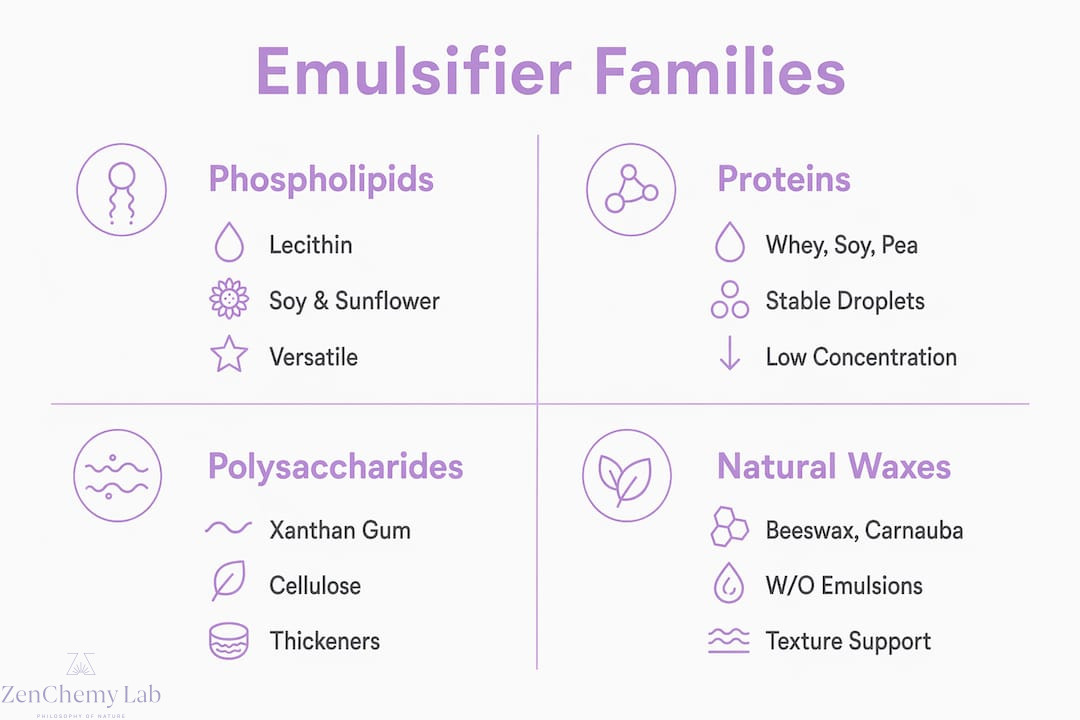
Common natural emulsifier families and where each is used
Natural emulsifiers fall into four main families: phospholipids, proteins, polysaccharides, and waxes/saponins. Each has a distinct performance profile.
Phospholipids: lecithin (soy and sunflower)
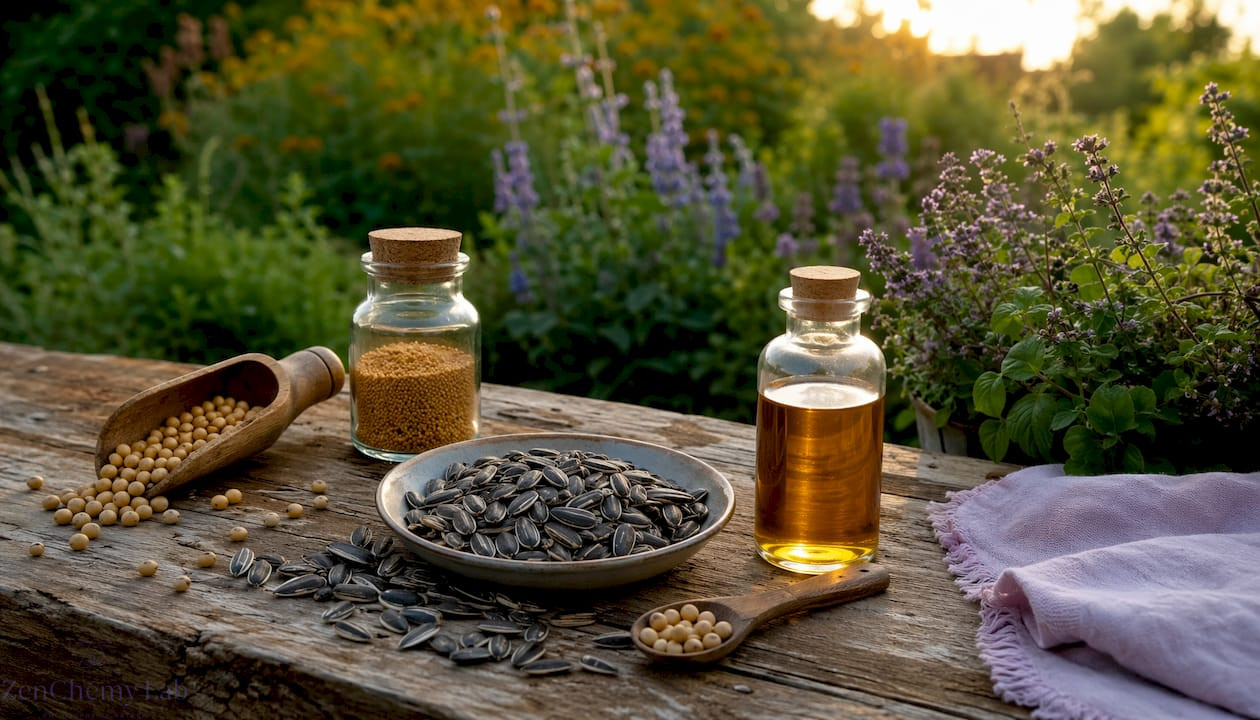
Lecithin is extracted from soy, sunflower seeds, or egg yolk. It’s one of the most versatile natural emulsifiers available, used in chocolate, baked goods, salad dressings, and skincare serums alike. Sunflower lecithin is the go-to for soy-free and vegan formulations. Egg lecithin works beautifully in food but is obviously off the table for vegan products.
⚠️ Allergen note: Soy lecithin may trigger reactions in people with soy allergies; egg lecithin is not suitable for vegans or those with egg allergies.
Proteins: whey, soy, and pea protein
Protein-based emulsifiers work at relatively low concentrations and produce fine, stable droplets. The trade-off is sensitivity: pH swings and high heat can denature them, breaking the emulsion. Whey protein is common in food applications; pea and soy proteins are preferred for vegan formulations. In skincare, proteins also contribute film-forming and conditioning benefits.
Polysaccharides: xanthan gum, cellulose, and starches
Xanthan gum, derived from bacterial fermentation, is a workhorse thickener and co-emulsifier in both food and cosmetics. It doesn’t emulsify on its own the way lecithin does, but it stabilises emulsions by increasing viscosity and slowing droplet migration. Polysaccharides generally need higher inclusion levels than proteins to achieve fine droplet sizes, but they’re far more resistant to pH and temperature stress.
Natural waxes: beeswax, candelilla, and carnauba
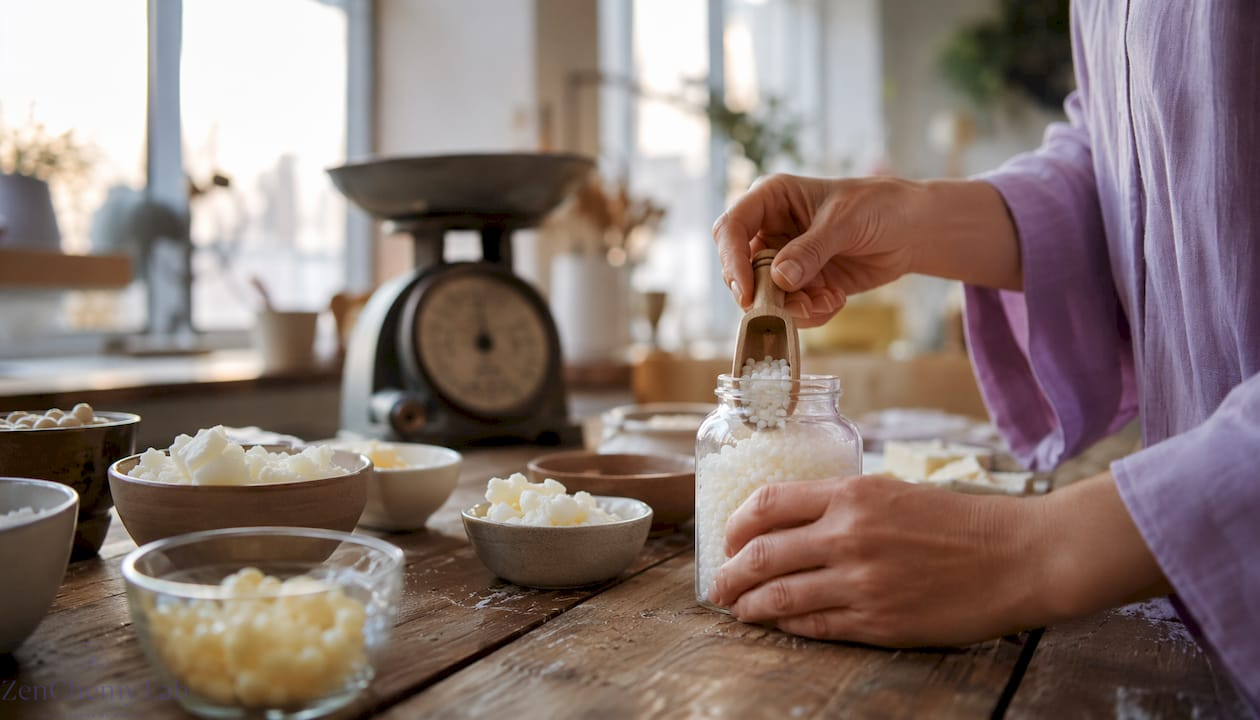
Waxes primarily support W/O emulsions and anhydrous products, with shea butter often used to enrich texture and moisturizing properties in these formulations (learn more about shea butter). Beeswax is the classic choice for lip balms, salves, and cold creams; it’s animal-derived and not vegan. Candelilla wax (from a Mexican shrub) and carnauba wax (from Brazilian palm leaves) are both plant-based and vegan-friendly alternatives with slightly harder textures. All three are available from Canadian natural ingredient suppliers.
Saponins and biosurfactants
Saponins, found in plants like quillaja bark and soapwort, can form fine emulsion droplets at relatively low concentrations. They’re used in specialty food and cosmetic applications, though regulatory status and labelling requirements vary by product category.
Comparison table: natural emulsifier families at a glance
| Family | Best for | Source | Emulsion type | Stability notes | Typical usage rate | Allergen / certification |
|---|---|---|---|---|---|---|
| Phospholipids (lecithin) | Food, skincare serums | Plant (soy, sunflower), animal (egg) | O/W, W/O | Moderate pH/heat sensitivity | 0.5–3% | Soy, egg allergens; COSMOS-eligible |
| Proteins (pea, soy, whey) | Food emulsions, skincare | Plant or dairy | O/W | Sensitive to pH and heat | 0.5–2% | Soy, dairy allergens; vegan options available |
| Polysaccharides (xanthan, starch) | Food, cosmetic co-emulsifier | Plant, microbial | O/W (co-emulsifier) | High pH/temp resistance | 0.1–1% (xanthan) | Generally allergen-free; COSMOS-eligible |
| Natural waxes (beeswax, candelilla, carnauba) | Balms, cold creams, DIY | Animal (beeswax), plant (candelilla, carnauba) | W/O | Stable; heat-melt required | 5–25% | Beeswax not vegan; plant waxes COSMOS-eligible |
| Saponins / biosurfactants | Specialty food, cosmetics | Plant | O/W | Good environmental resistance | 0.5–2% | Check regulatory status by product category |
Which emulsifier suits your application?
| Application | Recommended family | Source preference | O/W or W/O | pH / temp sensitivity | Texture impact |
|---|---|---|---|---|---|
| Light face lotion / serum | Phospholipids, modern plant emulsifiers | Plant | O/W | Moderate | Silky, lightweight |
| Rich body cream | Waxes + polysaccharide blend | Plant or animal | W/O or O/W | Low (waxes) | Rich, occlusive |
| Lip balm / salve | Natural waxes | Plant or animal | W/O (anhydrous) | Very stable | Firm, protective |
| Food dressing / sauce | Lecithin, proteins | Plant | O/W | Moderate | Smooth, creamy |
| Baked goods / chocolate | Lecithin | Plant (sunflower/soy) | O/W | Moderate | Improved texture |
| DIY home skincare | Lecithin, beeswax, xanthan | Plant or animal | Both | Moderate | Varies by ratio |
Polysaccharide blends and wax-based systems are generally the most forgiving for home DIY because they tolerate more variation in technique. Protein-based emulsifiers reward precision: get the pH or temperature wrong and the emulsion breaks.
Modern branded natural emulsifiers for cosmetics
Beyond raw ingredients, the cosmetic industry has developed purpose-built, plant-derived emulsifier systems that deliver consistent, predictable results. Three you’ll see frequently in natural and organic formulation communities:
- Olivem 1000 (INCI: Cetearyl Olivate, Sorbitan Olivate): Derived from olive oil, this self-emulsifying wax produces stable O/W emulsions with a skin-identical feel. It’s popular in certified organic formulations and is COSMOS-approved. Typical usage rate is 3–8%. Available through several Canadian cosmetic ingredient distributors.
- Ecomulse (also marketed as NatraMulse depending on the supplier): A plant-derived emulsifying wax system typically based on glyceryl stearate and related esters. It produces smooth, creamy O/W emulsions and is designed as a direct replacement for conventional emulsifying wax. Check the supplier’s Technical Data Sheet (TDS) for exact INCI, usage rate (commonly 4–8%), and certification status, as formulations can vary between distributors.
- Candelilla wax and carnauba wax (as standalone emulsifier/structurant systems): Both are Ecocert and COSMOS-eligible and widely available in Canada through suppliers like Voyageur Soap & Candle or New Directions Aromatics.
Why choose a branded system? Predictable performance, lower trial-and-error, and supplier-backed technical support. Always request the TDS before purchasing — it tells you the exact usage rate, recommended processing temperature, pH range, and any preservative compatibility notes. For certified organic products, confirm COSMOS or Ecocert status directly with the Canadian distributor.
Pro Tip: When sourcing Olivem 1000 or Ecomulse in Canada, ask your supplier for the lot-specific Certificate of Analysis (CoA) alongside the TDS. Batch variation in plant-derived emulsifiers is real, and a CoA confirms purity and active content before you scale up.
Why formulators choose natural emulsifiers: benefits and real trade-offs
The clean-label shift is the clearest driver: consumers want to read ingredient lists they recognise, and manufacturers are reformulating to replace synthetic surfactants with plant- or food-based alternatives. But natural doesn’t automatically mean easier to work with.
Key benefits:
- ✅ Biodegradable and lower environmental impact compared to many synthetic surfactants
- ✅ Clean-label appeal for both food and cosmetic products
- ✅ Multifunctional roles: biopolymers like proteins and polysaccharides act as emulsifiers, viscosifiers, and gelling agents simultaneously
- ✅ Delivery system potential: nanoemulsions with droplets of 50–500 nm increase bioavailability of fat-soluble actives like vitamins and carotenoids, a real advantage for botanical skincare
Trade-offs to know:
- ⚠️ Protein-based emulsifiers are sensitive to pH and heat; denaturation breaks the emulsion
- ⚠️ Polysaccharides often need higher inclusion levels to achieve fine droplet sizes
- ⚠️ Natural systems can be less robust than synthetic ones; combinations (protein + polysaccharide) often outperform single-ingredient approaches
- ⚠️ Stability testing is non-negotiable: droplet size, creaming, and coalescence checks confirm whether your emulsion will hold over its intended shelf life
Canadian regulatory note: Health Canada regulates cosmetic ingredients under the Cosmetic Regulations (Food and Drugs Act), and the Canadian Food Inspection Agency (CFIA) governs food labelling. If your product contains a known allergen (soy, egg, dairy), Canadian labelling rules require clear disclosure. For cosmetics sold in Canada, check the Health Canada cosmetic notification requirements before launch. Always combine data-driven emulsifier selection with supplier testing and small-batch stability trials.
How to choose the right natural emulsifier for your product
Work through this checklist before committing to an emulsifier:
- Define your emulsion type. O/W for light lotions and food dressings; W/O for rich creams, balms, and butter-style products.
- Set your sensory target. Light and fast-absorbing? Reach for lecithin or a plant-based emulsifier system like Olivem 1000. Rich and occlusive? Wax-based systems are your starting point.
- Check your pH range. Protein emulsifiers are unstable below pH 4 or above pH 8. Polysaccharides and waxes tolerate a wider range.
- Confirm preservative compatibility. Some emulsifiers interact with common preservatives (phenoxyethanol, sodium benzoate), reducing efficacy. Test the full formulation, not just the emulsifier alone.
- Assess heat stability. Will your product sit in a hot car or on a sunny shelf? Wax-based systems handle heat better than protein-based ones.
- Verify certification requirements. If you need COSMOS or Ecocert status, confirm with the supplier before purchasing. Not all “natural” emulsifiers qualify.
- Screen for allergens and vegan constraints. Soy lecithin, egg lecithin, whey protein, and beeswax each carry specific restrictions for certain consumers.
- Request the supplier TDS. Typical starting usage rates vary widely: lecithin at 0.5–3%, wax-based systems at 5–25%, xanthan gum at 0.1–1%. The TDS gives you the exact range for your specific grade.
- Run stability tests. At minimum: accelerated ageing (4 weeks at 40°C), refrigeration cycles, pH stress, and a visual check for creaming or phase separation. For formulating natural creams at home, small-batch testing before scaling is the single most important step.
Practical formulation tips when working with natural emulsifiers
Getting the emulsifier right on paper is only half the job. How you process it matters just as much.
- Melt wax-based emulsifiers into the oil phase first. Beeswax, candelilla, and carnauba waxes need to be fully melted (typically 70–80°C) before you combine phases. Adding them to a cool oil phase leaves unmelted lumps that never fully incorporate.
- Heat both phases to the same temperature before combining. A temperature mismatch between oil and water phases is one of the most common causes of immediate emulsion failure. Aim for within 2–3°C of each other.
- Add the water phase to the oil phase slowly, with continuous mixing. For O/W emulsions, this counter-intuitive step helps the emulsifier orient correctly at the interface. A stick blender or overhead mixer works well for small batches.
- Cool with moderate, steady mixing. High-shear mixing during cooling can introduce air and destabilise some natural emulsifiers, particularly protein-based ones. Switch to gentle stirring below 40°C.
- Add heat-sensitive actives below 40°C. Botanical extracts, vitamin C, and fragrance oils degrade at high temperatures. Add them in the cool-down phase, not during emulsification.
- Record everything. Batch weight, phase temperatures, mixing speed, pH at room temperature, and appearance at 24 hours. Without records, you can’t replicate a success or diagnose a failure.
- Run a preservative efficacy test on the final formulation. Emulsifier type influences how preservatives distribute across oil and water phases. A preservative that works in one formula may underperform in another with a different emulsifier.
Stability-testing checklist:
- Accelerated ageing: 4 weeks at 40°C, check for phase separation
- Freeze-thaw cycles: 3 cycles between –10°C and room temperature
- pH stress: test at your formula’s pH and ±1 unit
- Visual checks: creaming, coalescence, colour change, odour shift
- Preservative challenge test (especially for water-containing products)
Pro Tip: When blending a protein emulsifier with a polysaccharide (e.g., pea protein + xanthan gum), add the polysaccharide to the water phase first and allow it to fully hydrate before introducing the protein. This prevents competitive adsorption at the interface and produces a more stable, uniform droplet size.
DIY-friendly emulsifiers and their real limits
Making emulsified products at home is genuinely satisfying, but a few things can go wrong quickly if you skip the fundamentals.
Practical DIY options:
- Sunflower or soy lecithin granules/liquid: Easy to source at Canadian health food stores or online suppliers. Works well in light O/W emulsions, salad dressings, and simple face serums.
- Beeswax: Available at farmers’ markets, craft stores, and online across Canada. Ideal for lip balms, salves, and anhydrous body balms. Not suitable for vegan products.
- Candelilla wax: The vegan alternative to beeswax; slightly harder texture. Available through Canadian cosmetic ingredient suppliers.
- Xanthan gum: Found in most grocery stores. Use at 0.1–0.5% as a co-emulsifier and thickener in food and simple cosmetic emulsions.
- Egg yolk (food use only): A classic kitchen emulsifier for mayonnaise and hollandaise. Not appropriate for skincare due to microbial risk and short shelf life.
- Mustard (food use only): The mucilage in mustard acts as a mild emulsifier in vinaigrettes. Practical, but limited to small food applications.
Limitations you need to know:
- ⚠️ Shelf life is shorter. Home-made emulsions without proper preservation typically last days to weeks, not months. Any product containing water is a microbial growth environment.
- ⚠️ Preservation is non-negotiable for water-containing products. A lotion without a tested preservative system is a safety risk, not just a quality issue.
- ⚠️ Allergen risks are real. If you’re selling or sharing products in Canada, you have labelling obligations under Health Canada and CFIA rules. Soy, egg, and dairy-derived emulsifiers must be declared.
- ⚠️ Anhydrous products are the safest DIY starting point. Balms, body butters, and salves made with waxes and oils contain no water, so they don’t need a preservative system and have a much longer stable shelf life. For a deeper look at how natural emollients work alongside emulsifiers in these formulas, that’s a useful next read.
Key takeaways
Natural emulsifiers are amphiphilic, nature-derived substances that stabilise oil-water mixtures; choosing the right family (phospholipid, protein, polysaccharide, or wax) for your application, pH range, and certification needs determines whether your product holds together over time.
| Point | Details |
|---|---|
| Definition | A natural emulsifier is an amphiphilic, nature-derived substance that reduces interfacial tension to stabilise oil-water mixtures. |
| Top families for skincare | Phospholipids (lecithin), plant waxes (candelilla, carnauba), and modern systems like Olivem 1000 suit most O/W and W/O skincare formulas. |
| Top families for food | Lecithin (soy, sunflower) and protein-based emulsifiers are the most widely used in food dressings, baked goods, and chocolate. |
| Selection criteria | Match emulsion type, pH range, heat stability, allergen profile, and certification needs before choosing; always consult the supplier TDS. |
| Canadian regulatory reminder | Health Canada and CFIA require allergen disclosure on both cosmetic and food labels; confirm notification requirements before selling any emulsified product in Canada. |
| Zenchemylab approach | Zenchemylab’s handcrafted skincare uses carefully selected natural emulsifiers and plant-based ingredients, so you get clean-label formulations without the formulation risk. |
Why the “best natural emulsifier” question misses the point
There is no single best natural emulsifier, and the search for one is where most DIY formulators lose time. The right choice is always contextual: polysaccharides for environmental resistance, proteins for fine droplets at low concentration, biosurfactants for broad-range stability at low use levels. What I’ve seen repeatedly is that formulators reach for lecithin first because it’s familiar and easy to source, then get frustrated when a light face lotion turns greasy or a body cream separates after two weeks in a warm bathroom.
The real skill is matching the emulsifier’s performance profile to the product’s actual conditions: the pH of your active ingredients, the temperature range the product will experience in shipping and storage, and the sensory result your customer expects. Branded systems like Olivem 1000 exist precisely because they take some of that guesswork out of the equation. They’re not a shortcut; they’re a starting point with a known performance envelope. From there, small-batch testing and a proper stability protocol do the rest. If you want to go deeper on the formulation side, the natural cream formulation guide on this site walks through the process step by step.
Ready-made natural skincare, without the formulation work
Not everyone wants to spend an afternoon weighing out waxes and running pH tests, and that’s completely reasonable. Zenchemylab’s handcrafted skincare line is built around the same clean-label, plant-based principles covered in this guide, with every product formulated for stability, skin compatibility, and ingredient transparency.

Whether you’re looking for a nourishing body balm, a botanical face cream, or a gentle cleanser, the natural beauty tips and product guide is a good place to start. It pairs science-backed ingredient explanations with Zenchemylab’s ready-made options, so you can move from learning to actually caring for your skin. Browse the full body care collection to find products that match your skin type and values.
Useful sources for further reading
These are the authoritative Canadian and international sources worth bookmarking if you’re going deeper on natural emulsifiers, labelling, or formulation science.
- Health Canada — Cosmetics: The starting point for any Canadian selling cosmetic products. Covers notification requirements, prohibited ingredients, and labelling rules including allergen disclosure.
- Canadian Food Inspection Agency (CFIA) — Food Labelling: Governs allergen labelling and ingredient declaration for food products containing emulsifiers like lecithin, soy protein, or egg derivatives.
- Natural emulsifiers — biosurfactants, phospholipids, biopolymers, and colloidal particles (ScienceDirect): A peer-reviewed review of the molecular basis of natural emulsifier performance; the most comprehensive technical reference on this list.
- Progress in natural emulsifiers for utilisation in food emulsions (ScienceDirect): Covers proteins, polysaccharides, phospholipids, and saponins with a focus on food applications and environmental stress factors.
- Emulsion-based delivery systems for bioactive compounds (MDPI Foods): Useful for understanding how nanoemulsions improve bioavailability of fat-soluble vitamins and botanical actives.
- COSMOS / Ecocert certification pages: When sourcing certified-organic emulsifiers, check the COSMOS standard directly at cosmos-standard.org and confirm with your Canadian distributor that the specific grade and lot are certified.
This article is general educational information, not professional regulatory or formulation advice. Confirm current labelling rules and ingredient status with Health Canada, the CFIA, or a qualified cosmetic chemist for your specific product and market.