

TL;DR:
- Using essential oils correctly involves diluting them with carrier oils and matching specific oils to your skin type to avoid adverse reactions. Consistent application over 4 to 6 weeks supports improvements in skin texture, tone, and barrier function, with patience being key. Proper layering, patch testing, and choosing high-quality ingredients are essential for safe, effective skincare routines.
Most people who start using essential oils for skin pick up a bottle of tea tree or lavender, apply it straight to their face, and wonder why their skin reacts badly. Knowing how to use essential oils for skin correctly is the difference between a glowing complexion and a week of redness. These plant-derived concentrates act as anti-inflammatories and antimicrobials that support your skin’s natural chemistry rather than overriding it. This guide walks you through preparation, blending, daily application, and how to avoid the most common mistakes.
Table of Contents
- Key takeaways
- How to use essential oils for skin: start with the basics
- How to blend essential oils for skin
- Integrating oils into your daily skincare routine
- Troubleshooting and safety considerations
- What results to expect over time
- My take on using essential oils responsibly
- Explore Zenchemylab’s natural skincare range
- FAQ
Key takeaways
| Point | Details |
|---|---|
| Always dilute first | Never apply essential oils directly to bare skin. Use a carrier oil to reduce irritation risk. |
| Match oils to your skin type | Oily, dry, and sensitive skin each respond to different essential and carrier oils. |
| Follow dilution ratios | Facial use requires 0.5% to 2% dilution depending on your skin type and sensitivity. |
| Apply after moisturiser | Layering essential oil blends over moisturiser acts as a buffer and reduces long-term sensitivity. |
| Expect gradual results | Consistent use over 4 to 6 weeks supports visible skin texture and tone improvement. |
How to use essential oils for skin: start with the basics
Before you open a single bottle, you need to understand your skin type. This one step determines which essential oils will work for you and which ones may cause problems.
Skin type categories and matching oils:
- ✔ Dry skin responds well to rose, sandalwood, and geranium. Pair these with rich carrier oils like avocado or argan.
- ✔ Oily or acne-prone skin benefits from tea tree and lavender, both of which have documented antimicrobial and anti-inflammatory properties. Jojoba oil is the ideal carrier because its composition closely mirrors the skin’s sebum.
- ✔ Combination skin works well with frankincense or geranium, balanced in a lightweight carrier like sweet almond oil.
- ✔ Sensitive skin needs the gentlest options. Chamomile and lavender are your best choices. Keep dilutions low and test everything first.
Essential carrier oils and their roles:
Carrier oils are not just dilution vehicles. They bring their own skin benefits. Jojoba is non-comedogenic and absorbs quickly. Avocado oil is dense with fatty acids, ideal for dry or mature skin. Sweet almond oil sits in the middle, suitable for most skin types.
Basic tools you will need:
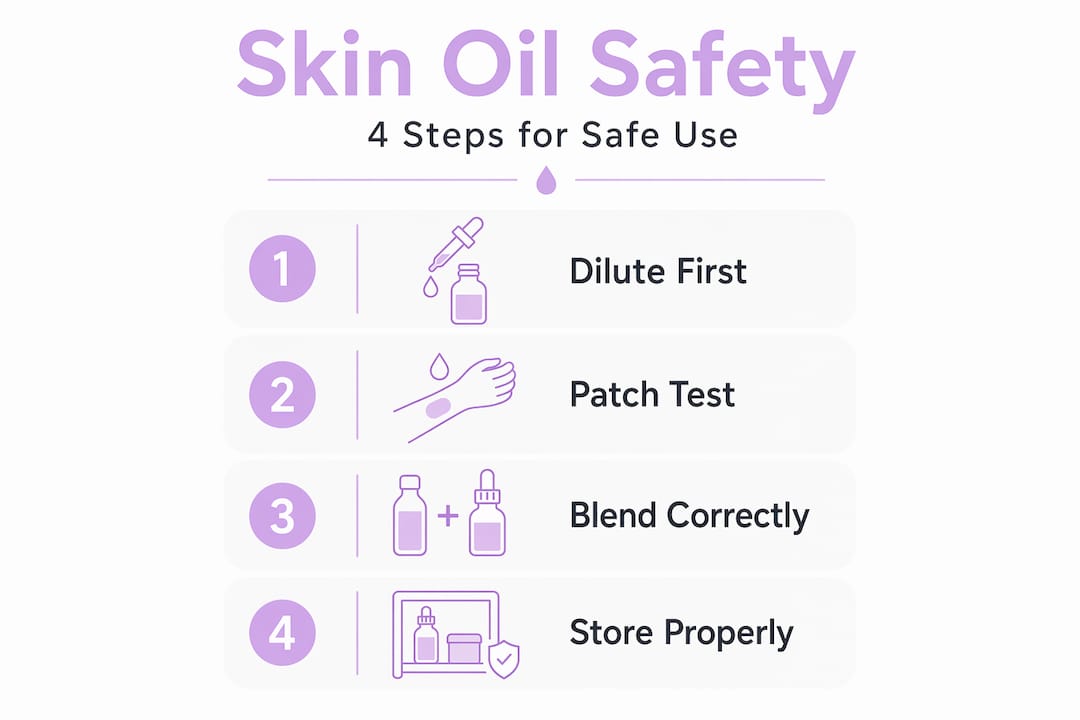
Small glass measuring cups, a glass stirring rod, a digital scale or dropper, and dark glass bottles for storage. These are not optional extras. Plastic containers can react with essential oils, and light degrades their potency quickly.

Pro Tip: Before any full-face use, patch test for 24 to 48 hours on your inner forearm or behind the ear. Check for redness, itching, or swelling at the 12, 24, and 48-hour marks. This step protects you from discovering a sensitivity the hard way.
How to blend essential oils for skin
Getting a blend right involves more than dropping a few oils together. Dilution accuracy and aromatic balance both matter.
Dilution ratios by skin type
Facial dilutions should sit between 0.5% and 2%, depending on how your skin behaves:
| Skin Type | Recommended Dilution | Example (per 10 ml carrier) |
|---|---|---|
| Sensitive skin | 0.5% to 1% | 1 to 2 drops essential oil |
| Normal or combination | 1% to 1.5% | 2 to 3 drops essential oil |
| Oily or acne-prone | Up to 2% | 4 drops essential oil |
| Body (not face) | 2% to 3% | 4 to 6 drops essential oil |
The 30/50/20 blending rule
A well-constructed blend follows the 30/50/20 aromatic note rule: 30% top notes, 50% middle notes, and 20% base notes. This produces a blend that is both pleasant to use and stable over time. Top notes like lemon or bergamot are the first impression but fade quickly. Middle notes like lavender or geranium carry the blend. Base notes like cedarwood or sandalwood anchor and extend the scent.
Step-by-step blending instructions
- Choose your carrier oil based on skin type (see section above).
- Measure your carrier into a dark glass bottle using a dropper or digital scale.
- Add base note drops first, then middle notes, then top notes.
- Cap the bottle and gently roll between your palms to combine. Never shake vigorously.
- Label the bottle with the blend name and date.
- Let the blend rest for 24 hours before first use. This allows the scent profile to settle.
DIY blend example for acne-prone skin: In 10 ml of jojoba oil, add 2 drops tea tree (middle/top), 1 drop lavender (middle), and 1 drop frankincense (base). This stays within the 2% dilution for oily skin and targets both microbial balance and inflammation.
DIY blend example for dry skin: In 10 ml of avocado oil, add 1 drop rose (middle), 1 drop sandalwood (base), and 1 drop geranium (middle). Keep it at 1.5% or below for nourishment without sensitivity risk.
Pro Tip: Add 1 to 2 drops of vitamin E oil to each blend before sealing. It acts as a natural antioxidant preservative. Combined with dark glass storage in a cool, dry spot, your blend can maintain quality for 6 to 12 months.
Integrating oils into your daily skincare routine
Knowing when and how to apply your blend is just as critical as the blend itself. Timing and layering affect both absorption and safety.
Morning routine:
- Cleanse your face with a gentle wash.
- Apply toner while skin is slightly damp.
- Follow with your serum if you use one.
- Apply moisturiser and allow 60 seconds to absorb.
- Apply your essential oil blend as the final step before sunscreen.
One important note: citrus-based oils like bergamot and lemon cause photosensitivity and should not be worn during sun exposure. If your blend includes citrus oils, use bergapten-free versions or reserve that blend for evenings only.
Evening routine:
- Double cleanse if you wore SPF or makeup during the day.
- Apply toner, then serum.
- Apply moisturiser.
- Finish with your essential oil blend. Nighttime is ideal for richer, more intensive blends.
The reason you apply oils after moisturiser is not just about comfort. The moisturiser layer acts as a physical buffer between your skin and the concentrated oil blend. Over time, applying oils directly to bare skin, even when diluted, can increase sensitivity. Applying over moisturiser reduces that cumulative irritation risk significantly.
Pro Tip: For best absorption results, try applying your blend to slightly damp skin after cleansing, before moisturiser, if your skin is resilient and not sensitive. This works well for body application in particular.
Troubleshooting and safety considerations
Most problems with essential oils come from skipping steps or rushing the process. Here is what to watch for.
Signs of irritation to recognise:
- Redness, burning, or stinging shortly after application
- Itching or hive-like bumps appearing within hours
- Dry patches or flaking in areas where the oil was applied
- Persistent breakouts that worsen rather than improve
If any of these occur, stop use immediately. Rinse the area with cool water and apply a plain, fragrance-free moisturiser. Do not reapply until the reaction fully resolves. When you reintroduce, use a lower dilution and patch test new blends even if they are made from natural ingredients.
Common mistakes to avoid:
- Applying essential oils undiluted directly to skin, even for spot treatments
- Using citrus-based oils before sun exposure without sunscreen
- Overusing potent oils like tea tree or clove, assuming “more is better”
- Skipping the patch test because you have used the oil before
“Essential oils support but do not cure skin conditions. They complement the skin’s natural chemistry as anti-inflammatories, antimicrobials, or balancing agents. Treating them as miracle cures sets up unrealistic expectations and increases the risk of overuse.”
Those with eczema, rosacea, or other diagnosed skin conditions should speak with a dermatologist before beginning any essential oil routine. Even the gentlest oils can trigger flare-ups in reactive skin. Read more about choosing oils for sensitive and reactive skin to understand which ingredients to prioritise.
What results to expect over time
Patience is genuinely required here, and not just as a platitude. Essential oils work by supporting natural skin cell turnover and barrier repair. That is a slow, biological process.
What consistent use supports over 4 to 6 weeks:
- ✔ Improved hydration and reduced transepidermal water loss (TEWL) in dry skin types
- ✔ Reduced inflammation and microbial imbalance in oily and acne-prone skin
- ✔ More even skin tone and smoother texture as cell turnover is supported
- ✔ A strengthened skin barrier, which is the “brick and mortar” structure that keeps moisture in and irritants out
Results vary depending on which oils you use, your skin type, and how consistent you are. Tracking progress matters. Take a photo every two weeks in the same lighting, and note any changes in texture, breakout frequency, or dryness. This gives you real data rather than vague impressions. Adjust your blend, dilution, or application timing if you do not see improvement by week six. The real role of essential oils in skincare is supportive and cumulative, not immediate or dramatic.
My take on using essential oils responsibly
I have seen two consistent patterns over the years. The first is people diving in with too many oils at once, applying them undiluted, and concluding that “essential oils don’t work” when their skin reacts. The second is people being so cautious they never actually commit to a routine long enough to see results.
The truth sits squarely between those two extremes. In my experience, the people who get the best outcomes start with one well-formulated blend, use it consistently for six weeks, and resist the urge to pivot every two weeks because results are “too slow.” Skin biology does not operate on your schedule.
What I have also noticed is that most beginners underestimate how much the carrier oil matters. Choosing jojoba for oily skin or avocado for dry skin is not a minor decision. It shapes how the whole blend performs. The natural body care ingredients you pair your oils with can make or break the results.
My honest advice: start with two essential oils, one carrier, and a proper dilution. Learn how your skin responds before adding complexity. There is no blending shortcut that replaces the knowledge you build by paying attention to your own skin over time.
— Alex
Explore Zenchemylab’s natural skincare range

If you are ready to put these principles into practice, Zenchemylab is built for exactly this. The focus at Zenchemylab has always been on purity, botanical quality, and formulations that respect how skin actually functions. Whether you are looking for natural skin care products to support your essential oil routine or searching for precious carrier oils to blend with, the Zenchemylab catalogue is a thoughtful starting point. You can also explore a complete natural skincare routine guide to see how essential oils fit into a full, effective daily regimen. Clean ingredients. Honest skincare. No guesswork required.
FAQ
What is the safest way to apply essential oils to skin?
Always dilute essential oils in a carrier oil before applying to skin. For facial use, stay between 0.5% and 2% dilution depending on your skin type, and apply the blend after moisturiser for an added buffer layer.
Which essential oils work best for acne-prone skin?
Tea tree and lavender are the best-supported options for acne-prone skin, with documented antimicrobial and anti-inflammatory properties. Use them diluted in jojoba oil at up to 2% concentration for targeted treatment.
How long before you see results from essential oils?
Expect 4 to 6 weeks of consistent use before noticing visible improvement. Essential oils work by supporting natural skin cell turnover and barrier repair, which are gradual biological processes.
Can you use essential oils every day?
Yes, when properly diluted and applied correctly, most essential oils are safe for daily use. Avoid citrus-based oils before sun exposure, and monitor your skin weekly for any signs of cumulative sensitivity.
Do you need to patch test every new blend?
Yes. Patch test every new blend on your inner forearm or behind the ear for 24 to 48 hours, even if you have used the individual oils before. New combinations can produce reactions that individual oils do not.


1 Comments