TL;DR:
- Minimalist skincare involves using a few well-chosen, effective products that support your skin’s natural barrier. It promotes consistency and reduces ingredient conflicts, leading to healthier, brighter skin over time. This approach emphasizes quality, research-backed formulations, and simple routines for sustainable, proven results.
Your bathroom shelf is stacked with a dozen products, your routine takes 20 minutes, and your skin still isn’t cooperating. Sound familiar? What is minimalist skincare, and why are so many people turning to it? Simply put, it’s a philosophy that replaces product overload with a small selection of well-chosen, effective formulas that actually work with your skin rather than against it. This guide breaks down the principles, the proven benefits, and the exact steps you need to build a routine that is simpler, smarter, and genuinely kind to your skin.
Table of Contents
- Key takeaways
- What is minimalist skincare, really?
- Building a minimalist skincare routine
- The science-backed benefits of minimalist skincare
- Common pitfalls when switching to minimalist skincare
- How to build your routine by skin type
- My take on minimalist skincare
- Zenchemylab’s approach to minimalist skincare
- FAQ
Key takeaways
| Point | Details |
|---|---|
| Fewer products, better results | Using fewer, well-chosen products reduces ingredient conflicts and supports a healthier skin barrier. |
| Four steps are enough | A gentle cleanser, serum, moisturiser, and SPF cover what your skin truly needs daily. |
| Patience is non-negotiable | Visible improvements typically take 4 to 6 weeks once your skin barrier begins to recover. |
| Simpler routines stick | Consistent daily use is the single most reliable predictor of skincare effectiveness. |
| Minimalism is not neglect | Effective minimal routines rely on targeted, multifunctional products, not skipped steps or guesswork. |
What is minimalist skincare, really?
Minimalist skincare is the practice of using the fewest products necessary to keep your skin clean, hydrated, protected, and treated for any specific concerns you have. It is not about doing nothing. It is about doing the right things with purpose.
The philosophy rests on a simple truth: your skin has a natural barrier, often described as a “brick and mortar” structure made up of skin cells (the bricks) and lipids (the mortar). This barrier controls transepidermal water loss (TEWL), keeps irritants out, and regulates how your skin looks and feels. Pile on too many products with conflicting actives, mismatched pH levels, or unnecessary fragrances, and you disrupt that barrier rather than support it.
What is minimal ingredient skincare in this context? It is a closely related concept, referring specifically to choosing formulas with shorter, cleaner ingredient lists. Minimalist skincare as a whole is broader. It covers both the number of products in your routine and the quality of what those products contain. Here is what the approach prioritises:
- ✅ Multifunctional products that address more than one concern at a time
- ✅ Research-backed actives such as ceramides, hyaluronic acid, niacinamide, and vitamin C
- ✅ pH compatibility between products to avoid neutralising each other’s effects
- ✅ Consistency over complexity, meaning the same few products used daily
- ✅ Transparent ingredient lists so you know exactly what you are applying
What minimalist skincare is not is a shortcut or a sign that you do not care about your skin. It is a deliberate, evidence-informed choice to give your skin what it needs and nothing more.
Building a minimalist skincare routine
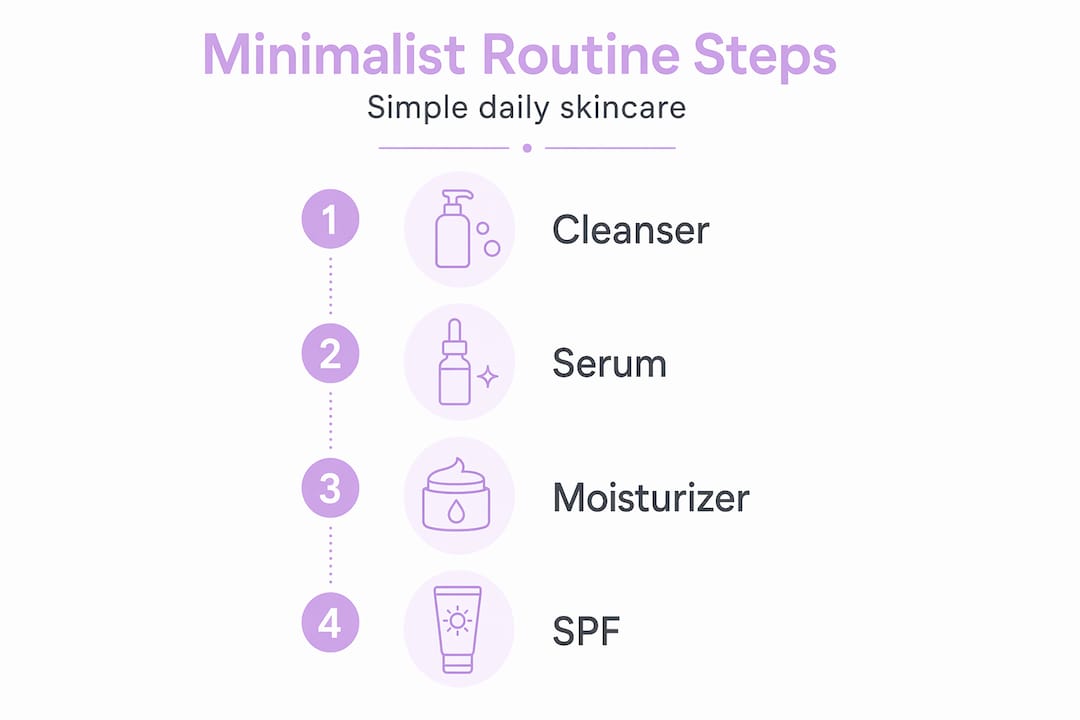
A strong minimalist skincare routine does not require you to reinvent your entire approach overnight. It requires you to understand which steps are genuinely load-bearing. According to a simplified 4-step framework, a cleanser, serum, moisturiser, and SPF are all your skin needs to look its best, with visible texture improvements possible within a single week.
Here is how each step works and what to look for:
-
Cleanser Choose a gentle, pH-balanced formula that removes dirt, oil, and sunscreen without stripping your skin’s natural moisture. A good cleanser leaves your skin feeling clean and comfortable, not tight or dry. Avoid anything with harsh sulphates if you have sensitive or dry skin. Gentle cleansing methods also prevent micro-damage to the skin barrier that sets off a cascade of reactivity.
-
Treatment serum This is where you address specific concerns. Vitamin C serums target uneven tone and UV-related oxidative damage. Hyaluronic acid draws moisture into skin cells. Niacinamide calms redness and tightens pores. You do not need all three at once. Pick one based on your primary concern and use it consistently.
-
Moisturiser Look for barrier-supporting ingredients like ceramides, fatty acids, and plant-based oils. A good moisturiser seals in the hydration delivered by your serum and reinforces that lipid-rich mortar layer. For a natural option, a botanically rich face moisturiser can do this without heavy synthetic emollients. Think of it as feeding your skin the building blocks it needs.
-
Sunscreen ☀️ This step is non-negotiable. Up to 80% of visible skin aging is driven by cumulative UV exposure, which means broad-spectrum SPF 50 is the single highest-impact product in any minimalist kit. Apply it every morning, rain or shine.
Pro Tip: Layer your products from thinnest to thickest consistency. Cleanser first, then serum, then moisturiser, then SPF. This order maximises absorption and prevents heavier formulas from blocking lighter actives.
The science-backed benefits of minimalist skincare
Is minimalist skincare effective? The evidence says yes, and it explains why in concrete terms.
When you reduce ingredient conflicts, you give your skin’s barrier a real chance to function properly. Products that interfere with each other’s pH, such as vitamin C applied on top of an alkaline cleanser, can destabilise active ingredients before they even reach the deeper layers of skin. A paired-down routine eliminates that interference entirely.
“The primary benefit of minimalist skincare is allowing skin to recover from excessive layering, improving hydration and texture by rebalancing natural oils.” — Vogue, Simplified Skincare
Beyond the biology, there is a deeply practical benefit. Simple routines increase the likelihood of consistent daily use, and consistent use is the actual mechanism through which skincare works. A ten-step routine that you abandon after two weeks outperforms nothing. A three-step routine you follow every day without fail delivers compounding results over months.
There are financial and environmental benefits too. Buying fewer products means spending less money and generating less packaging waste. For anyone committed to a more sustainable lifestyle, a minimalist approach aligns skincare with those broader values without sacrificing effectiveness.

For people in their 40s and 50s, experts emphasise that consistent use of a gentle cleanser, moisturiser, and SPF 30 or higher is more protective of barrier health and aging prevention than any aggressive multi-active protocol. Gentler is often smarter. For mature skin, you may also find it helpful to explore skin tightening options as a complement to a well-maintained minimalist routine.
Common pitfalls when switching to minimalist skincare
Understanding how to practise minimalist skincare also means understanding where people go wrong.
The most common mistake is expecting too fast a result. Skin turnover takes roughly 28 days, and a damaged or overloaded barrier can take additional time to recover. Benefits often appear after 4 to 6 weeks of consistent use. If you abandon your new routine at week two, you will never know whether it was working.
Other pitfalls include:
- ❌ Confusing minimalism with neglect. Skipping moisturiser because “your skin doesn’t feel dry” or avoiding SPF because you are staying indoors both undermine the approach. Every step in a well-designed minimalist routine has a biological reason for being there.
- ❌ Layering harsh actives even in a short routine. Using retinol alongside a vitamin C serum and an exfoliating acid in the same routine creates irritation, even if it is only three products. Minimalism means choosing actives that work together, not stacking the most potent options.
- ❌ Not reading ingredient lists. A product can be marketed as “natural” or “clean” and still contain fragrance, alcohol, or other potential irritants. Scrutinise what is actually in the formula, not just the marketing language.
- ❌ Switching products too quickly. Introducing a new product every week makes it impossible to know what is working and what is causing a reaction.
One of the genuine advantages of a streamlined routine is that it acts as a diagnostic tool for irritation. When you use only four products and your skin reacts, you can isolate the cause within days. With a twelve-product routine, pinpointing the culprit can take months of elimination.
Pro Tip: When troubleshooting a skin reaction, pause all actives for one week and use only your cleanser, a plain moisturiser with ceramides, and SPF. Once your skin calms down, reintroduce one product at a time every five to seven days to identify the trigger.
How to build your routine by skin type
Choosing the right minimalist skincare products starts with knowing your skin type and primary concern. Use this as a starting framework:
| Skin type | Cleanser | Treatment | Moisturiser |
|---|---|---|---|
| Dry or sensitive | Cream or oil-based, fragrance-free | Hyaluronic acid or ceramide serum | Rich barrier cream with shea or plant oils |
| Oily or combination | Gel or foam, low-pH formula | Niacinamide serum (regulates sebum) | Lightweight gel or lotion moisturiser |
| Normal or balanced | Gentle milk or gel cleanser | Vitamin C serum for antioxidant protection | Medium-weight cream with antioxidants |
| Mature (40s and 50s) | Gentle cream cleanser | Peptide or hyaluronic acid serum | Nourishing cream with ceramides and oils |
Everyone adds SPF 50 on top, every morning, without exception.
The beauty of building a natural skincare routine from natural, botanical ingredients is that many plant-derived formulas are inherently multifunctional. A well-formulated botanical serum may deliver antioxidants, hydration, and anti-inflammatory support in a single step, which is the epitome of minimalist skincare philosophy.
Start with these four steps. After eight weeks of consistent use, reassess. If a specific concern (such as hyperpigmentation or fine lines) remains, that is the right moment to add one targeted treatment. Not before. Allow your skin to show you what it actually needs rather than anticipating problems before they arise.
My take on minimalist skincare
I have watched people abandon their skin routines, not because they did not care, but because the routine itself was unsustainable. I’ve seen it happen repeatedly. Someone starts with great intentions, builds up to nine or ten products, and within a month the routine collapses under its own weight.
When I switched to a four-step approach myself, the most surprising outcome was not the skin improvement, though that came. It was the reduction in decision fatigue. Not deliberating every morning over which serum goes first, or whether tonight is a retinol night, genuinely frees up mental space. That might sound trivial, but it has a real effect on how consistently you show up for your skin.
What I’ve learned is that most people do not need more products. They need better products used consistently. The skin is not a machine that rewards maximum input. It is a living organ that responds to stability. Give it a reliable routine, and it will almost always improve. Disrupt it constantly with new additions, and you will never know what it is capable of.
The perfection trap is also real. People give up on minimalism because they feel like four products cannot possibly be enough. They can be. The evidence supports it, and so does my own experience.
— Alex
Zenchemylab’s approach to minimalist skincare

At Zenchemylab, every formula starts with the same question: what does this ingredient actually do for your skin? That philosophy makes our products a natural fit for anyone building or refining a minimalist routine. Our natural skincare range is formulated around botanically rich, purposeful ingredients, no unnecessary fillers, no synthetic fragrance layered in for aesthetics.
Whether you are looking for a gentle, pH-friendly cleanser to anchor your morning routine, a ceramide-rich moisturiser to protect your barrier, or a botanical serum that does the work of several products in one step, Zenchemylab has options built around exactly that kind of simplicity. Our Butterfly Pea face moisturiser is a great example: antioxidant-rich, hydrating, and lightweight enough to sit comfortably under SPF.
For skin that glows without the complexity, explore our glowing skin collection or read our guide on building a natural routine for step-by-step product recommendations tailored to your skin type.
FAQ
What is minimalist skincare in simple terms?
Minimalist skincare means using a small number of carefully selected products that support your skin’s natural functions. It prioritises quality and consistency over quantity.
How many products does a minimalist routine include?
A fundamental minimalist routine uses four products: a cleanser, a serum, a moisturiser, and a broad-spectrum SPF. Additional treatments are only added when a specific concern requires them.
Is minimalist skincare effective for all skin types?
Yes. The products and formulas vary by skin type, but the four-step structure applies universally. Dry skin leans toward richer formulas while oily skin benefits from lightweight, sebum-regulating options.
How long before you see results from a minimalist routine?
Visible improvements typically appear after four to six weeks of consistent use, as the skin barrier needs time to recover and rebalance.
What is the difference between minimal ingredient skincare and minimalist skincare?
Minimal ingredient skincare refers to formulas with short, clean ingredient lists. Minimalist skincare is broader, covering both the number of products you use and the intentionality behind choosing them.