

TL;DR:
- Unrefined oils retain plant polyphenols, tocopherols, and phytosterols that refining eliminates, enhancing skincare benefits. These oils support the skin barrier, provide antioxidant protection, and offer sensory richness, making them ideal as finishing ingredients. Proper sourcing, storage, and application ensure they deliver their full nutrient and therapeutic potential.
Unrefined oils retain the plant’s natural polyphenols, tocopherols (vitamin E), and phytosterols that refining strips away — making them genuinely valuable as special-use ingredients in artisanal skincare, not just a marketing label.
✅ Quick reasons to choose unrefined oils for skin:
- Nutrient retention: cold-pressing and virgin extraction preserve antioxidants and anti-inflammatory compounds that refining can significantly reduce
- Barrier support: intact fatty-acid structures and phytosterols reinforce the skin’s “brick and mortar” lipid barrier
- Antioxidant protection: polyphenols neutralise free radicals linked to premature ageing and inflammation
- Sensory richness: natural scent and texture that refined oils lose entirely
- Special-use positioning: dietitians recommend treating them as high-quality finishing ingredients, not blanket replacements
At Zenchemylab, contributor Alex works with these oils daily in small-batch formulations — and the difference in skin feel and ingredient integrity is tangible.
Table of Contents
- What exactly are unrefined oils, and how are they made?
- How do unrefined oils actually benefit your skin?
- How artisan formulators use unrefined oils in skincare products
- How to choose high-quality unrefined oils: what labels and sourcing actually tell you
- How long do unrefined oils last, and how should you store them?
- Cautions: allergies, comedogenicity, and when not to use unrefined oils
- Unrefined vs. refined oils: a practical comparison
- How to add unrefined oils to your skincare routine
- Key takeaways
- The case for being selective, not evangelical
- Zenchemylab’s unrefined oil products are worth exploring
- Useful sources
What exactly are unrefined oils, and how are they made?
Unrefined oils are extracted by purely mechanical means: cold-pressing, expeller-pressing, or traditional wood-pressing. No chemical solvents, no bleaching, no deodorising. The result is an oil that preserves vitamins, antioxidants, and natural aroma that industrial refining removes.
Refined oils go through several additional steps — solvent extraction (often hexane), high-heat treatment, degumming, bleaching, and deodorising. Each step extends shelf life and raises the smoke point, but the principal cost is nutritional depletion: polyphenols, tocopherols, and aroma compounds are reduced or eliminated.
The label alone does not guarantee quality. Raw material freshness, seed or fruit origin, and pressing method together predict the final nutrient profile more reliably than any single term on the bottle.
How do unrefined oils actually benefit your skin?
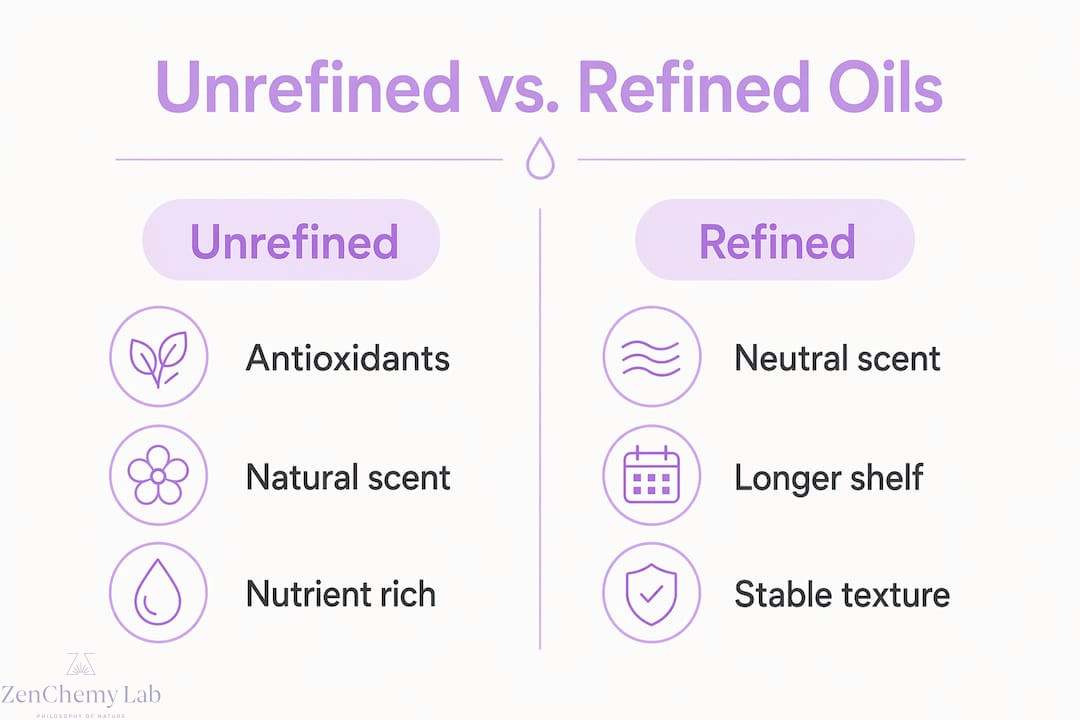
The skin benefits come from specific bioactive compounds that survive only when extraction stays gentle.
Primary actives and their skin functions:
- Polyphenols (oleuropein, hydroxytyrosol, resveratrol): potent antioxidants that reduce oxidative stress and calm inflammation
- Tocopherols (vitamin E): protect cell membranes from lipid peroxidation; support the skin’s vitamin E oil antioxidant network
- Phytosterols: structurally similar to cholesterol; reinforce the skin barrier and reduce transepidermal water loss (TEWL)
- Intact polyunsaturated fatty acids (PUFAs): linoleic and alpha-linolenic acids support barrier lipid synthesis
Research on virgin olive oil from the PREDIMED trial found that a Mediterranean diet supplemented with extra-virgin olive oil reduced major cardiovascular events by roughly 30% compared with a control diet — benefits attributed to its polyphenol content. A PMC umbrella review confirms that only virgin olive oil, enriched with higher polyphenol concentrations, shows antioxidant and anti-inflammatory effects beyond what refined versions deliver. Polyphenols are also mechanistically linked to neuroprotective effects and microbiome diversity — a benefit entirely separate from fatty-acid profile.
| Compound | Lost in refining? | Skin-relevant function |
|---|---|---|
| Polyphenols | significant reduction | Antioxidant, anti-inflammatory |
| Tocopherols (vitamin E) | Significant reduction | Lipid-peroxidation protection |
| Phytosterols | Partially removed | Barrier reinforcement, TEWL reduction |
| Natural fatty acids | Structure altered by heat | Barrier lipid synthesis |
Alex at Zenchemylab notes that when you work with genuinely cold-pressed oils in formulation, the colour, scent, and skin feel are noticeably different — and those sensory cues are direct evidence that the bioactives are still present.
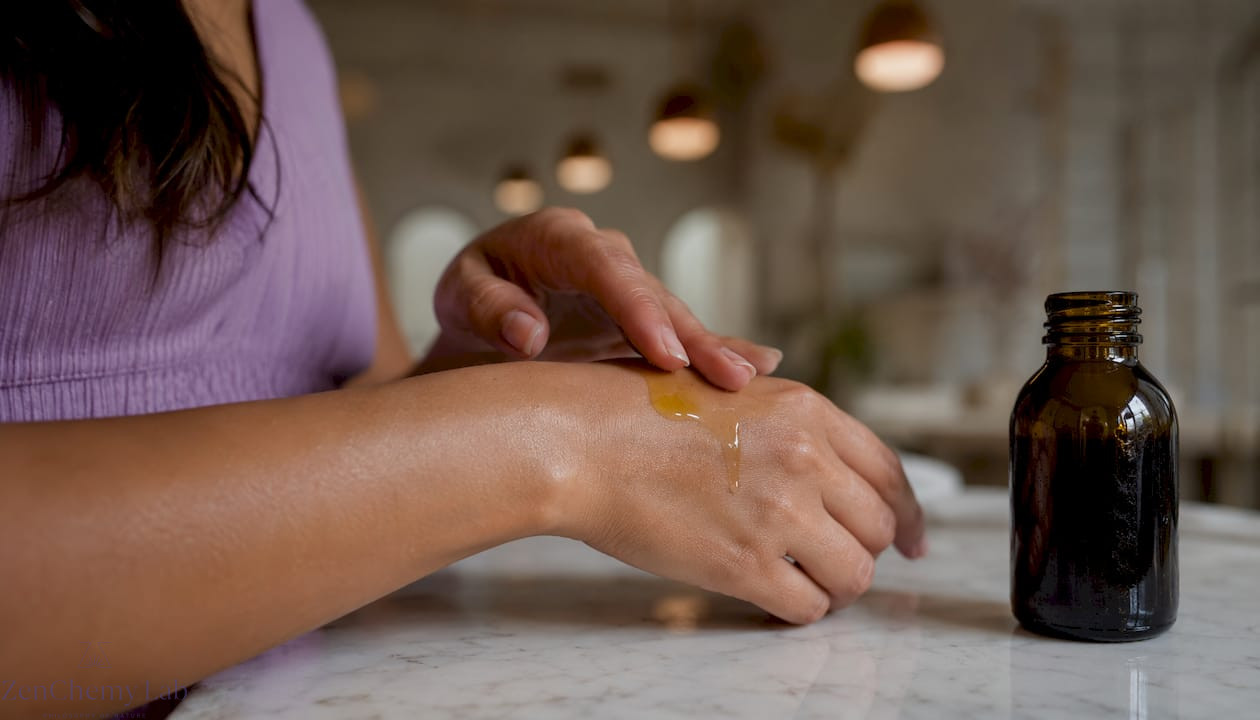
How artisan formulators use unrefined oils in skincare products
Unrefined oils earn their place in artisanal formulations precisely because of what they bring beyond basic emolliency.
Product types where they shine:
- Face oils and finishing serums: a few drops of rosehip or argan oil applied after a water-based serum delivers antioxidants and barrier lipids without occlusion
- Facial balms: avocado oil’s high monounsaturate content makes it ideal for rich, nourishing balms for dry or mature skin
- Cold-process soaps: unrefined oils contribute glycerine, vitamins, and natural scent during saponification
- Body oils and massage oils: jojoba and avocado oils provide slip and deep nourishment without a greasy finish
Matching oils to skin types and concerns:
| Oil | Best for | Key benefit |
|---|---|---|
| Rosehip oil | Ageing, hyperpigmentation, dry skin | High in linoleic acid and beta-carotene |
| Argan oil | All skin types, especially oily-combination | Lightweight, rich in tocopherols |
| Jojoba oil | Sensitive, acne-prone, oily skin | Wax ester structure mimics sebum |
| Raspberry seed oil | Sun-sensitive, inflamed skin | High antioxidant load, omega-3 rich |
| Avocado oil | Dry, mature, eczema-prone skin | Deeply penetrating, high in oleic acid |
You can explore Zenchemylab’s argan oil and dry rose oil collections to see how these are used in finished formulations.
Pro Tip: When layering unrefined oils with active ingredients like niacinamide or vitamin C, apply the water-based active first and let it absorb fully before adding the oil. Mixing them directly can dilute actives and reduce efficacy.
How to choose high-quality unrefined oils: what labels and sourcing actually tell you
A “cold-pressed” label is a starting point, not a guarantee. Quality depends on what happened before and after pressing.
Checklist for evaluating oil quality:
- ✅ Extraction method stated (cold-pressed, expeller-pressed, wood-pressed)
- ✅ Origin of seed or fruit listed (country, region, or farm)
- ✅ Harvest or press date visible (not just a best-before date)
- ✅ Packaged in dark glass (amber or violet) to block UV oxidation
- ✅ Lab certificate available for polyphenol content or absence of solvent residues
Independent lab testing is one of the most meaningful differentiators — many brands market polyphenol benefits without publishing the data to back it up.
On sourcing and sustainability: small-batch pressing from traceable, ethically sourced seeds or fruits typically yields higher polyphenol content because the raw material is fresher and handled with more care. Ethical palm and seed sourcing also matters for environmental impact — look for certified sustainable supply chains and biodegradable packaging. The higher price of genuinely unrefined oils reflects real production costs, not just positioning.
How long do unrefined oils last, and how should you store them?
Because unrefined oils retain volatile compounds, they are more susceptible to oxidation than their refined counterparts. Keeping them cool and dark and using them within months of opening is the single most important step to preserve both their skin benefits and safety.
Storage rules:
- ️ Store in a cool, dark location away from heat sources and direct sunlight
- Use dark-coloured glass containers; avoid clear plastic, which allows UV penetration
- ❄️ Refrigerate volatile-seed oils (rosehip, raspberry seed, flaxseed) after opening
- Keep lids tightly sealed between uses to minimise air exposure
Signs an oil has oxidised: a sharp, crayon-like, or rancid smell; increased bitterness on the skin; cloudiness that was not present when fresh; or unexpected skin irritation after application. If you notice any of these, discard the oil — rancid lipids can trigger inflammation rather than soothe it.
Write the press or harvest date on the bottle when you receive it. Delicate seed oils like rosehip typically last 6–12 months opened; more stable oils like jojoba can last considerably longer.
Cautions: allergies, comedogenicity, and when not to use unrefined oils
Unrefined oils are powerful ingredients, and that means using them thoughtfully.
Allergy and sensitivity guidance:
- Always perform a patch test: apply a small amount to the inner forearm and wait 24–48 hours before full use
- Nut and seed allergies are relevant — those with tree-nut allergies should approach argan oil cautiously; sesame-sensitive individuals should avoid sesame-based oils
- Redness, itching, or swelling after a patch test means stop use immediately
Comedogenicity by skin type:
- Oily or acne-prone skin: choose jojoba (comedogenic rating 2) or rosehip (rating 1); avoid coconut oil (rating 4) and avocado oil (rating 3) on the face
- Dry or mature skin: avocado and argan oils are well-tolerated and deeply nourishing
- Sensitive or reactive skin: raspberry seed oil and jojoba are among the gentlest options
Interactions and situations to avoid:
- Do not apply unrefined oils immediately before or after strong chemical exfoliants (AHAs, BHAs) — the oil can act as a barrier that reduces exfoliant penetration or traps irritation
- Use caution when layering with retinoids; introduce oils gradually and monitor for sensitivity
- Unrefined cosmetic oils are not food-grade cooking oils — never use them for cooking. Flaxseed oil, for example, has a smoke point of roughly 107°C, making it entirely unsuitable for heat applications
- “Unrefined” does not equal universally healthy: coconut and red palm oils remain high in saturated fatty acids regardless of processing
Unrefined vs. refined oils: a practical comparison
| Dimension | Unrefined oils | Refined oils |
|---|---|---|
| Best for (skin concern) | Antioxidant protection, barrier repair, sensitive/dry skin | Neutral emolliency, high-heat formulations |
| Typical uses | Face oils, serums, balms, cold-process soaps, finishing body oils | Mass-market lotions, high-heat cooking, long-shelf products |
| Texture / absorption / scent | Richer texture, natural aroma, varies by oil | Lighter, odourless, consistent |
| Shelf life / oxidation risk | Shorter shelf life; higher oxidation risk | Longer shelf life; lower oxidation risk |
| Price / positioning | Higher cost; special-use, finishing ingredient | Lower cost; general-purpose |
Refined oils are the better choice when shelf stability is the priority, when a neutral scent is required, or when the formulation involves heat. Unrefined oils earn their premium when nutrient delivery and sensory experience are the goal.
How to add unrefined oils to your skincare routine
- Patch test first — apply to the inner forearm, wait 24–48 hours, confirm no reaction
- Cleanse and tone — start with a clean, slightly damp face to improve absorption
- Apply water-based serums — let them absorb fully (60–90 seconds)
- Add your unrefined oil — 2–4 drops warmed between palms, pressed gently into skin
- Seal with an occlusive if needed — a balm or cream locks in the oil layer for very dry skin
Routine tips by skin type:
- Dry skin: use avocado or rosehip oil morning and evening; layer under a moisturiser
- Oily or combination skin: jojoba or argan oil in the evening only; skip the occlusive
- Sensitised skin: raspberry seed oil every other evening; introduce slowly and monitor
Seasonal adjustment matters too. In Canadian winters, barrier-supportive oils like avocado become especially valuable as indoor heating depletes skin moisture. In summer, lighter options like argan or jojoba work well without feeling heavy. For a full routine framework, Zenchemylab’s natural skincare routine guide walks through layering order in detail.
Key takeaways
Unrefined oils are worth choosing for artisanal skincare because they retain the polyphenols, tocopherols, and phytosterols that refining removes — compounds that deliver real antioxidant and barrier-support benefits to the skin.
| Point | Details |
|---|---|
| Nutrient retention | Refining can substantially reduce polyphenol content; cold-pressing preserves these bioactives. |
| Special-use positioning | Treat unrefined oils as high-quality finishing ingredients, not universal replacements for all oils. |
| Storage matters | Keep in dark glass, cool and dark; refrigerate volatile-seed oils and use within months of opening. |
| Selection cues | Look for extraction method, origin, press date, dark packaging, and available lab certificates. |
| Zenchemylab | Zenchemylab’s face oils, body oils, and massage oils use unrefined ingredients with transparent sourcing. |
The case for being selective, not evangelical
There is a tendency in natural skincare circles to treat “unrefined” as an unconditional virtue. It is not. Jojoba oil is technically a wax ester, not a triglyceride, and its stability has nothing to do with polyphenol content. Coconut oil is unrefined and still a poor choice for acne-prone skin. Raspberry seed oil is extraordinary for antioxidant load but goes rancid quickly enough that a poorly stored bottle does more harm than good.
What actually matters is matching the right oil to the right application, storing it properly, and buying from a source that can prove what is in the bottle. The “cold-pressed” label is only as meaningful as the transparency behind it. When a brand publishes lab data on polyphenol and tocopherol content, that is the signal worth paying attention to — not the font on the packaging.
Unrefined oils used well, in the right formulation, for the right skin type, are genuinely special ingredients. Used carelessly, they are expensive bottles going rancid in a bathroom cabinet.
Zenchemylab’s unrefined oil products are worth exploring
If you have read this far, you already know what to look for. Zenchemylab formulates its face oils, body care, and massage oils with unrefined ingredients and ingredient transparency as a baseline, not a selling point. Every product page lists the key botanicals so you can evaluate what you are actually applying to your skin.

For a broader look at how these ingredients fit into a science-backed routine, the natural beauty tips guide is a practical next step. Browse the natural skin archive to find products that match your skin type and concerns, and check individual product pages for ingredient sourcing details. If you are curious about complementary textures, whipped body butters pair well with finishing oils for a complete body-care routine.
This article is general information, not medical or dermatological advice. Confirm ingredient suitability for your specific skin concerns with a qualified professional.
Useful sources
- Health Effects of Various Edible Vegetable Oil: An Umbrella Review (PMC) — peer-reviewed synthesis distinguishing virgin from refined oils and their distinct health effects
- Health Outcomes Associated with Olive Oil Intake: An Umbrella Review (PMC) — comprehensive meta-analysis of olive oil’s cardiovascular, metabolic, and anti-inflammatory benefits
- Only virgin olive oil reduces mortality risk — European Journal of Clinical Nutrition — PREDIMED-linked cohort data on polyphenol-rich virgin oils
- Is unrefined better than refined? It depends — Science Insights — balanced explainer on refining trade-offs, solvent residues, and storage needs
- Cold-pressed oil: the science — Kaizer — covers polyphenol and tocopherol losses during refining and the value of lab transparency
- Virgin vs. refined olive oil and gut-brain health — Medical News Today — explains polyphenol links to microbiome diversity and neuroprotection
- Healthful Fats: The Skinny on Unrefined Plant Oils — Today’s Dietitian — registered dietitian guidance on special-use positioning, smoke points, and lipid profiles
- What are Cold Pressed Oils? — Sharon Palmer, The Plant-Powered Dietitian — practical overview of extraction methods, avocado oil, and culinary versus topical use


1 Comments
ug88login
Logging in here is always a smooth and secure experience thanks to their updated safety protocols. I can access all my favorite products without waiting in long queues and the dashboard keeps my stats organized. The support team is responsive and handles account verification quickly. I recommend this to friends who want a trustworthy seller