

TL;DR:
- Proper skin pH regulation is crucial for maintaining barrier integrity, enzyme activity, and microbial balance. Disrupting this acidity through inappropriate products can weaken the skin and impair active ingredient performance. Supporting a balanced pH with gentle, compatible products helps sustain healthy, resilient skin.
The role of pH in skin care is the regulation of your skin’s acidity, which controls barrier integrity, enzyme function, microbial balance, and how well your active ingredients actually work. Skin is not a passive surface. It maintains a precise chemical environment, and when that environment shifts, everything from moisture retention to breakout frequency changes with it. Dr. Ginni Mansberg, writing in Aesthetic Medicine, confirms that skin’s natural acidity is not incidental. It is structurally necessary for the skin to function at all.
What is the role of pH in skin care and why does it matter?
Healthy adult facial skin sits at a pH of approximately 4.5–5.5. That slightly acidic range is not arbitrary. It is the precise environment your skin needs to carry out four simultaneous biological jobs: building the barrier, running enzyme reactions, managing its microbial community, and controlling inflammation.
The structure responsible for this is called the acid mantle, a thin film of sebum, sweat, and amino acids that coats the surface of the stratum corneum. Think of it as the mortar in the brick-and-mortar structure of your skin barrier. Without it, the bricks (your skin cells) lose cohesion, and moisture escapes while irritants get in.
The acid mantle is not a single layer. Research from Creative Touch shows it consists of three functional pH zones across the stratum corneum, each maintained by proton pumps, fatty acid production, and continuous biological processes. This gradient matters because different functions happen at different depths.
Here is what that slightly acidic pH range actively supports:
- ✅ Ceramide processing: Enzymes that synthesise ceramides (the lipids that hold your barrier together) require an acidic environment to activate. Raise the pH and ceramide production slows.
- ✅ Cell turnover: Serine proteases, the enzymes that shed dead skin cells in an orderly way, are pH-dependent. Alkaline conditions cause irregular desquamation.
- ✅ Microbiome balance: Beneficial bacteria like Lactobacillus thrive in acidic conditions. Pathogens like Staphylococcus aureus, linked to eczema and acne, prefer a more neutral or alkaline environment.
- ✅ Inflammation control: An acidic pH suppresses certain inflammatory pathways. Disruption of this environment is associated with increased skin reactivity and sensitisation.
Your skin’s microbiome balance depends directly on this acidic foundation. When pH drifts upward, the ecosystem shifts, and the downstream effects show up as dryness, redness, or persistent breakouts.
How does skincare product pH affect ingredient performance?
Product pH is one of the most underestimated factors in a skincare routine. The pH of a cleanser, serum, or exfoliant determines not just how your skin feels after use, but whether the active ingredients in that product actually do anything.

The clearest example is vitamin C. L-ascorbic acid, the most bioavailable form of vitamin C, is most stable and effective at a pH of approximately 2.5–3.5. Above pH 3.5, oxidation accelerates rapidly. A vitamin C serum that has turned orange is not just aesthetically off-putting. It has lost its potency and may even cause irritation. This is why the pH of the formula matters more than the percentage on the label.
The same principle applies to AHAs (alpha hydroxy acids) like glycolic acid and lactic acid, and BHAs (beta hydroxy acids) like salicylic acid. These chemical exfoliants require a low pH to remain in their active, free-acid form. At higher pH, they convert to their salt form and lose their ability to penetrate and exfoliate.
| Active Ingredient | Optimal pH Range | What Happens Outside This Range |
|---|---|---|
| L-ascorbic acid (Vitamin C) | 2.5–3.5 | Oxidises rapidly, loses efficacy, may irritate |
| AHAs (glycolic, lactic acid) | 3.0–4.0 | Convert to inactive salt form, no exfoliation |
| BHAs (salicylic acid) | 3.0–4.0 | Reduced penetration and exfoliant activity |
| Niacinamide | 5.0–7.0 | Stable across a wider range, less pH-sensitive |
| Retinoids | 4.5–6.5 | Degrade in highly acidic or alkaline conditions |
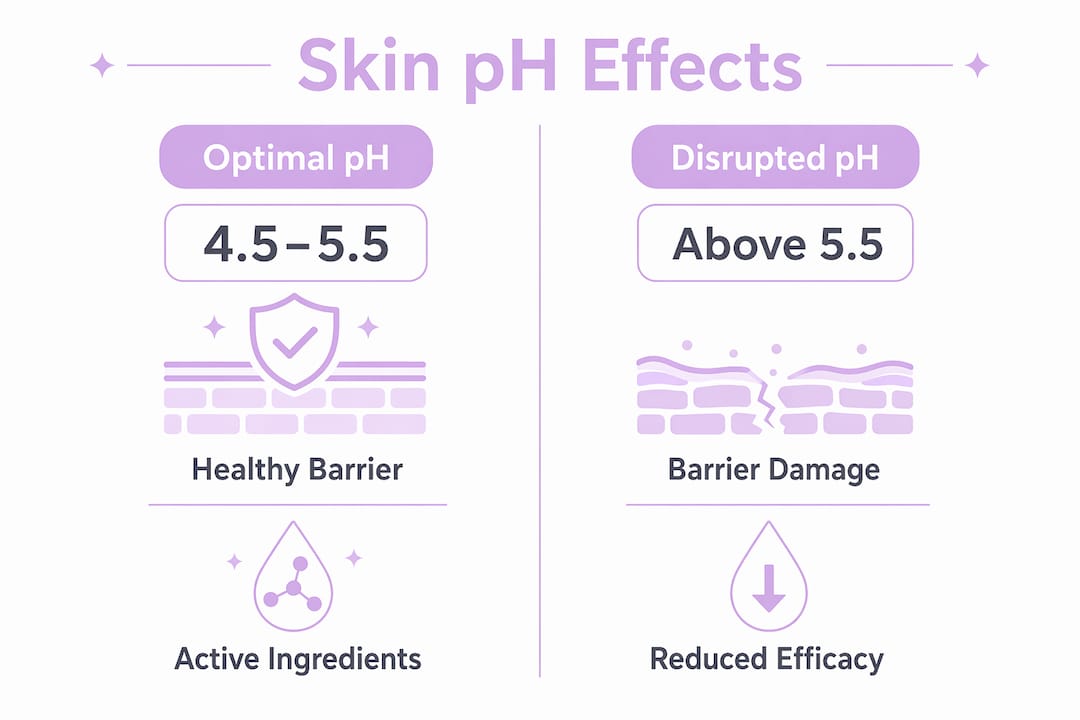
Formulation pH can affect ingredient stability and skin penetration more than concentration alone. A lower-percentage active at the correct pH often outperforms a higher-percentage product at an unsuitable pH. This is a critical insight for anyone building a results-focused routine.
Pro Tip: Check the pH of your vitamin C serum with inexpensive pH strips. A reading above 3.5 means the formula is likely already oxidised or poorly formulated. Look for serums with a pH clearly stated by the brand.
What are the risks of disrupting your skin’s natural pH?
Disrupting the skin’s pH balance does not produce subtle results. The effects are measurable, cumulative, and sometimes difficult to reverse without a deliberate recovery period.
On the alkaline side, high-pH cleansers at pH 9 and above strip the acid mantle, increase transepidermal water loss (TEWL), and leave the barrier compromised. Many traditional bar soaps fall into this category. After washing with them, your skin may feel “squeaky clean,” but that sensation is actually a sign of barrier disruption, not cleanliness.
On the acidic side, overusing low-pH exfoliants or strong chemical peels causes a different kind of damage. Repeated excessive acid exposure weakens the barrier, increases redness, and creates a cycle of sensitivity and dehydration. More acid does not mean better results. It means faster barrier breakdown.
The risks of pH disruption include:
- Increased TEWL: When the barrier weakens, your skin loses water faster. This shows up as tightness, flaking, and a dull complexion.
- Pathogen overgrowth: A more alkaline environment favours Staphylococcus aureus and Cutibacterium acnes, both linked to inflammatory skin conditions.
- Ceramide depletion: Without the right pH, ceramide-processing enzymes slow down. The barrier thins over time.
- Sensitisation: Persistent pH disruption from alkaline products, hard water, or inflammation causes coordinated failure of acid-dependent biological functions, including ceramide processing, desquamation, and antimicrobial defence.
Recovery from pH disruption requires stepping back from actives and focusing on barrier-supportive ingredients. Ceramides, fatty acids, cholesterol, and humectants like hyaluronic acid help rebuild the barrier. Give your skin at least two to four weeks of gentle, pH-compatible products before reintroducing exfoliants.
Pro Tip: If your skin feels reactive after a new product, check its pH before assuming you have a sensitivity to an ingredient. A mismatch in pH is often the actual culprit.
How to maintain optimal skin pH in your daily routine
Maintaining your skin’s natural acidity does not require a complicated protocol. It requires consistent, informed product choices and a few practical habits.
-
Choose a pH-balanced cleanser. Look for cleansers with a pH between 4.5 and 6.5. Gel cleansers and micellar waters typically fall in this range. Traditional bar soaps often do not. If you are unsure about your current cleanser, pH strips cost very little and give you a clear answer. You can also explore pH levels in handmade soap to understand how artisanal formulations compare.
-
Be mindful of water quality. Hard water has a higher pH and leaves a mineral film on skin that raises surface acidity. If you live in a hard water area, a gentle, slightly acidic toner after cleansing helps restore the acid mantle.
-
Layer actives in pH order. Apply your lowest-pH products first (vitamin C serums, AHAs, BHAs), then wait 20–30 minutes before applying higher-pH products like niacinamide or moisturisers. Mixing incompatible pH levels in quick succession neutralises actives and reduces their effectiveness.
-
Support the acid mantle from within. Omega-3 fatty acids support lipid production in the skin, which contributes to the fatty acid component of the acid mantle. Foods rich in omega-3s, such as salmon, flaxseed, and walnuts, support the skin’s ability to maintain its own pH gradient.
-
Choose leave-on products with compatible pH. Moisturisers, serums, and treatments that sit on your skin for hours have a greater cumulative effect on your skin’s pH than rinse-off products. Prioritise formulations in the 4.5–6.5 range for leave-on products. Selecting pure skincare ingredients with pH compatibility in mind makes a measurable difference over time.
-
Avoid over-exfoliating. Two to three times per week is sufficient for most skin types using AHAs or BHAs. Daily use of low-pH exfoliants is one of the fastest ways to compromise the barrier and trigger a cycle of sensitivity.
Key takeaways
Skin pH balance is the single most important factor determining whether your barrier holds, your actives work, and your microbiome stays healthy.
| Point | Details |
|---|---|
| Ideal skin pH is 4.5–5.5 | This slightly acidic range supports ceramide production, enzyme activity, and microbial balance. |
| Product pH determines active efficacy | Vitamin C, AHAs, and BHAs only perform at specific pH levels; formulation matters more than concentration. |
| Alkaline cleansers disrupt the barrier | Cleansers at pH 9 and above increase TEWL and strip the acid mantle, causing dryness and sensitivity. |
| Over-exfoliation damages the barrier | Repeated low-pH acid exposure weakens skin, causing redness, dehydration, and sensitisation over time. |
| Recovery requires barrier-focused care | After pH disruption, ceramides, fatty acids, and gentle pH-compatible products restore barrier function. |
Why pH is the skincare variable most people ignore
I have spoken with a lot of skincare enthusiasts who have spent real money on high-percentage actives, only to wonder why their skin looks worse after six weeks than it did before. Nine times out of ten, the issue is not the ingredient. It is the pH.
The skincare industry does a poor job of communicating this. Labels list percentages because percentages sound impressive. A 20% vitamin C serum sounds stronger than a 10% one. But if the 20% formula is oxidised or formulated at the wrong pH, it is doing nothing except irritating your skin. The 10% formula at pH 3.0, properly stabilised, will outperform it every time.
What I find most interesting is that pH is not a static property of your skin. It changes with age (skin becomes less acidic as we get older), with the seasons, with hormonal shifts, and with every product you apply. Treating pH as a single fixed number misses the point. Your routine needs to support your skin’s ability to maintain its own acidity, not just match a number on a chart.
The most common mistake I see is combining a high-pH cleanser with a low-pH exfoliant and expecting the exfoliant to work. The cleanser raises the pH, the exfoliant tries to lower it, and the skin spends the whole time compensating rather than benefiting. Sequence and compatibility matter as much as the products themselves.
Start with your cleanser. If it is alkaline, everything downstream is compromised before you even begin.
— Alex
Zenchemylab’s pH-Conscious natural skincare collection
At Zenchemylab, every formulation starts with the question: will this support or disrupt the skin’s natural acidity?

Our natural skin collection is built around botanicals and artisanal processes that respect the skin’s pH range. From our handcrafted cleansing bars to our botanical serums, each product is formulated to work with your acid mantle, not against it. If you are ready to build a routine that supports your barrier from the first cleanse to the last step, explore our natural skincare routine tips and find the products that fit your skin’s actual needs.
FAQ
What is the ideal pH for healthy skin?
Healthy adult facial skin has a pH of approximately 4.5–5.5. This slightly acidic range supports barrier function, enzyme activity, and a balanced skin microbiome.
Why does cleanser pH matter so much?
High-pH cleansers at pH 9 and above strip the acid mantle and increase transepidermal water loss. This leaves the barrier weakened and skin prone to dryness and irritation.
What pH should a vitamin c serum be?
L-ascorbic acid is most stable and effective at pH 2.5–3.5. Above pH 3.5, it oxidises rapidly and loses potency, which is why a serum turning orange signals it is no longer working.
Can you use ahas and niacinamide together?
You can, but not simultaneously. AHAs require a pH of 3.0–4.0 to remain active, while niacinamide works best at pH 5.0–7.0. Apply your AHA first, wait 20–30 minutes, then apply niacinamide to avoid neutralising the acid and reducing its effectiveness.
How do you restore skin pH after barrier disruption?
Step back from all low-pH actives and focus on ceramides, fatty acids, and humectants for two to four weeks. Barrier-supportive skincare with compatible pH allows the acid mantle to rebuild and enzyme activity to normalise.


2 Comments