TL;DR:
- Maintaining a skin pH of 4.5 to 5.5 is essential for preserving the skin’s barrier, microbiome, and enzymatic functions. Most cleansers disrupt this balance, especially alkaline soaps at pH 9–10, which increase water loss and microbial imbalance. Using buffered, pH-balanced products supports skin health and enhances the effectiveness of active ingredients in your routine.
pH-balanced skincare is defined as the practice of using products formulated to maintain your skin’s natural acidic environment, typically within a pH range of 4.5–5.5, to preserve barrier function, enzymatic activity, and microbial balance. This is not a marketing phrase. It is a biological requirement. When your cleanser, toner, or moisturiser works within this range, your skin can do its job. When it does not, you pay the price in dryness, redness, and sensitivity. Products like Eucerin pH5 Wash Lotion have built their entire formulation philosophy around this principle, and the science behind them is more compelling than most labels suggest.
Explaining pH balanced skincare: the biology behind it

Your skin is not a passive surface. It is a living system that depends on acidity to function correctly. The outermost layer, the stratum corneum, maintains what scientists call the acid mantle. This is not a single uniform pH level. The acid mantle is a pH gradient with three distinct zones within the stratum corneum, each maintained by a combination of organic acids, the sodium-hydrogen exchanger NHE1 pump, and fatty acids. Disrupting one zone affects all of them at once.
Here is why that matters at a cellular level:
- ✅ Enzymatic balance: Healthy skin pH supports the enzymatic activity needed for ceramide production, which is critical for barrier lipids. Raise the pH and ceramide synthesis drops.
- ✅ Serine protease control: Low pH suppresses serine proteases, enzymes that cause inflammation when overactive. An alkaline environment lets them run unchecked.
- ✅ Microbial stability: The acidic surface favours beneficial bacteria like Lactobacillus and discourages pathogens like Staphylococcus aureus, which thrives at higher pH.
- ✅ Exfoliation regulation: pH directly governs the enzymes that shed dead skin cells in an orderly way.
The most significant 2026 finding in this space comes from a PNAS study identifying the proton-activated chloride channel PACC1 as a key acid sensor in the skin. PACC1 links epidermal acidification to the upregulation of kallikrein enzymes KLK5 and KLK7, which control desmosomal degradation and skin exfoliation via JNK/AP-1 signalling. This means pH regulation is a biological signalling system, not simply a cosmetic compatibility issue.
“pH is not just a number on a label. It is the switch that turns skin’s most critical repair and renewal processes on or off.”
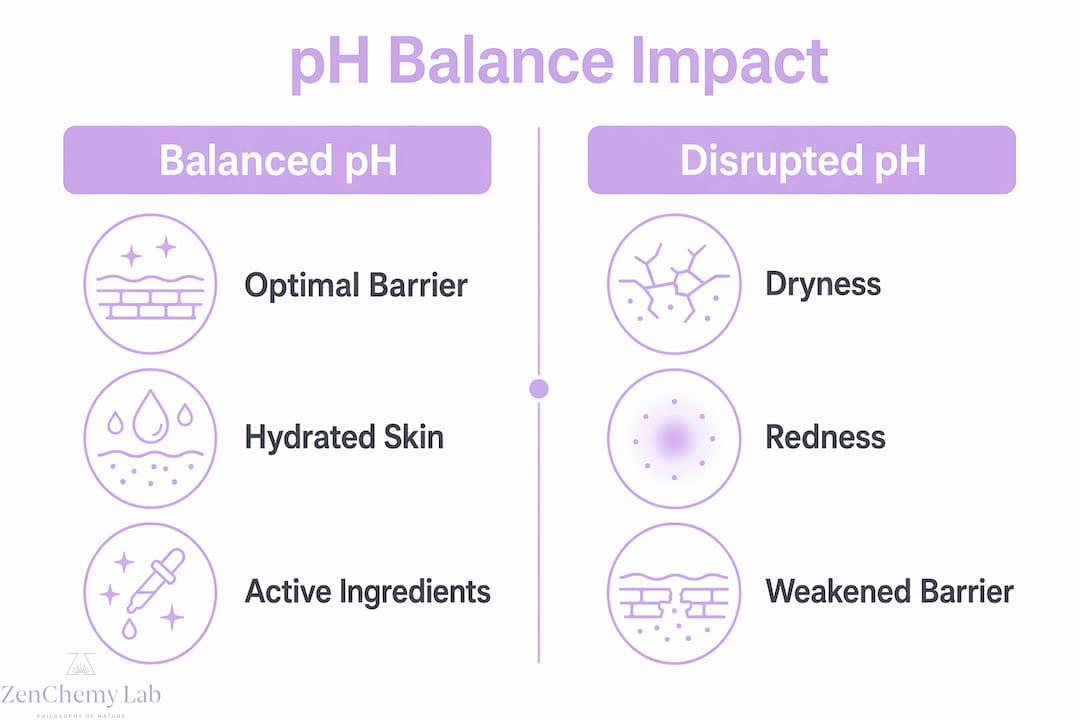
When your skin’s pH climbs above 5.5 consistently, you are not just experiencing dryness. You are disrupting a cascade of enzymatic, microbial, and structural processes simultaneously.
How do skincare products affect your skin’s pH?
The cleanser you use every morning is the single greatest pH disruptor in most people’s routines. Conventional bar soaps typically sit at a pH of 9–10. That is four to five full pH units above your skin’s natural range. Because pH is a logarithmic scale, each unit represents a tenfold difference in acidity. A pH 9 cleanser is not slightly alkaline. It is dramatically alkaline relative to your skin.
The consequences are measurable. A 15-day clinical study of the Venusia Glo face wash found a 12.3% decrease in TEWL (transepidermal water loss) when participants used a pH-balanced cleanser. Baseline TEWL dropped from 17.38 to 15.24, while skin pH held steady between 4.97 and 5.12 throughout the study. Lower TEWL means your skin is holding onto moisture more effectively. That is a direct, measurable benefit of keeping your cleanser within the physiologic pH range.
Here is how alkaline versus pH-balanced cleansers compare in practice:
| Factor | Alkaline Cleanser (pH 9–10) | pH-Balanced Cleanser (pH 4.5–5.5) |
|---|---|---|
| Acid mantle impact | Disrupts significantly | Preserves or restores |
| TEWL outcome | Increases moisture loss | Reduces moisture loss |
| Microbial balance | Favours pathogens | Supports beneficial flora |
| Skin irritation risk | Higher | Lower |
| Barrier lipid production | Reduced | Supported |
Not all products labelled “pH-balanced” are equal. The critical factor is whether the formula uses a buffering system. Unbuffered products can shift pH when diluted with water during rinsing, losing their effectiveness at the moment of skin contact. A genuinely pH-balanced cleanser uses buffering agents like citrate to maintain stable acidity throughout the entire cleansing process, not just in the bottle.
Pro Tip: Check the ingredient list for sodium citrate or citric acid alongside each other. This citrate buffering system is a reliable indicator that the formula is designed to hold its pH during water contact, not just at the point of manufacture.
How does pH affect active ingredients in your routine?
pH does not just affect your skin. It determines whether your active ingredients work at all. This is one of the most overlooked aspects of building a skincare routine.
- AHAs (alpha hydroxy acids) like glycolic and lactic acid require a pH of 3.0–4.0 to exfoliate effectively. Above pH 4.5, their free acid form converts to a salt form and loses its ability to penetrate the stratum corneum.
- BHAs (beta hydroxy acids) like salicylic acid work best at pH 3.0–4.0 as well. At higher pH, salicylic acid becomes less lipophilic and less able to penetrate pores.
- Vitamin C (L-ascorbic acid) is notoriously unstable. It requires a pH below 3.5 to remain in its active form and deliver antioxidant protection.
- Retinoids are more stable across a wider pH range but are still degraded in highly alkaline environments.
- Niacinamide is one of the few actives that performs well across a broader pH range of 5.0–7.0, making it a good pairing with barrier-supportive products.
Skincare ingredient performance depends on formulation pH, and pH extremes increase TEWL while weakening barrier integrity. This means using a high-pH cleanser before applying a vitamin C serum is counterproductive. The cleanser raises your skin’s surface pH, and the vitamin C serum cannot perform at that elevated level.
Routine sequencing matters as much as product selection. Cleansing is the pH reset point for your entire routine. Mismatched pH at the cleansing stage causes inconsistent performance from every product you apply afterward. Professionals call rapid pH swings between products “pH yo-yoing,” and it is a primary cause of unexplained sensitivity and product ineffectiveness.
Overuse of low-pH exfoliating acids is equally problematic. Daily use of pH 3.0 AHA products without recovery time weakens the barrier, causing redness, flaking, and heightened sensitivity. Your skin needs time to restore its natural pH gradient between treatments.
Pro Tip: If you use an AHA or BHA exfoliant, wait 20–30 minutes before applying your next product. This allows your skin’s pH to partially recover and reduces the risk of barrier disruption from stacking two low-pH products in rapid succession.
How to test your skin’s pH and build a balanced routine
Testing your skin’s pH at home is straightforward. Litmus paper strips designed for skin pH testing are widely available and give a reasonable approximation. For more precise readings, a digital pH metre calibrated for skin use provides accurate results. Dermatologists and aestheticians can also measure skin pH with professional-grade devices during a consultation.
Watch for these signs that your skin’s pH may be out of range:
- Persistent dryness or tightness after cleansing, which suggests the acid mantle has been disrupted
- Redness or sensitivity that appears without a clear trigger, often linked to elevated serine protease activity
- Frequent breakouts despite a consistent routine, which can indicate microbial imbalance from an alkaline surface environment
- Flaking or rough texture that does not respond to moisturiser, pointing to impaired ceramide synthesis
- Products stinging or burning on application, a sign the skin barrier is compromised
When selecting products for a pH balance skincare routine, prioritise these criteria:
- Choose cleansers with a stated pH of 4.5–5.5 or those that list citrate buffering agents
- Select toners at pH 5.0–6.0 to avoid disrupting the acid mantle after cleansing
- Use moisturisers and barrier creams at pH 5.0–6.5 to support ceramide production
- Avoid mixing strongly acidic actives (pH below 3.5) with alkaline products in the same routine step
For those interested in pH levels in handmade soap, it is worth knowing that traditionally made cold-process soaps typically sit at pH 8–10 due to saponification chemistry. Well-formulated artisanal soaps can include conditioning agents and acidic additives to bring the final pH closer to skin-friendly levels, though this requires careful formulation.
Key takeaways
Maintaining your skin’s natural pH of 4.5–5.5 is the single most effective way to protect barrier function, support active ingredient performance, and prevent chronic sensitivity.
| Point | Details |
|---|---|
| Skin pH is a biological signal | pH controls enzymatic activity, ceramide production, and microbial balance simultaneously. |
| Alkaline cleansers cause measurable harm | Conventional soaps at pH 9–10 disrupt the acid mantle and increase transepidermal water loss. |
| Buffering agents define true pH balance | Look for citrate buffering in cleansers to confirm stable pH during rinsing, not just in the bottle. |
| Active ingredients require specific pH | AHAs, BHAs, and vitamin C lose efficacy above pH 4.5, making cleanser choice critical to routine outcomes. |
| Sequencing prevents pH yo-yoing | Apply products in pH order and allow recovery time between low-pH actives to protect barrier integrity. |
Why pH literacy is the skill most skincare routines are missing
I have spent years watching people invest in high-quality serums and moisturisers, only to undermine everything with a single alkaline cleanser. The frustration is real. Products that should work, do not. Skin that should be calm, is not. And the explanation almost always comes back to pH.
What strikes me most about the 2026 PACC1 research is that it reframes pH from a cosmetic consideration into a physiological one. Your skin has a dedicated molecular sensor for acidity. That is not a minor detail. It means pH management is as fundamental to skin health as hydration or sun protection.
The consumer confusion I see most often is the assumption that “natural” automatically means pH-safe. It does not. A natural soap made through traditional saponification can sit at pH 9 or higher. A synthetic cleanser formulated with citrate buffering can preserve your acid mantle perfectly. The question is always formulation, not origin. At Zenchemylab, we take this seriously. Every product we develop starts with the question of how it will interact with your skin’s natural pH environment, because that is where real results begin.
My honest recommendation is to start with your cleanser. Fix that one product and you will likely see more improvement than from any serum you add. Simplicity and consistency, grounded in pH awareness, outperform complicated routines built on incompatible products every time. You can explore pure ingredient selection to understand how formulation choices affect your skin at a deeper level.
— Alex
Discover pH-Conscious skincare from Zenchemylab
At Zenchemylab, every formulation begins with your skin’s natural biology. We craft artisanal soaps, botanical cosmetics, and body care products with pH compatibility at the centre of our process. Our natural ingredients are selected not just for their purity, but for how they interact with your skin’s acid mantle and barrier function.

Whether you are building your first pH-aware routine or refining an existing one, our resources and natural skincare collection give you the tools to make informed choices. For a broader look at where science meets sustainability in 2026 skincare, explore our guide to natural beauty this year. Your skin deserves products that work with its biology, not against it.
FAQ
What is pH-Balanced skincare?
pH-balanced skincare refers to products formulated to maintain or support the skin’s natural acidic pH of 4.5–5.5. This range preserves the acid mantle, supports ceramide production, and keeps the skin microbiome stable.
What pH should a face cleanser be?
A face cleanser should have a pH of 4.5–5.5 to avoid disrupting the acid mantle. pH-balanced cleansers with buffering agents like citrate maintain this range even during rinsing with water.
How do i know if my skin’s pH is off?
Signs of pH imbalance include persistent dryness after cleansing, unexplained redness, frequent breakouts, and products stinging on application. These symptoms often indicate a disrupted acid mantle rather than a product allergy.
Can i use ahas and bhas every day?
Daily use of AHA or BHA exfoliants at pH 3.0–4.0 can weaken the skin barrier over time. Overuse of low-pH acids causes redness, sensitivity, and increased TEWL, so limiting use to two to three times per week with recovery days is advisable.
Does natural soap disrupt skin pH?
Traditional cold-process soap typically sits at pH 8–10 due to saponification chemistry, which is significantly above the skin’s natural range. Choosing a pH-appropriate cleanser or a specially formulated artisanal option is preferable for maintaining acid mantle integrity.