TL;DR:
- Exfoliation removes dead skin cells to support skin renewal, improve texture, and enhance product absorption.
- Using the correct method and frequency prevents barrier damage, redness, and sensitivity, optimizing skincare results.
Exfoliation is defined as the deliberate removal of dead skin cells from the outermost layer of the skin, known as the stratum corneum. The role of exfoliation in skincare is to support your skin’s natural renewal cycle, improve texture and tone, and allow moisturisers and treatment products to absorb more effectively. Your skin follows a roughly 28-day renewal cycle that slows with age, causing dead cells to accumulate in layers of 10–30 deep. Without regular exfoliation, that build-up leaves skin looking dull, feeling rough, and blocking the actives you spend money on from doing their job.
How does exfoliation improve skin health and appearance?
Exfoliation accelerates the removal of dead skin layers that pile up when your natural cell turnover slows. The result is smoother texture, more even tone, and skin that genuinely responds to the products you apply.

Cell turnover and why it matters
Your skin renews itself constantly, but the pace drops as you age. In your twenties, new cells reach the surface in roughly 28 days. By your forties, that cycle can stretch to 45 days or longer. Dead cells that linger on the surface create a physical barrier. That barrier dulls your complexion and physically blocks serums, retinols, and moisturisers from penetrating the layers where they work best.
Exfoliation improves penetration of actives and moisturisers, which means every product in your routine performs better after you exfoliate. Think of it as clearing the path before you lay down the good stuff.
Key benefits at a glance ✅
- Smoother texture: Removes rough, uneven surface cells for a noticeably softer feel
- Brighter tone: Reveals fresher skin underneath, reducing dullness and greyness
- Unclogged pores: Loosens debris and excess sebum that contribute to blackheads and breakouts
- Better product absorption: Allows serums, vitamin C, and retinol to reach deeper skin layers
- More even pigmentation: Helps fade post-acne marks and mild sun spots over time
Skin renewal cycle by age
| Age Range | Approximate Renewal Cycle | Exfoliation Need |
|---|---|---|
| Teens to mid-20s | 21–28 days | Low to moderate |
| Late 20s to 30s | 28–35 days | Moderate |
| 40s to 50s | 35–45 days | Moderate to high |
| 60 and above | 45–60+ days | Higher, but gentler methods |
The older you get, the more your skin benefits from a little help clearing the surface. The key is choosing the right method for your skin type.
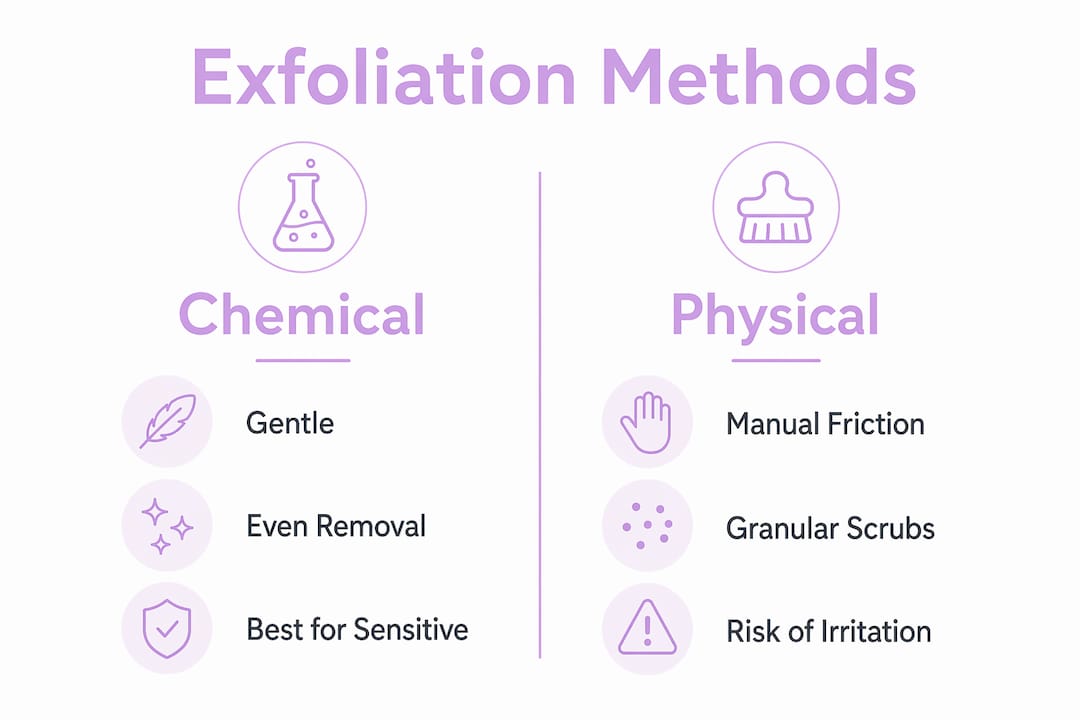
Chemical vs. physical exfoliation: which is right for you?
Two broad categories define all exfoliation techniques: physical and chemical. Each works differently, suits different skin types, and carries its own set of risks.
Physical exfoliation
Physical exfoliation uses friction to manually lift dead cells from the skin’s surface. Common tools include granular scrubs, konjac sponges, exfoliating mitts, and cleansing brushes. The appeal is immediacy. You feel the smoothness right away.
The risk is real, though. Physical scrubs can cause micro-tears and worsen inflammation, particularly for sensitive or acne-prone skin. For individuals with darker skin tones, aggressive physical scrubbing raises the risk of post-inflammatory hyperpigmentation. If you use a physical scrub, choose one with round, uniform particles rather than jagged ones, and apply it with a light hand.
Chemical exfoliation
Chemical exfoliation uses acids to dissolve the bonds holding dead cells together, allowing them to shed without friction. The two main families are:
- AHAs (alpha hydroxy acids): Glycolic acid and lactic acid work on the skin’s surface. Glycolic acid has a small molecular size that penetrates well, improving texture, tone, and product absorption. Lactic acid is gentler and adds mild hydration, making it a better fit for dry or sensitive skin.
- BHAs (beta hydroxy acids): Salicylic acid is oil-soluble, meaning it penetrates into pores to clear out sebum and debris. It is the go-to choice for oily and acne-prone skin types.
Comparison: physical vs. chemical exfoliation
| Method | Mechanism | Best For | Key Risk | Recommended Frequency |
|---|---|---|---|---|
| Physical scrub | Friction removes cells | Normal, oily skin | Micro-tears, irritation | 1–2 times per week |
| AHA (glycolic, lactic) | Dissolves cell bonds at surface | Dry, dull, ageing skin | Sun sensitivity | 2–3 times per week |
| BHA (salicylic acid) | Penetrates pores, clears sebum | Oily, acne-prone skin | Dryness if overused | 2–3 times per week |
| Enzyme exfoliants | Digest dead cell proteins | Sensitive skin | Minimal if used correctly | 1–2 times per week |
Chemical exfoliation is generally preferred for long-term use because it works more evenly and with less mechanical trauma to the skin barrier.
Pro Tip: Always apply your exfoliant to damp skin. Wet exfoliation provides better glide and significantly reduces the risk of micro-tears compared to applying a scrub on dry skin.
How often should you exfoliate, and what happens if you overdo it?
Frequency is where most people go wrong. More is not better when it comes to exfoliation.
The right frequency
Dermatologists recommend exfoliating 1–3 times per week for most skin types. That range balances effective cell removal with barrier preservation. Sensitive skin types should start at once per week and assess how their skin responds before increasing.
The consequences of over-exfoliation
Over-exfoliation causes barrier loss, increased dehydration, breakouts, and dark spots. When you strip the skin barrier too frequently, you compromise its “brick and mortar” structure. The lipid-rich mortar between skin cells breaks down, transepidermal water loss (TEWL) increases, and your skin becomes reactive, red, and prone to sensitivity.
Daily exfoliation damages the skin barrier and increases TEWL, sensitivity, and the risk of chronic inflammation. That means the very thing you are trying to improve gets worse.
Signs you are over-exfoliating
- Persistent redness or a burning sensation after applying any product
- Skin that feels tight, dry, or paper-thin
- Sudden breakouts in areas that were previously clear
- Increased sensitivity to products you have used without issue before
- Shiny, waxy-looking skin that lacks normal texture
The “skin purging” misconception
Misinterpreting redness and breakouts from over-exfoliation as skin purging is a common mistake that leads people to exfoliate even more aggressively. True purging is a short-term response to actives like retinol that accelerate cell turnover. Breakouts from over-exfoliation are a sign of barrier damage, not a phase to push through. If your skin is reacting badly, stop exfoliating for one to two weeks and focus on barrier repair with ceramide-rich moisturisers.
Pro Tip: Keep a simple skin journal for two weeks when you introduce a new exfoliant. Note texture, redness, and hydration levels after each session. Patterns become obvious quickly, and you can adjust your routine before damage sets in.
How to build exfoliation into your skincare routine
Knowing when and how to exfoliate matters as much as choosing the right product. Placement in your routine affects both safety and results.
Step-by-step placement
- Cleanse first: Always exfoliate on clean skin. Applying an exfoliant over sunscreen, makeup, or pollution residue reduces its effectiveness and can cause irritation.
- Exfoliate on damp skin: As noted above, damp skin reduces friction and improves chemical exfoliant distribution.
- Tone or treat next: If you use a toner or targeted serum, apply it after exfoliation when absorption is at its peak.
- Moisturise immediately: Hydrating with lipid-replenishing moisturisers right after exfoliation protects the barrier and offsets TEWL. Look for ingredients like ceramides, shea butter, or squalane.
- Apply SPF in the morning: Exfoliation increases your skin’s sensitivity to UV radiation. Broad-spectrum SPF 30 or higher is non-negotiable on any morning you exfoliate.
Don’t forget the body
Your face gets most of the attention, but body skin benefits just as much from regular exfoliation. Rough patches on knees, elbows, heels, and hands respond well to a consistent body scrub routine. For very rough areas like heels, a urea-based cream applied after exfoliation works well. Urea is a keratolytic, meaning it softens and loosens dead skin cells while simultaneously hydrating the area.
Pro Tip: For dry, rough body skin, apply a urea cream (10–20% concentration) immediately after exfoliating while skin is still slightly damp. The urea locks in moisture and continues softening the skin between sessions.
Explore Zenchemylab’s guide on natural skincare routines for more practical advice on building a routine that works with your skin type.
Key takeaways
Exfoliation works best when it is consistent, appropriately frequent, and followed by proper hydration and sun protection.
| Point | Details |
|---|---|
| Support cell renewal | Exfoliation assists the skin’s natural 28-day cycle, which slows significantly with age. |
| Choose the right method | Chemical exfoliants like AHAs and BHAs are gentler long-term than most physical scrubs. |
| Frequency matters | Exfoliating 1–3 times per week prevents barrier damage while delivering visible results. |
| Moisturise after every session | Applying a lipid-rich moisturiser immediately after exfoliation protects the skin barrier. |
| Exfoliation has limits | It improves texture and brightness but cannot reverse deep wrinkles or structural ageing. |
What i’ve learned after years of watching people exfoliate wrong
I’ve seen the same pattern repeat itself more times than I can count. Someone discovers exfoliation, notices a dramatic improvement in their skin within two weeks, and then doubles down. They exfoliate daily. They layer a glycolic toner over a salicylic cleanser. They wonder why their skin is suddenly red, reactive, and breaking out in places it never did before.
The honest truth is that exfoliation is one of the most misused steps in a skincare routine. It is not a treatment. It is maintenance. The benefits of exfoliation are real, but they are surface-level improvements. Brighter tone, smoother texture, better product absorption. Exfoliation cannot reverse deep wrinkles or structural signs of ageing, and treating it like a cure-all leads to barrier damage that takes weeks to repair.
What I find most useful is treating your skin’s response as data. If you exfoliate twice a week and your skin looks calm, hydrated, and clear, that frequency is working. If you notice tightness, sensitivity, or new breakouts, that is your skin telling you to pull back. Listening to your skin’s response is the most reliable guide you have.
The other thing I’d push back on is the idea that more expensive or more aggressive exfoliants produce better results. A well-formulated lactic acid at 5% used consistently twice a week will outperform a 30% glycolic peel used recklessly. Consistency and restraint beat intensity every time.
Pair exfoliation with solid foundational habits: a gentle cleanser, a barrier-supporting moisturiser, and daily SPF. Those four steps together will do more for your skin than any single product ever could.
— Alex
Discover natural skincare that works with your skin

At Zenchemylab, we believe that what you put on your skin should be as clean and thoughtful as what you put in your body. Our botanical body care products are crafted from natural, lipid-rich ingredients that support your skin barrier before and after exfoliation. Whether you are looking for a gentle scrub to complement your routine or a nourishing body butter to lock in moisture post-exfoliation, our natural beauty guides walk you through science-backed choices made from pure, sustainable ingredients. Explore our full range and find products that respect your skin’s biology while delivering real, visible results.
FAQ
What is the role of exfoliation in a skincare routine?
Exfoliation removes accumulated dead skin cells from the surface, supporting the skin’s natural renewal cycle and improving texture, tone, and the absorption of moisturisers and treatment products.
How often should you exfoliate your skin?
Most skin types benefit from exfoliating 1–3 times per week. Sensitive skin should start at once per week and increase only if the skin tolerates it well.
What is the difference between chemical and physical exfoliation?
Physical exfoliation uses friction from scrubs or tools, while chemical exfoliation uses acids like glycolic acid (AHA) or salicylic acid (BHA) to dissolve dead cell bonds. Chemical methods are generally preferred for long-term use, especially for sensitive or acne-prone skin.
What are the signs of over-exfoliation?
Signs include persistent redness, tight or paper-thin skin, increased sensitivity, new breakouts, and a shiny or waxy skin appearance. If these occur, pause exfoliation and focus on barrier repair with ceramide-rich products.
Can exfoliation reduce wrinkles and signs of ageing?
Exfoliation improves surface texture and brightness but cannot reverse deep wrinkles or structural ageing. It is a maintenance tool, not a treatment for deep skin changes.