

Avoid synthetic ingredients when they are documented sensitisers, opaque “fragrance” blends, or substances with known contaminants. That is the core rule. Three harms stand out:
- ⚠️ Allergic contact dermatitis from synthetic fragrance components and certain preservatives
- Airway irritation from volatile organic compounds (VOCs) released by synthetic fragrances
- ️ Hidden chemicals masked behind blanket label terms like “parfum” or misleading “natural” front-of-package claims
Health Canada requires all cosmetics sold in Canada to list ingredients by their INCI names on the outer label. The Cosmetic Ingredient Hotlist identifies prohibited and restricted substances. Dermatologists consistently single out fragrance as the most common cosmetic cause of allergic contact dermatitis — making it the first category worth scrutinising on any label.
Table of Contents
- How synthetic ingredients can irritate your skin and airways
- Is “natural” always safer than synthetic?
- Which synthetic ingredients are worth avoiding on labels?
- How to choose safer skincare in Canada
- What to do if you have a skin or respiratory reaction
- Gentle ingredient categories worth considering for sensitive skin
- Key takeaways
- A perspective on purity and ingredient transparency
- Fragrance-free artisanal skincare from Zenchemylab
- Authoritative sources for Canadian shoppers
How synthetic ingredients can irritate your skin and airways
Certain synthetic ingredients cause harm through two main pathways: sensitisation and VOC exposure. Sensitisation happens when repeated skin contact with a molecule triggers an immune response. Once sensitised, even tiny amounts of that ingredient can provoke a reaction. VOC exposure is a separate issue: synthetic fragrance compounds evaporate at room temperature, enter the airways, and can irritate mucous membranes, trigger headaches, or worsen asthma.
Fragrance is the single most frequent cause of allergic contact dermatitis from cosmetics, followed by preservatives and hair dyes. Scented leave-on products carry a higher risk than rinse-off ones because prolonged skin contact increases the chance of sensitisation. Younger adults and frequent users of scented products show some of the strongest associations in population studies.
Dermatologists frequently recommend avoiding synthetic fragrances as a practical first step for anyone with sensitive skin, existing dermatitis, or asthma. The reasoning is straightforward: “parfum” on a label can represent a proprietary blend of more than 3,000 possible fragrance ingredients, according to the International Fragrance Association, with no individual disclosure required under current rules.
Toxicology adds an important nuance here. Risk is not determined by whether a molecule is synthetic or natural. It depends on the specific molecule, its concentration, how often you use the product, and whether it contacts skin or is inhaled. That said, opaque blends and high-frequency leave-on use genuinely raise exposure in ways that matter for sensitive individuals.

Is “natural” always safer than synthetic?
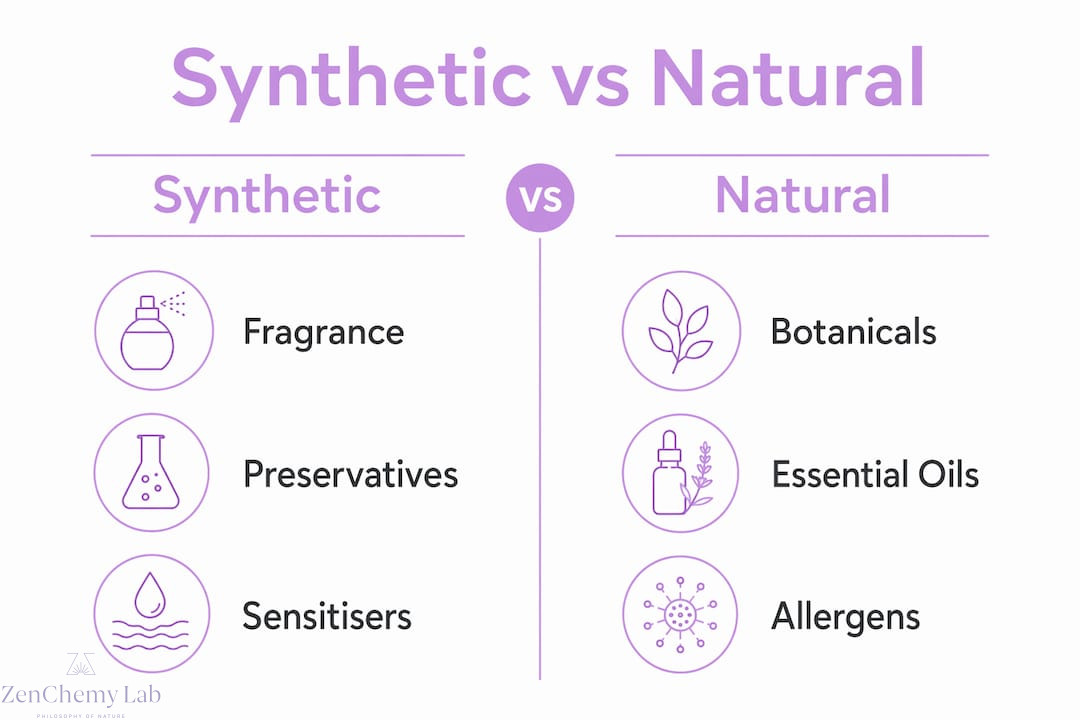
Origin alone does not determine safety. A toxicologist’s view is clear: the real risk of any ingredient is determined by its molecular properties, concentration, and frequency of exposure, not whether it came from a plant or a lab. Poison ivy is natural. So is arsenic.
Marketing terms like “natural,” “chemical-free,” and “hypoallergenic” are not legally defined in Canada in a way that guarantees fewer sensitisers. Under the Cosmetic Regulations, a manufacturer cannot make claims implying the product will not cause harm unless they hold evidence to validate that claim. “Hypoallergenic” has no standardised test behind it. Researchers advise consumers to read ingredient lists rather than rely on front-of-package marketing, because “natural” marketing does not guarantee fewer synthetics. For a deeper look at the evidence, Zenchemylab’s guide on natural vs synthetic skincare is a good next read.
Pro Tip: Flip the product over before you read the front. The INCI list on the outer label is the only legally required disclosure. If “parfum” or “fragrance” appears without further breakdown, that single term may represent dozens of undisclosed compounds.
Which synthetic ingredients are worth avoiding on labels?
The categories most often implicated in skin and respiratory reactions are synthetic fragrances, certain preservatives, some dyes, phthalates, and formaldehyde-releasing agents. Here is what to look for:
- Parfum / Fragrance — a blanket INCI term hiding complex proprietary blends; associated with contact allergy, VOC-related airway irritation, and headaches
- Methylisothiazolinone (MI) / Methylchloroisothiazolinone (MCI) — preservatives linked to allergic responses; widely restricted in leave-on products in many markets
- Phthalates (e.g., diethyl phthalate, often hidden inside “fragrance”) — associated with endocrine concerns and allergic responses
- Formaldehyde releasers (e.g., DMDM hydantoin, imidazolidinyl urea) — slowly release formaldehyde in the product, a known skin sensitiser
- Synthetic dyes (e.g., FD&C Red No. 40, D&C Yellow No. 5) — some individuals react with contact dermatitis or hives
| Ingredient category | Typical INCI label names | Common risk |
|---|---|---|
| Synthetic fragrance | Parfum, Fragrance | Contact allergy, VOC airway irritation |
| Isothiazolinone preservatives | Methylisothiazolinone, Methylchloroisothiazolinone | Allergic contact dermatitis |
| Phthalates (in fragrance) | Diethyl phthalate (DEP) | Endocrine concern, allergic response |
| Formaldehyde releasers | DMDM Hydantoin, Imidazolidinyl Urea | Skin sensitisation |
| Synthetic dyes | FD&C Red 40, D&C Yellow 5 | Contact dermatitis, hives |
Gentler alternatives include fragrance-free formulas, single-ingredient botanical extracts with documented sourcing, and preservative systems such as sodium benzoate or phenoxyethanol at low concentrations. Understanding fragrance science can also help you distinguish aesthetic scent choices from genuine health risks.
How to choose safer skincare in Canada
Prefer fragrance-free, minimal-ingredient formulas with transparent INCI labelling and documented safety testing. That preference alone eliminates most of the high-risk categories above.
Step-by-step, here is how to shop more safely:
- Read the INCI list first. Ingredients are listed in descending order of concentration. If “parfum” or “fragrance” appears high on the list, the product contains a significant amount of an undisclosed blend.
- Look up suspicious names. The Health Canada Cosmetic Ingredient Hotlist flags prohibited and restricted substances. Remember: the Hotlist is not exhaustive. Manufacturers must comply with the Food and Drugs Act even for ingredients not on the list.
- Understand label terms. “Fragrance-free” means no fragrance compounds were added. “Unscented” may still contain masking fragrances. “Natural” has no standardised legal definition in Canada. Under the Cosmetic Regulations, any claim implying the product will not cause harm requires manufacturer evidence.
- Choose shorter ingredient lists for sensitive skin. Fewer ingredients means fewer potential triggers.
- Ask artisan makers for sourcing details, batch records, and safety testing on botanical extracts.
Pro Tip: Request a trial or sample size before committing to a full product. Patch-test on your inner forearm for 24–48 hours. If redness, itching, or swelling appears, do not proceed. This one habit can save you from a full-face reaction.
For a detailed walkthrough of INCI reading, Zenchemylab’s skincare label guide covers every step.
What to do if you have a skin or respiratory reaction
Stop using the product immediately. Do not wait to see if the reaction improves on its own.
- Stop use and set the product aside without discarding it (you may need the INCI list later).
- Rinse the affected area gently with cool water for several minutes.
- Apply a cool compress to reduce redness and swelling.
- Document the product name, lot number, and full INCI list — photograph the label.
- Patch-test later with a dermatologist or allergist to identify the specific trigger.
- Contact a healthcare provider if symptoms persist beyond 48 hours or worsen after stopping use.
Seek urgent care immediately if you experience widespread hives, facial swelling, difficulty breathing, or any systemic symptoms. These may indicate anaphylaxis, which requires emergency treatment.
Do not resume using the product after partial improvement. Repeated exposure to a sensitiser deepens the immune response and can make future reactions more severe. For sensitive skin guidance, Zenchemylab’s resource on sensitive skin care offers additional context.
Gentle ingredient categories worth considering for sensitive skin
Well-studied, generally well-tolerated ingredient categories exist for nearly every skincare function. Starting here is practical.
- ✅ Glycerin — a humectant that draws moisture into the skin; well-tolerated across skin types and extensively studied
- ✅ Hyaluronic acid — another humectant; effective at low concentrations and rarely sensitising
- ✅ Niacinamide (at 2–5%) — supports the skin barrier and reduces redness; generally gentle, though very high concentrations can cause flushing
- ✅ Non-oxidised plant oils (e.g., sunflower, jojoba) — emollients that mimic the skin’s own lipids; choose cold-pressed, properly stored oils to avoid rancidity-related irritation
- ✅ Sodium benzoate / phenoxyethanol at low concentrations — preservative systems with a better tolerance profile than isothiazolinones for most people
Pro Tip: Even “natural” botanicals and essential oils can sensitise. Lavender, tea tree, and citrus oils all contain VOCs and known sensitisers. Treat them with the same scrutiny you would apply to synthetics: check the concentration, the processing method, and whether the supplier provides batch testing.
Favour brands that share stability and safety testing for their botanical extracts. Documented sourcing and batch transparency are the markers of a genuinely trustworthy formulator, whether artisanal or commercial. Zenchemylab’s natural ingredients list shows what documented sourcing looks like in practice.
Key takeaways
Avoiding synthetic ingredients is most warranted when those ingredients are known sensitisers, opaque fragrance blends, or substances with undisclosed contaminant risks — not simply because they are synthetic.
| Point | Details |
|---|---|
| Fragrance is the top risk | “Parfum” hides complex blends; it is the leading cosmetic cause of allergic contact dermatitis. |
| Origin does not equal safety | Both natural and synthetic ingredients require scrutiny based on molecule, concentration, and exposure. |
| Read the INCI list | Front-of-package claims like “natural” or “hypoallergenic” have no standardised legal definition in Canada. |
| Use Health Canada’s Hotlist | Check the Cosmetic Ingredient Hotlist for restricted substances, but note it is not an exhaustive list. |
| Zenchemylab’s approach | Zenchemylab offers fragrance-free, small-batch options with transparent INCI labelling for sensitive skin shoppers. |
This article is general information, not medical or professional advice. Consult a dermatologist or qualified healthcare provider for your specific situation, and verify current ingredient restrictions with Health Canada directly.
A perspective on purity and ingredient transparency
The conversation around synthetic ingredients in skincare often gets pulled in two directions: blanket fear of “chemicals” on one side, and dismissive reassurance that “everything is a chemical” on the other. Neither serves you well.
What actually matters is specificity. Opaque fragrance blends are a real and documented problem, not a marketing talking point. Over one million Canadians are estimated to be affected by fragrance allergens hidden behind a single label term. That is a regulatory failure as much as a formulation one, and Canada’s 2023 proposed amendments to the Cosmetic Regulations acknowledged it directly. The push to require individual disclosure of fragrance allergens on labels is overdue.
At the same time, the instinct to avoid anything synthetic and embrace anything natural can lead shoppers toward products that are just as likely to cause reactions. Undiluted essential oils, oxidised plant oils, and high-concentration botanical extracts have well-documented sensitisation profiles. The standard should be transparency and evidence, not origin.
Zenchemylab’s commitment to fragrance-free formulations, documented INCI lists, and small-batch sourcing reflects exactly that standard. It is not about avoiding all synthetics categorically. It is about knowing what is in your product, at what concentration, and why it is there.
Fragrance-free artisanal skincare from Zenchemylab
If you have been reading ingredient labels and finding more questions than answers, Zenchemylab’s botanical body care collection is a practical place to start. Every product is formulated without synthetic fragrance, with full INCI transparency and small-batch traceability.

For readers who want to go further, the top botanical cosmetics guide walks through curated options for sensitive skin, with ingredient notes and sourcing context for each. Trial sizes are available so you can patch-test before committing. Browse the collection and reach out directly if you have questions about a specific formulation or ingredient.
Authoritative sources for Canadian shoppers
| Source | What it covers | Why it matters |
|---|---|---|
| Health Canada — Cosmetic Ingredient Hotlist | Prohibited and restricted cosmetic ingredients | First stop for checking whether a specific ingredient is flagged in Canada |
| Cosmetic Regulations (C.R.C., c. 869) | Full text of labelling and claims rules | Confirms what manufacturers must disclose and what claims require evidence |
| Health Canada — Cosmetic Advertising & Labelling | INCI labelling requirements and claim guidance | Explains what “natural” and “hypoallergenic” legally mean (and do not mean) |
| Canada Gazette — Fragrance Allergen Disclosure Proposal | Proposed amendments requiring fragrance allergen labelling | Background on the regulatory gap around “parfum” and the push for transparency |
| Healthline — What is fragrance? | Consumer-facing review of fragrance risks and VOCs | Accessible summary of dermatology and toxicology findings on fragrance |
| MSU — Synthetic vs natural chemical ingredients | Toxicologist perspective on risk and origin | Corrects the natural-equals-safe misconception with evidence |


2 Comments