Castile soap is a plant-oil, biodegradable soap that is generally gentle, versatile, and eco-friendly once you dilute it properly. It handles body wash, hair care, and most household cleaning jobs from one concentrated bottle. The catch: it’s naturally alkaline, so it needs the right water ratio and a patch test before it earns a permanent spot in your routine.
TL;DR:
- Proper dilution is essential, with one to two teaspoons per 250 mL of water for face and one tablespoon for body, to prevent dryness or irritation.
- Using saturated concentrations or skipping rinses in hard water can lead to soap scum, residue, and skin dryness issues.
- Scented versions with essential oils may cause irritation, especially in sensitive or intimate areas, so fragrance-free formulas are safer.
- Castile soap is not antibacterial and does not disinfect, so it is unsuitable for replacing chemical disinfectants like bleach.
- Olive oil-based formulas offer conditioning benefits, but excessive coconut oil can cause dryness, making oil balance a key formulation factor.
Table of Contents
- What is castile soap, and why does its oil base matter?
- What are the main castile soap benefits?
- How do you use castile soap on skin, hair, and sensitive areas?
- How does castile soap perform for household cleaning, laundry, and pets?
- What are the downsides and risks of castile soap?
- How do you dilute and use castile soap safely?
- Why formulation choices behind the soap actually matter
- What the research actually supports (and what marketing overstates)
- Choosing the right castile-style soap for your routine
- Sources
- FAQ
What is castile soap, and why does its oil base matter?
Castile soap is true soap, made through saponification, when a fatty oil reacts with an alkali to form a cleansing bar or liquid. The name traces back to olive oil soaps historically produced in Castile, Spain, though most modern versions blend several vegetable oils.
You’ll find it in two forms: liquid, diluted for pumps and spray bottles, and bar, firmer and better suited to daily hand or body washing. The oil blend shapes performance. Olive oil brings conditioning and a mild, low-lather feel, while coconut oil adds bubbles but can dry out skin if it dominates the formula, according to soap-making analysis from Bearsville Soap Company. That’s a different chemistry than synthetic detergents, which strip oil more aggressively to boost foam. Real soap tends to leave more of your skin’s natural lipids intact.
What are the main castile soap benefits?
The appeal comes down to four practical wins that show up across skin care, hair care, and the cleaning cupboard.
- Gentle on sensitive skin when diluted. Fewer additives than detergent-based cleansers means less potential for irritation, a point dermatology sources at Cleveland Clinic emphasize repeatedly.
- Biodegradable and vegan. It breaks down without leaving synthetic residue behind, which is why refill programs and concentrate formats keep gaining traction according to The Spruce’s household guidance.
- Cost-effective by design. A little goes a long way since it’s sold concentrated, so one bottle stretches across weeks of body wash, dish duty, and floor cleaning.
- Genuinely multipurpose. The same base product covers face, body, hair, laundry boosts, and multi-surface cleaning with different dilution ratios.
That range is exactly why so many households replace three or four single-use cleaners with one bottle.
How do you use castile soap on skin, hair, and sensitive areas?
Your face, body, scalp, and intimate skin each want a different concentration, and getting that wrong is where most complaints start.
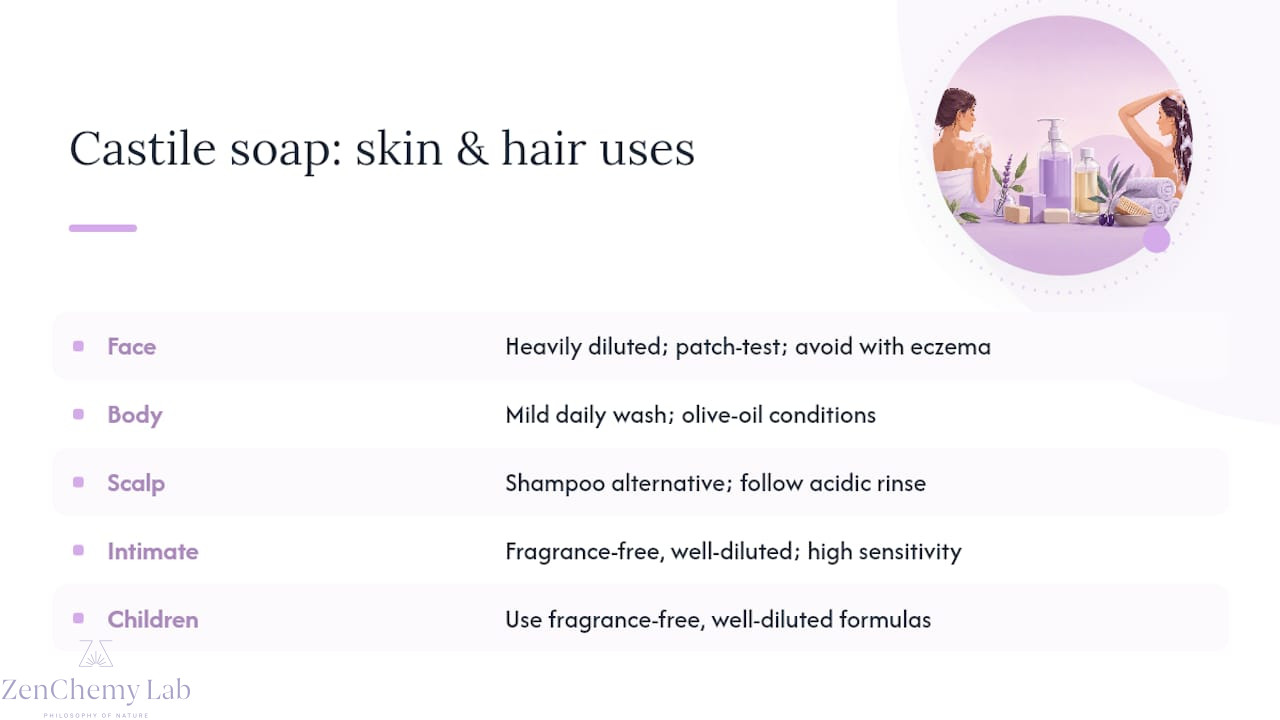
For the face, dilute heavily. A low concentration limits dryness, and you should always patch-test on your inner arm first. If you have chronic eczema or rosacea, a soap-free cleanser is often the smarter default rather than Castile soap of any strength.
For the body, the olive-oil base does real work here. Its conditioning properties make it one of the milder daily wash options for normal to dry skin, though a small four-week study cited by Cleveland Clinic found topical olive oil itself improved hydration and elasticity. That benefit belongs to the oil, not automatically to the saponified soap, so treat it as a supporting data point rather than a guarantee.
For hair, Castile soap works as a shampoo alternative but lathers less than commercial formulas and can leave strands feeling coated in hard water. Follow with an acidic rinse (applied separately, never mixed in) to restore shine and manageability.
For intimate areas and children, stick to fragrance-free, well-diluted formulas. Verywell Health notes essential oils in scented versions can irritate sensitive skin here more than anywhere else on the body. See a clinician if irritation persists beyond a few uses.
Pro Tip: Keep a small labelled spray bottle of diluted Castile soap in the shower specifically for intimate and underarm use, separate from your body-wash dilution. Different skin, different tolerance, different bottle.
How does castile soap perform for household cleaning, laundry, and pets?
Around the house, dilution ratios matter just as much as they do on skin, and a few limits are worth knowing before you toss your other cleaners.
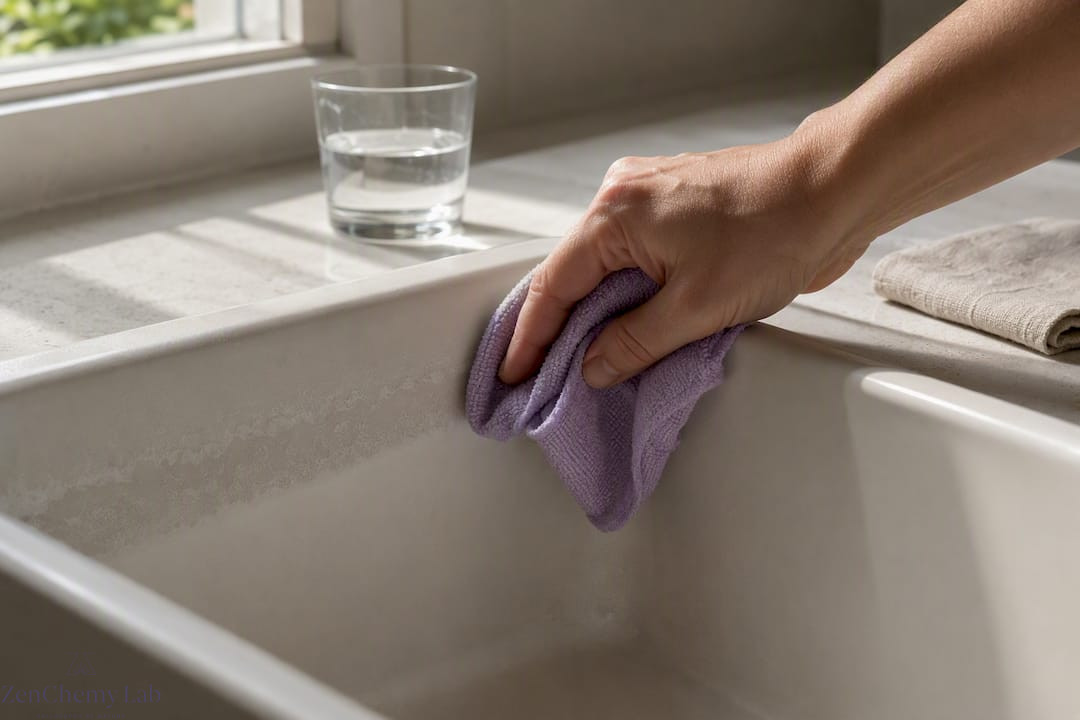
- Multi-surface cleaning. Mix roughly one to two teaspoons per litre of water for countertops, floors, and general wipe-downs.
- Laundry boost. A small amount added to a wash cycle helps with light soil, but it won’t replace enzyme-based stain removers or heavy-duty detergent for grease and set-in stains.
- Pet washing. Plain, unscented Castile soap is generally fine diluted for occasional pet baths, but skip any version with essential oils. Tea tree, citrus, and several other oils are harmful to cats and dogs, so check the label every time.
- Sustainability upside. Because it’s concentrated and biodegradable, one bottle replacing several single-purpose cleaners cuts plastic packaging waste over time, a pattern The Spruce points to as the real environmental payoff of refill habits.
What it won’t do: disinfect like bleach, or cut through mineral buildup like ammonia-based cleaners. Treat it as your everyday, lower-impact option, not a full replacement for every specialty product under the sink.
What are the downsides and risks of castile soap?
The biggest limitation is chemistry, not marketing. Castile soap sits on the alkaline side of the pH scale, and that alkalinity can dry out skin or aggravate conditions like eczema and rosacea in some people. If you’re managing a chronic skin condition, a dermatologist-recommended, pH-balanced, soap-free cleanser is usually the safer long-term choice.
It’s also worth being clear-eyed about what it doesn’t do: Castile soap is not antibacterial. It lifts dirt, oil, and microbes away mechanically through the same surfactant action as any true soap, rather than killing them chemically, a distinction Cleveland Clinic makes explicitly.
Hard water is the other practical headache. Mineral-heavy water reacts with soap to form scum and residue on skin, hair, and surfaces alike, something The Spruce flags as one of the most common complaints. Diluting with distilled water or adding a separate rinse step largely solves it. And if you’re using scented versions around pets or very sensitive people, remember essential oils are the irritant, not the soap base itself.
How do you dilute and use castile soap safely?
Getting the ratio right is most of the battle, and the recipes are simpler than they look once you write them down.
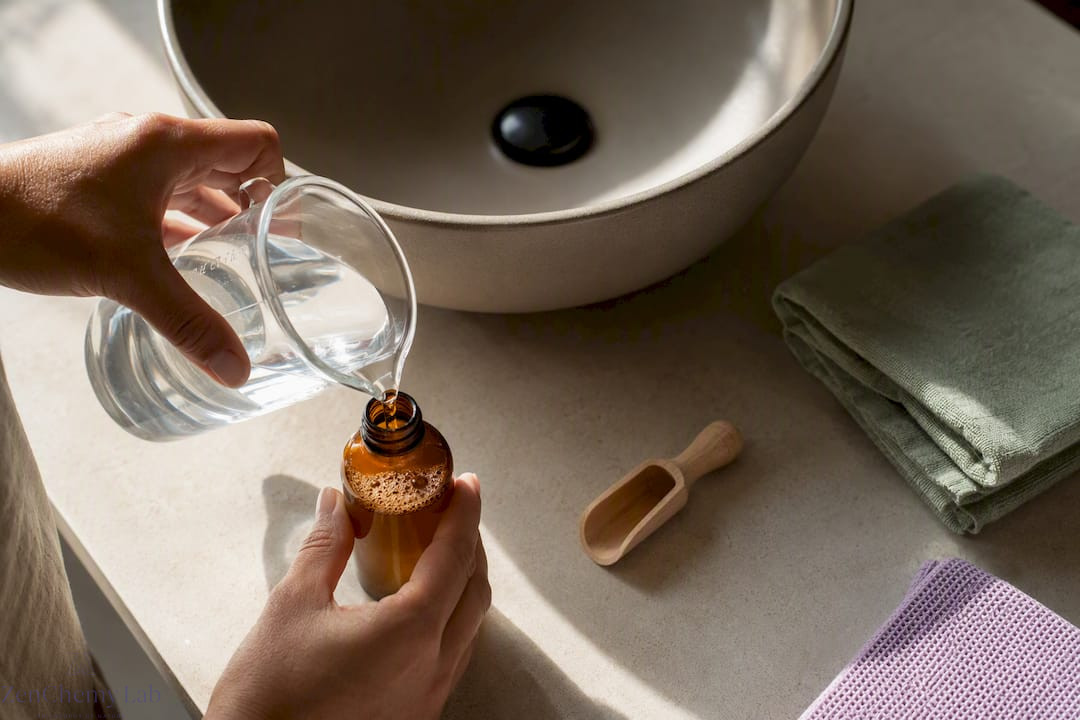
- Face wash: one to two teaspoons of Castile soap per 250 mL of water.
- Body wash: one tablespoon per 250 mL of water.
- Shampoo: one to two tablespoons per 250 mL of water, followed by an acidic rinse for shine.
- Multi-surface cleaner: one to two teaspoons per litre of water.
Never mix Castile soap with vinegar or lemon juice in the same bottle. The acid reverses saponification, breaking the soap back into raw oils and leaving a cloudy, greasy residue instead of a working cleaner, a reaction explained clearly by the David Suzuki Foundation’s usage guide. If you want the shine or descaling benefit of vinegar, apply it as a separate rinse afterward, never in the same mix.
Because it’s sold concentrated, using it undiluted is a common mistake. Full-strength application can feel harsh on skin and leaves sticky film on surfaces, a point The Spruce makes about nearly every complaint tied to overuse. In hard water areas, add an extra rinse cycle or switch your dilution water to distilled. Label your spray bottles, patch-test anything new, and start weaker than the recipe suggests. You can always add more soap; you can’t unirritated skin.
Why formulation choices behind the soap actually matter
The approach to Castile-style soap starts with the principle that the oil balance determines how the bar behaves on skin. Cold-processed methods and olive-forward oil blends provide conditioning qualities that help a daily bar avoid feeling stripping, especially for households with different skin sensitivities.
Ingredient transparency matters here too. If you’re trying to figure out why one bar lathers differently than another, our breakdown of soap ingredients for healthy, glowing skin walks through the trade-offs. And if pH questions keep you up at night before a purchase, our guide to pH levels in handmade soap covers exactly what your skin barrier needs.
What the research actually supports (and what marketing overstates)
Research supports that Castile soap is a low-additive, mechanically effective cleanser that behaves predictably once its alkalinity is understood and it is diluted accordingly.
Dilution ratio is key. Complaints about dryness or film often come from using too strong a concentration or skipping a rinse step in hard water. Complaints about insufficient cleaning usually come from expecting disinfection, which true soap does not provide regardless of label claims.
If I had to prioritize one thing for a first-time buyer, it wouldn’t be scent or brand story. It would be checking whether the formula is fragrance-free before it touches your face or intimate skin, and whether you’ve actually measured your dilution rather than eyeballing it. The plant-oil sourcing and biodegradability are real advantages. They’re just not the reason people end up disappointed. Weak dilution habits are.
— Alex
Choosing the right castile-style soap for your routine
If you’ve read this far, you already know dilution and oil balance decide whether a Castile-style soap feels gentle or harsh on your skin. That’s exactly what we build around at Zenchemy Lab. Our Artisan Soap Collection, handmade and cold-processed with prices in a moderate range, gives you an olive-forward option built for daily conditioning rather than stripping lather.

If you’re sensitive to fragrance, look for our unscented bars first. If you prefer liquid for hands-free dispensing, our shop lists both bar and liquid formats side by side. And if sustainability is part of why you switched to Castile soap in the first place, our cold-processed bulk option is offered in a higher-priced, bulk format that cuts packaging waste across a household. Browse the full collection at Zenchemylab and pick the format that matches how you actually wash.
Sources
- Is Castile Soap a Cure-All Cleanser?
- What is Castile Soap? (The Spruce)
- Castile Soap: What It Is, Uses, Risks (Verywell Health)
FAQ
What are the downsides of Castile soap?
Its alkaline pH can dry out skin or aggravate eczema and rosacea in some people, and it isn’t antibacterial, since it removes microbes mechanically rather than killing them, according to Cleveland Clinic. In hard water, it can also leave soap scum unless you dilute carefully or add a rinse step.
Is Castile soap good for daily use?
Yes, for most skin types, when properly diluted. Verywell Health notes it’s generally safe for regular use, though people with chronic skin conditions should check with a dermatologist first.
Is Castile soap safe for intimate areas?
Fragrance-free, well-diluted Castile soap is generally considered gentle enough for intimate use, but scented versions with essential oils carry a real irritation risk. If irritation continues after switching to a fragrance-free formula, see a clinician rather than continuing to experiment.
Is Castile soap good for your face?
It can work for some skin types at a light dilution, roughly one to two teaspoons per 250 mL of water, with a patch test beforehand. If you have persistent dryness, eczema, or rosacea, a soap-free cleanser from a line like Zenchemy Lab’s face wash collection is often the gentler daily option.