Topical niacinamide (nicotinamide) is a well-researched, versatile skincare active, and its effects come from the molecule itself, not whether a brand markets it as “natural.” The chemical structure is identical no matter how it’s sourced. What actually determines results is concentration, formulation quality, and the ingredients it’s paired with, not a sourcing story on the label.
TL;DR:
- The effectiveness of niacinamide depends on concentration and formulation quality, not whether it is labeled as natural or synthetic.
- Proper formulations typically contain 2-5% niacinamide, with visible skin benefits like improved barrier function and reduced hyperpigmentation appearing after 6 to 12 weeks.
- To ensure safety and efficacy, patch testing is recommended, and products should clearly list niacinamide in the ingredients without vague claims about being plant-derived.
- Combining niacinamide with vitamin C or retinoids can be effective and tolerated when layered correctly, often enhancing brightening and anti-inflammatory effects.
- Focus on product formulation and transparent sourcing over vague “natural” claims, prioritizing clear ingredient lists and known concentrations.
Table of Contents
- What is niacinamide in natural skincare, chemically speaking?
- What are the real benefits of niacinamide in a natural routine?
- How to use niacinamide in a natural skincare routine
- Is niacinamide safe, and how should you patch test it?
- How do you choose a natural skincare product with niacinamide?
- ZenChemy Lab’s perspective on using niacinamide in natural formulas
- Where to find honest, niacinamide-forward natural formulas
- Sources
What is niacinamide in natural skincare, chemically speaking?
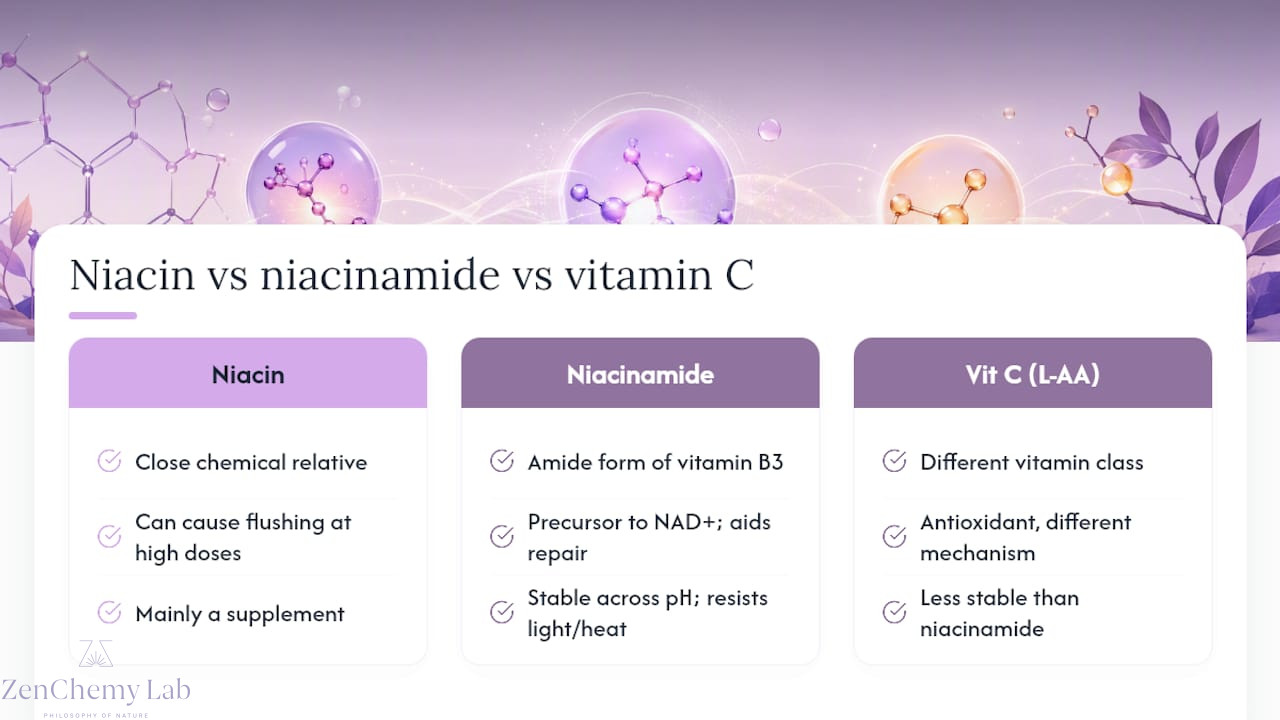
Niacinamide is the amide form of vitamin B3, also called nicotinamide. It’s a close relative of niacin, but the two behave differently on skin. Niacin can cause flushing at higher doses, while niacinamide sits calmly in most formulations without that reaction, which is part of why it became a skincare staple rather than a supplement footnote.
Inside skin cells, niacinamide acts as a precursor to NAD+, a molecule your cells rely on for energy production and repair. Without getting too deep into cellular biology, the short version is that steady NAD+ supply gives skin cells more capacity to repair damage, manage inflammation, and maintain the barrier that keeps moisture in and irritants out. That’s the mechanism behind most of the visible benefits people notice.
Most over-the-counter formulations use niacinamide at concentrations commonly used in clinical trials, generally low single-digit percentages, a range clinical trials have repeatedly tested and validated. A 12-week randomized split-face trial using 5% nicotinamide showed measurable improvement in fine lines, hyperpigmentation, and skin texture, which is a meaningfully long runway for anyone expecting overnight change.
One underrated advantage: niacinamide is chemically stable across a wide pH range and holds up better under light and heat exposure than vitamin C in its pure L-ascorbic acid form. That stability is part of why formulators lean on it so heavily. A stable active behaves the same way in the jar on day one as it does on day ninety.
What are the real benefits of niacinamide in a natural routine?
Dermatology reviews and consumer health resources consistently point to the same handful of outcomes, and the evidence behind each one varies slightly in strength and timeline.
- Barrier repair and moisture retention: niacinamide supports ceramide synthesis, which helps reduce transepidermal water loss (TEWL). Skin that’s losing less water through its surface tends to feel less tight and look less flaky within weeks.
- Brightening and pigmentation: it interferes with melanosome transfer, the process that moves pigment into surface skin cells, which softens the look of dark spots over time rather than erasing them instantly.
- Oil regulation: many users notice pores looking less prominent and skin feeling less greasy by midday, an effect tied to how niacinamide influences sebum behaviour.
- Calming inflamed or reactive skin: its anti-inflammatory action helps with redness associated with acne, rosacea, and general sensitivity.
- Texture and fine lines: longer-term use is linked to smoother texture and softer fine lines.
Here’s a number worth remembering: clinical evaluations typically show visible pigment improvement over a 6 to 12 week window, and some combination formulas pairing niacinamide with stabilized vitamin C showed improved brightening effects with good tolerability. Randomized studies have also found that nicotinamide reduces inflammation and sebum output in acne-prone skin, making it a legitimate supporting player rather than a trendy add-on.
Set your expectations around that six-to-twelve-week window. Anyone promising visible pigment change in a week is overselling the ingredient.
How to use niacinamide in a natural skincare routine
Building niacinamide into your routine is simpler than most layering charts make it look.
- Start low. Begin with a product in the 2% to 4% range, especially if you have sensitive or reactive skin, and increase toward 5% only if your skin tolerates it well.
- Apply after cleansing, before moisturizer. Serums go on clean, slightly damp skin; moisturizer locks the formula in afterward.
- Layering with vitamin C: the old idea that niacinamide and vitamin C cancel each other out doesn’t hold up. Evidence now shows the two work at complementary stages of pigment regulation and can be used together or layered in the same routine with good tolerability.
- Layering with retinoids: waiting five to ten minutes after applying a retinoid before layering a niacinamide moisturizer on top can reduce irritation while preserving the benefits of both.
- Frequency: once or twice daily works for most people; morning use pairs well with antioxidants, evening use pairs well with repair-focused actives.
- If sensitivity shows up: cut back to every other day, drop to a lower concentration, or apply over moisturizer rather than under it until skin adjusts.
Is niacinamide safe, and how should you patch test it?
Topical niacinamide has one of the better safety records in skincare. Clinical reviews describe it as well tolerated at the concentrations typically used in commercial products, and serious reactions are uncommon. Some people experience mild stinging or transient redness, usually at the higher end of the concentration range or when paired with other actives that already stress the barrier.
To patch test, apply a small amount to your inner forearm or behind your ear and wait 24 to 48 hours before using it on your face. If irritation shows up, reduce frequency, drop to a lower concentration, or apply it over moisturizer instead of under it.
Systemic concerns from topical use are rare. Oral niacinamide supplementation is a different matter entirely, and any decision about oral dosing should involve a clinician rather than a skincare label.

How do you choose a natural skincare product with niacinamide?
On an ingredient list, niacinamide typically appears by that exact name, sometimes alongside “nicotinamide” in parentheses. Products that pair it with ceramides, hyaluronic acid, or antioxidants tend to deliver more noticeable barrier and brightening results than niacinamide alone.
Watch for warning signs before you buy:
- Vague “all natural” claims with no visible INCI list at all.
- Marketing that emphasizes “plant-derived” without explaining the actual sourcing method.
- Concentration claims that sound suspiciously high without any supporting formulation detail.
Sustainability signals worth noticing include fermentation-based sourcing and suppliers willing to explain their process in plain language rather than hiding behind buzzwords.
Pro Tip: Before checkout, run through three quick questions: does the INCI list actually show niacinamide, does the brand name a real concentration or range, and does the supplier explain sourcing without leaning on vague “natural” language? If all three check out, you’re likely holding an honestly formulated product.
ZenChemy Lab’s perspective on using niacinamide in natural formulas
We use niacinamide selectively, at concentrations backed by clinical evidence, and always alongside supporting botanicals rather than as a standalone marketing hook. Our formulation approach favours transparency over buzzwords: if an active earns its place, we say why. Explore our other ingredient breakdowns for more of that same reasoning.
— Alex
Where to find honest, niacinamide-forward natural formulas
If you’ve read this far, you already know the sourcing story matters less than the formulation behind it. Formulation transparency is provided in product pages, so you’re checking real concentrations and real ingredient lists instead of guessing from marketing copy.

Our natural skincare product line is built around the same principles this article walks through: clear INCI lists, supportive actives instead of filler, and no vague “natural” claims standing in for actual information. If you want a fuller framework for building a routine around ingredients like this one, our guide to natural beauty practices for 2026 walks through how sustainability and formulation science intersect in practice. Browse the current lineup and pick a product that matches the concentration and pairing guidance covered above, then check the label yourself before it ever reaches your cart.
Sources
Here’s the part that trips up even ingredient-savvy shoppers: niacinamide is chemically identical no matter where it comes from. There is no “synthetic version” that behaves differently from a “natural version” once the molecule is finished. When a brand says “plant-derived niacinamide,” it usually means the raw feedstock, often sugars fermented by yeast or bacteria, originated from plant material before being converted into the final compound. The finished ingredient in the bottle is the same molecule either way.
Common sourcing routes include direct chemical synthesis, microbial fermentation of plant-derived sugars, and extraction methods tied to yeast or botanical precursors. None of these routes changes what the molecule does on your skin. What they can affect is sustainability and traceability, which matters if you care about supply chain transparency, but it’s a separate conversation from efficacy.
So what should you prioritize instead of chasing “natural” labelling? Look at the formulation partners: the preservative system, the humectants, and the supportive actives surrounding the niacinamide. Those choices affect stability, feel, and how well the product performs over its shelf life far more than the sourcing story does.
Pro Tip: Skip past the marketing copy and go straight to the INCI list. A transparent supplier will list niacinamide clearly and won’t bury it under vague terms like “vitamin complex.” If a brand can’t or won’t explain its sourcing when asked, that’s a bigger red flag than any synthetic-versus-natural debate.
- Nicotinamide: A Multifaceted Molecule in Skin Health and Beyond
- Clinical evidence supporting nicotinamide in acne management