
TL;DR:
- A clean beauty routine involves using skin care products free from harmful ingredients, focusing on safety, transparency, and effectiveness. Since “clean” lacks federal regulation, consumers must read labels and seek third-party certifications like EWG or Credo to ensure product safety. Building a simple, four-step AM and PM routine—cleanse, treat, moisturize, and protect—paired with patch testing and ingredient literacy optimizes skin health over time.
A clean beauty routine is a carefully curated set of skin and personal care products free from harmful or irritating ingredients, designed to support healthier skin through safety, transparency, and effectiveness. The term “clean beauty” has no federal regulation in Canada or the US, meaning any brand can use it without meeting a defined standard. That gap puts the responsibility on you to read labels, seek third-party certifications, and understand what you are actually putting on your skin. Organisations like the EWG (Environmental Working Group) and Credo Beauty have stepped in to fill that regulatory void with their own ingredient standards. This guide gives you a clear, dermatologist-informed framework for building a green beauty routine that actually works.
How to build a clean beauty routine step by step
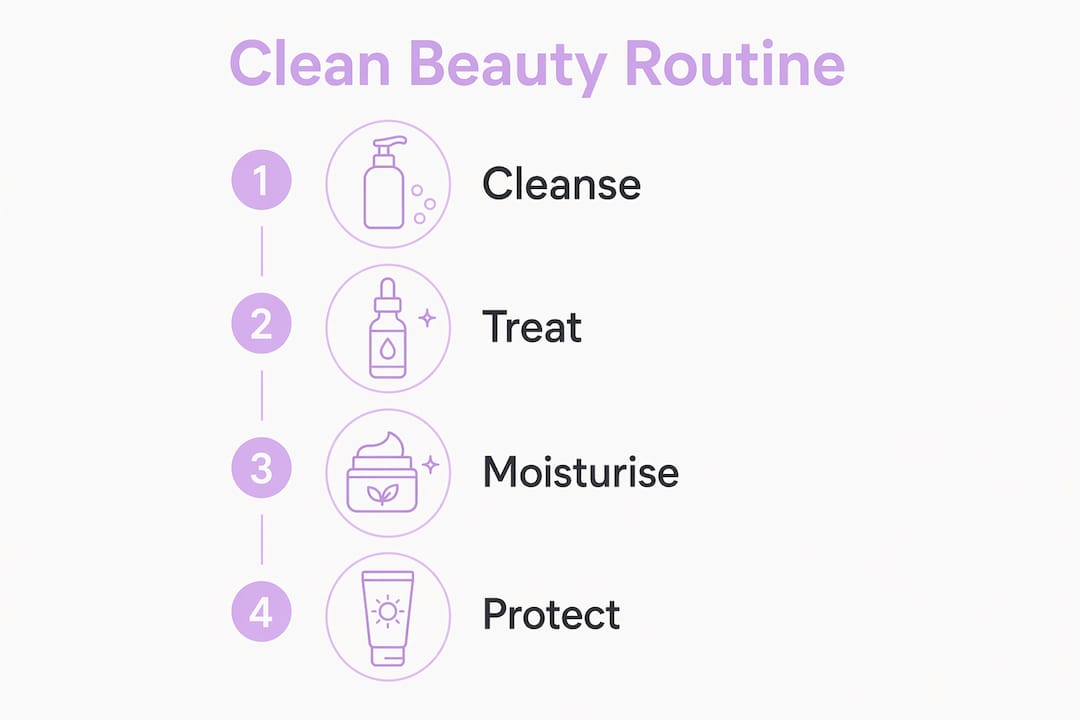
The foundation of any effective clean skincare routine is a four-step structure: cleanse, treat, moisturise, and protect. Dermatologists consistently recommend this minimal effective routine because it covers every biological need your skin has without overloading it. Keeping it simple also makes it far easier to stick to, which is ultimately what produces results.
Your morning and evening routines serve different purposes, and structuring them correctly matters.
☀️ Morning routine
- Cleanse — Use a gentle, sulphate-free cleanser to remove overnight sebum and any residue from your PM products. You do not need a foaming lather to get clean skin.
- Treat — Apply a targeted serum if your skin has a specific concern, such as vitamin C for brightening or niacinamide for pore minimisation. Keep this step optional if your skin is sensitive.
- Moisturise — Lock in hydration with a lightweight moisturiser suited to your skin type. Look for ingredients like hyaluronic acid, ceramides, or plant-based squalane.
- Protect — Apply a broad-spectrum SPF 30+ as the final step. Sun protection is the single most evidence-backed intervention for long-term skin health, and skipping it undoes much of what the rest of your routine achieves.
** Evening routine**
- Remove makeup and sunscreen — Improper removal of sunscreen and makeup before cleansing causes product build-up that can lead to misdiagnosed intolerances. Use a micellar water or cleansing oil first if you wear SPF or makeup.
- Cleanse — Follow with your gentle cleanser to fully clear the skin.
- Treat — Evening is the right time for actives like retinol or AHAs, since these ingredients increase photosensitivity. Introduce only one active at a time.
- Moisturise — Use a slightly richer moisturiser at night to support overnight skin repair and reduce transepidermal water loss (TEWL).
Pro Tip: Layer products from thinnest to thickest consistency. Serums go before moisturisers, and moisturisers go before SPF. This order preserves the efficacy of each product and reduces the risk of pilling.
How to choose clean beauty products: labels, certifications, and ingredients to avoid
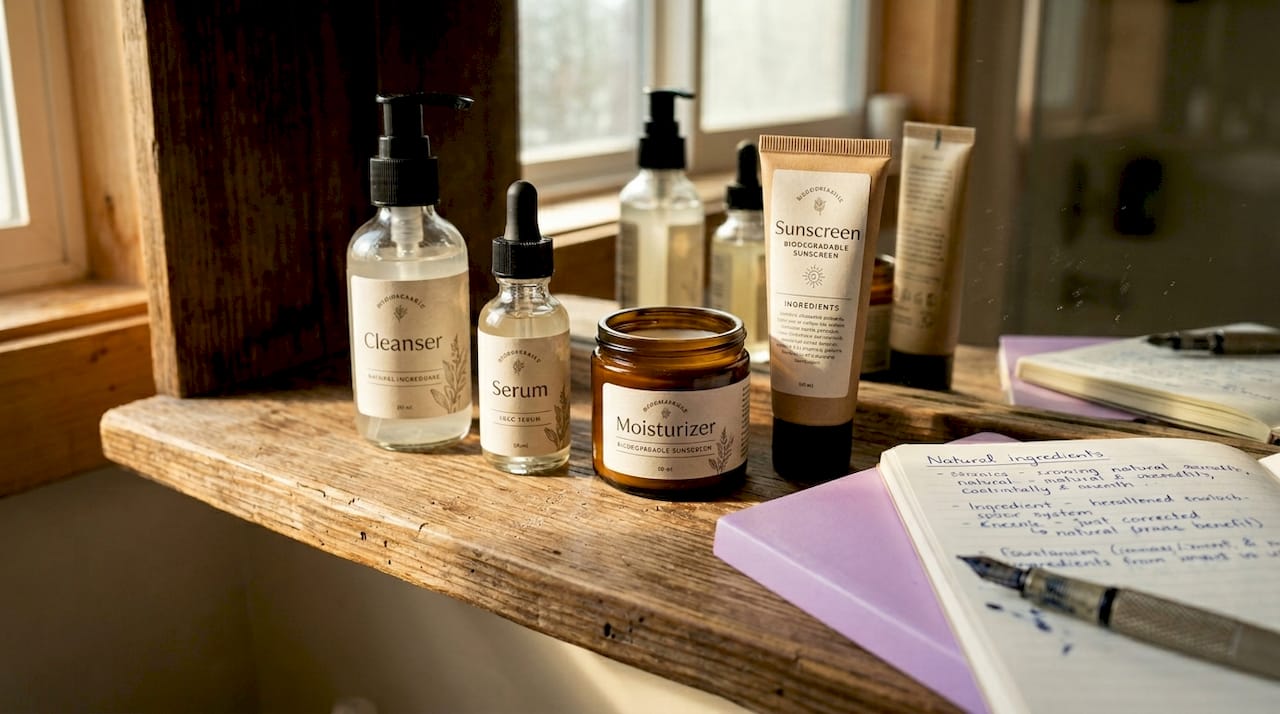
Reading a product label beyond the front-of-pack marketing claim is the single most important skill in building a natural beauty regimen. Brands can print “clean,” “natural,” or “green” on packaging without any obligation to back it up. The ingredient list on the back is where the truth lives.
Ingredients worth avoiding
- Parabens (methylparaben, propylparaben): Synthetic preservatives linked to endocrine disruption concerns. The EU restricts several parabens in cosmetics.
- Sulphates (sodium lauryl sulphate, sodium laureth sulphate): Harsh surfactants that strip the skin’s lipid barrier, increasing TEWL and sensitivity.
- Synthetic fragrances: Listed simply as “fragrance” or “parfum,” these can contain hundreds of undisclosed chemicals and are a leading cause of contact dermatitis.
- Formaldehyde-releasing preservatives: Ingredients like DMDM hydantoin and quaternium-15 release small amounts of formaldehyde over time.
- Oxybenzone: A chemical UV filter with potential hormone-disrupting properties, often found in conventional sunscreens.
Certifications and databases that do the vetting for you
Third-party verification removes the guesswork. Look for products certified by or listed in:
- EWG Skin Deep: Rates cosmetic ingredients on a hazard scale from 1 to 10. Products with an EWG Verified mark meet strict criteria for transparency and safety.
- Credo Clean Standard: One of the most rigorous retailer-led standards in North America, with a “Dirty List” of over 2,700 restricted ingredients.
- EU Cosmetics Regulation: The European Union bans or restricts over 1,300 ingredients in cosmetics. Buying EU-compliant products is a reliable proxy for cleaner formulations.
Pro Tip: Not all natural ingredients are gentle. Essential oils like cinnamon bark, clove, and citrus can cause significant irritation, especially on sensitive or compromised skin. “Natural” on a label is not a safety guarantee.
| Claim | What it actually means |
|---|---|
| “Clean” | No regulated definition in Canada or the US. Verify with EWG or Credo. |
| “Natural” | No legal standard. Can include synthetic ingredients alongside plant-derived ones. |
| “Fragrance-free” | No added fragrance compounds. Preferable for sensitive skin. |
| “Hypoallergenic” | No standardised testing requirement. Patch testing is still necessary. |
| “Dermatologist-tested” | Tested by a dermatologist, but results and criteria are not publicly disclosed. |
For a deeper look at how to interpret ingredient labels and navigate the clean beauty space, the clean beauty guide at Zenchemylab walks through the most common misleading claims in plain language.
Why patch testing is non-negotiable when switching products
Patch testing is the practice of applying a new product to a small area of skin over several days to detect irritation or allergic reactions before full-face use. A proper self patch test involves applying the product twice daily to a small area, such as the inner forearm or behind the ear, for 7 to 10 days. This timeline matters because some reactions, particularly delayed hypersensitivity responses, do not appear within the first 24 to 48 hours.
Here is the method to follow:
- Choose a test site — The inner forearm is ideal for most products. For facial products, the area just behind the ear or along the jawline more closely mimics facial skin behaviour.
- Apply a small amount — Use the same quantity you would apply in your actual routine. Twice daily application mirrors real-world use conditions.
- Observe for 7 to 10 days — Watch for redness, itching, swelling, or small bumps. Mild tingling that resolves within a few minutes can be normal with actives like AHAs, but persistent discomfort is a signal to stop.
- Introduce one product at a time — Adding products one at a time with adequate spacing between introductions is the only reliable way to identify which ingredient caused a reaction.
- Discontinue and note the ingredient — If a reaction occurs, stop use immediately and check the ingredient list against any known sensitivities. This builds your personal ingredient profile over time.
When to see a professional: A self patch test identifies common irritant and contact reactions, but it cannot replicate the precision of a dermatologist-administered patch test. If you experience persistent reactions, widespread redness, or suspect a true allergy, a dermatology consultation is the appropriate next step. Clinics like Rituel Med Spa offer professional skin assessments that can help identify underlying sensitivities before you invest further in new products.
For guidance on which ingredients tend to be gentlest on reactive skin, the Zenchemylab resource on sensitive skin ingredients is a practical reference.
Common mistakes that undermine a clean beauty routine
Building a guide to natural skincare would be incomplete without addressing the habits that quietly sabotage results. Most people do not fail because they chose the wrong products. They fail because of how they use them.
- Overcomplicating the routine: Using too many actives simultaneously disrupts the skin barrier and triggers reactive conditions. Simplified routines promote barrier repair and are easier to maintain consistently.
- Skipping SPF: Sunscreen is the most evidence-backed anti-ageing and skin-protective step available. Mineral options with zinc oxide and titanium dioxide offer broad-spectrum protection and are generally well-tolerated by sensitive skin types.
- Chasing trends instead of results: A new “hero ingredient” appears in the clean beauty space every few months. Switching products constantly prevents you from ever seeing what a stable routine can do for your skin.
- Expecting immediate results: Most active ingredients, including retinoids and niacinamide, require a minimum of four to twelve weeks of consistent use before visible improvement appears. Patience is not optional.
- Starting with serums: Begin your clean beauty transition with swaps in your cleanser, moisturiser, and sunscreen before introducing serums. This staggered approach isolates variables and makes it far easier to assess tolerance.
Pro Tip: Keep a simple skincare journal for the first 60 days of a new routine. Note what you applied, in what order, and how your skin responded. This record is invaluable when troubleshooting reactions or deciding which products to keep.
Key takeaways
A clean beauty routine works best when it is built on four core steps, ingredient literacy, and patient, one-product-at-a-time introductions.
| Point | Details |
|---|---|
| Structure your routine | Follow cleanse, treat, moisturise, protect in both AM and PM with adjusted focus for each. |
| Verify “clean” claims | Use EWG Skin Deep, Credo, or EU Cosmetics Regulation standards to vet products independently. |
| Patch test every new product | Apply twice daily to a small area for 7 to 10 days before full-face use. |
| Introduce products one at a time | Stagger new additions to isolate reactions and protect your skin barrier. |
| Prioritise SPF daily | Broad-spectrum SPF 30+ mineral sunscreen is the most impactful single step in any routine. |
What I have learned from years in the clean beauty space
The most common mistake I see is treating a clean beauty routine as a shopping exercise rather than a skin health practice. People spend hours researching the best clean beauty products, fill their shelves with certified, beautifully packaged formulas, and then wonder why their skin is reacting. The answer is almost always too much, too fast.
What actually works is boring by comparison. A gentle cleanser, a well-formulated moisturiser, and a reliable mineral SPF will outperform a ten-step routine of trending actives every single time. I have seen this play out repeatedly. The skin barrier, that “brick and mortar” structure of lipids and corneocytes, does not reward complexity. It rewards consistency and restraint.
Ingredient literacy changed how I approach product selection more than any certification ever did. When you can read an INCI list and understand what each ingredient does, marketing loses its power over you. You stop buying “clean” and start buying informed. That shift is where real skin health begins.
One more thing worth saying plainly: your skin will not transform in two weeks. Give any new routine at least eight weeks before drawing conclusions. The readers who see the most meaningful results are not the ones who found the perfect product. They are the ones who stayed consistent long enough for their skin to respond.
— Alex
Discover Zenchemylab’s natural skincare collection

Zenchemylab formulates every product around the same principles this guide is built on: transparent ingredient lists, minimal harmful substances, and botanicals that genuinely support skin health. Whether you are starting with a gentle cleanser, a plant-based moisturiser, or a mineral SPF, each step of your routine can be filled with products you can actually trust. Explore the full range of natural skin products to find formulations aligned with your skin type and clean beauty goals. For a curated starting point, the natural skincare routine tips guide pairs directly with the steps covered in this article.
FAQ
What does “clean beauty” actually mean?
“Clean beauty” has no federally regulated definition in Canada or the US, so the term can be used by any brand without certification. Verification through third-party standards like EWG Skin Deep or the Credo Clean Standard is the most reliable way to assess a product’s safety profile.
How many steps does a clean skincare routine need?
A minimal effective clean skincare routine requires three to four steps: cleanse, treat (optional), moisturise, and protect with SPF 30+. Dermatologists consistently confirm that this structure covers all core skin needs without the barrier disruption that comes from overloading with actives.
How long should I patch test a new product?
Patch testing should run for 7 to 10 days, with twice-daily application to a small skin area such as the inner forearm. This duration captures both immediate irritant reactions and slower delayed hypersensitivity responses that would not appear in a 24-hour test.
Are natural ingredients always safe for sensitive skin?
No. Natural ingredients like cinnamon bark oil, clove extract, and citrus-derived compounds can cause significant irritation and contact dermatitis, particularly on sensitive or compromised skin. “Natural” is not a synonym for gentle, and patch testing applies equally to plant-based formulations.
When should I add serums to my clean beauty routine?
Introduce serums only after your cleanser, moisturiser, and sunscreen are established and well-tolerated. Starting with the foundational three products first reduces interaction variables and makes it far easier to identify the source of any reaction when you do begin adding targeted treatments.