
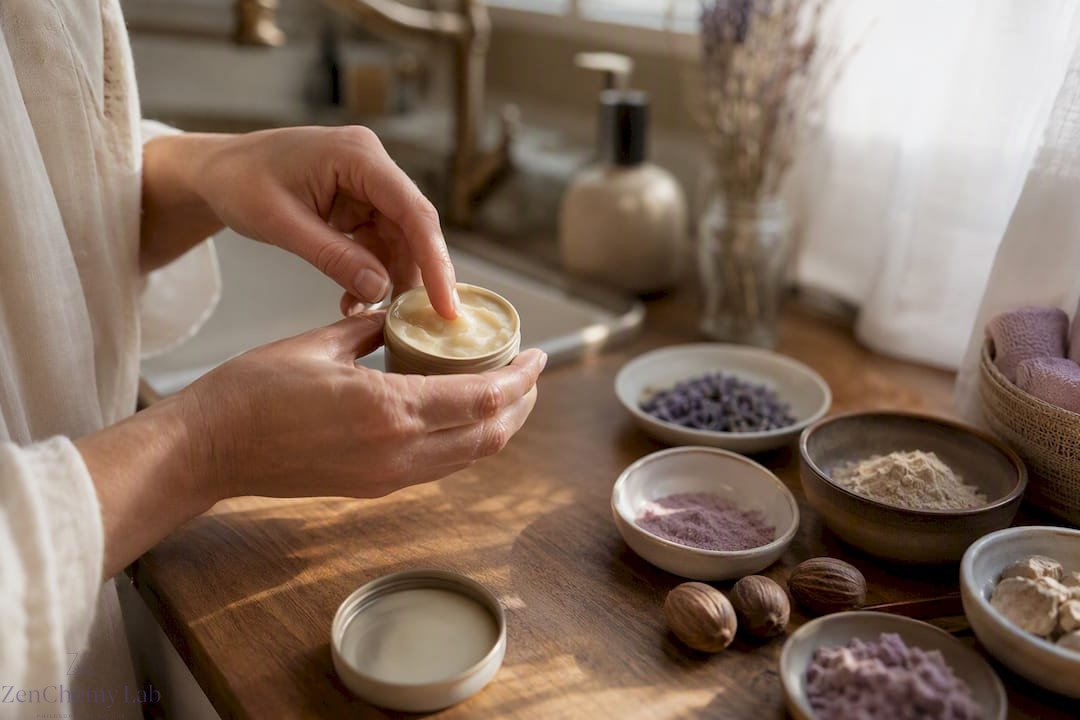
Aluminum-free deodorants stop odour but do not stop sweating. That’s the trade-off, and it’s non-negotiable: without aluminum salts, nothing in the formula physically blocks your sweat ducts. What you gain instead is a gentler product built for specific needs.
The people who benefit most are predictable:
- Anyone with sensitive or reactive underarm skin
- Buyers who want plant-based or metal-free formulations on principle
- People tired of yellow underarm stains on white shirts
The trade-off in plain terms: you’ll likely sweat more, some botanical actives (baking soda especially) can irritate skin, and most people need one to four weeks to adjust before judging whether a formula works.
Key takeaways
Aluminum-free deodorants control odour through antimicrobial and absorbent ingredients, not by blocking sweat, and the formula’s active ingredient determines irritation risk far more than the word “natural” on the label.
| Point | Details |
|---|---|
| Odour control, not sweat control | Aluminum-free formulas target bacteria and absorb moisture; only aluminum salts reduce sweat output. |
| Baking soda is the top irritant | Roughly 20 to 30% of sensitive-skin users react to sodium bicarbonate formulas. |
| Expect a real adjustment period | Sweat and odour can increase for one to four weeks as your underarm microbiome recalibrates. |
| Current evidence is reassuring | Major reviews found no link between aluminum antiperspirants and breast cancer risk. |
| Zenchemylab offers a vetted starting point | Its Canadian-made aluminum-free deodorant skips baking soda in favour of gentler actives for sensitive skin. |
Table of Contents
- What aluminum-free deodorant benefits actually come from
- The real benefits of switching to natural deodorant
- Where aluminum-free formulas fall short
- What to expect during the switch to aluminum-free deodorant
- Choosing a formula: what actually matters on the label
- ZenChemy Lab’s approach to aluminum-free formulation
- How switching affects your underarm microbiome
- How well aluminum-free deodorant works compared with antiperspirants
- Does aluminum in deodorant cause health problems?
- Alex’s take: the trade-off nobody frames honestly
- Zenchemylab’s aluminum-free deodorant for sensitive, everyday use
- Sources
What aluminum-free deodorant benefits actually come from
The odour under your arms isn’t sweat itself. Fresh sweat is nearly odourless. The smell shows up when skin bacteria metabolize the proteins and lipids in that sweat, particularly in the apocrine glands concentrated in the armpit. Aluminum-free deodorants target that bacterial process directly, rather than trying to stop sweat production.
Three mechanisms do most of the work in a typical formula:
- Antimicrobial actives like magnesium hydroxide and certain essential oils (tea tree, sage) slow the bacteria responsible for odour.
- Absorbent bases such as arrowroot powder, kaolin clay, and tapioca starch soak up moisture on the skin’s surface without plugging sweat ducts.
- Masking and neutralizing scents cover residual odour while the antimicrobial actives work.
This is where the regulatory line matters, and it’s worth understanding if you’ve ever wondered why the label says “deodorant” and not “antiperspirant.” Antiperspirants use aluminum salts that form a temporary plug inside the sweat duct, which is the only mechanism approved to physically reduce perspiration. That sweat-blocking action is classified as a drug function in most jurisdictions, which is why antiperspirants carry drug monograph requirements. Deodorants, aluminum-free or not, are regulated as cosmetics because they only address odour, not the body’s physiology.
Removing aluminum from a formula removes the sweat-blocking function by definition. A true “aluminum-free antiperspirant” is a contradiction in terms under most over-the-counter drug frameworks, since an antiperspirant requires aluminum salts to earn that name. Marketing sometimes blurs this distinction, so read labels carefully if staying dry is your priority.
Understanding this mechanism explains almost everything else in this guide: why some people switch and feel liberated, why others switch and feel damp, and why the “right” choice depends heavily on what you’re actually trying to solve.
The real benefits of switching to natural deodorant
For the right person, the case for going aluminum-free is concrete, not aspirational.
- Less irritation for reactive skin. People who develop rashes, bumps, or itching from aluminum salts often find relief with a well-formulated aluminum-free alternative, since the irritating mechanism is removed entirely.
- No aluminum-related clothing stains. The yellowish underarm stains on white shirts are frequently linked to a reaction between aluminum compounds and sweat proteins. Skipping aluminum sidesteps that specific chemistry.
- Sweating proceeds normally. Sweating cools your body and clears toxins through the skin. Letting it happen unimpeded is, for many people, simply a comfort preference rather than a health necessity.
- Ingredient and packaging alignment. Many natural deodorant brands lean into plant-based actives and recyclable or compostable packaging, which matters if you’re making purchasing decisions on values as much as performance.
On the safety question specifically, it’s worth being precise rather than alarmist. A 2014 review published in Critical Reviews in Toxicology found no correlation between aluminum-based antiperspirants and increased breast cancer risk. That’s a meaningful data point against the version of this story that circulates on social media, and it means switching for cancer-avoidance reasons specifically isn’t supported by the current evidence. Switching for comfort, skin sensitivity, or ingredient preference stands on much firmer ground.
The practical upshot: well-formulated aluminum-free deodorants control odour effectively for most people through a normal workday, provided the formula matches your activity level and skin type.
Where aluminum-free formulas fall short
The honest drawbacks deserve equal airtime, because a non-alarmist guide cuts both ways.
The most obvious limitation is that these products don’t block sweat. If you’re presenting in a boardroom, running a marathon, or working an outdoor shift in July, you will sweat through an aluminum-free deodorant in a way you likely wouldn’t with an antiperspirant. That’s not a formulation failure. It’s the entire point of the category.
The most common irritation culprit is baking soda. Estimates suggest roughly 20 to 30% of sensitive-skin users react to baking-soda-based formulas, usually with redness, itching, or a burning sensation, especially on freshly shaved skin. Sodium bicarbonate is alkaline, and it can shift underarm skin pH out of its comfortable range.
Other things to watch for:
- Essential oils and added fragrance can trigger contact reactions in already-sensitive skin.
- Natural deodorants often cost more per gram than mass-market antiperspirants.
- Performance can dip in heat or during intense exercise, requiring reapplication.
Pro Tip: If you notice redness, swelling, or a rash that persists more than two or three days after switching formulas, stop use and try a baking-soda-free version before assuming natural deodorant “doesn’t work” for you.
What to expect during the switch to aluminum-free deodorant
Give yourself a real adjustment window before deciding a product has failed you. Guides on transitioning from antiperspirant to deodorant commonly report a one to four week period where sweat and odour temporarily increase as underarm skin and its bacterial population recalibrate.
- Patch-test first. Apply a small amount to clean skin for two to three nights before full use to catch reactions early.
- Launder more often. Sweat and skin bacteria behave differently without aluminum, so shirts may need washing sooner than you’re used to.
- Use absorbent layers if needed. Cotton undershirts or moisture-wicking base layers help through the adjustment window, and runners managing friction alongside sweat often lean on anti-chafing products designed for active use during this period too.
- Carry a midday wipe. A quick refresh at lunch bridges the gap while your skin recalibrates.
None of this is a systemic “detox,” despite how the wellness world frames it. It’s your underarm microbiome and sweat glands settling into a new equilibrium, not toxins leaving your body. If irritation worsens rather than easing over two weeks, or if you see blistering, that points to allergy rather than normal adjustment, and it’s time to change formulas or see a clinician.
Pro Tip: Switch during a lower-stress week rather than right before a big presentation. Your body needs the adjustment window, and you don’t want to be testing that timeline under pressure.
Choosing a formula: what actually matters on the label
Not every aluminum-free deodorant is built the same way, and the ingredient list tells you more than the marketing copy does.
For sensitive or shaved skin, look for baking-soda-free formulas built around magnesium hydroxide instead. Magnesium hydroxide neutralizes odour-causing bacteria without the pH swing that makes sodium bicarbonate irritating, which makes it the better starting point if you’ve reacted to natural deodorant before.
| What you need | Look for | Why it fits |
|---|---|---|
| Sensitive or reactive skin | Magnesium hydroxide, no baking soda | Gentler pH, lower dermatitis risk |
| Active lifestyle, more sweat | Arrowroot or kaolin clay absorbers | Higher moisture capacity through the day |
| Scent preference over sweat control | Essential oil blends, minimal absorbers | Lighter feel, odour masking focus |
| First-time natural switcher | Dermatologist-tested claim, sample or trial size | Lower risk while you patch-test |
Beyond the active ingredients, a few practical checks help:
- Favour brands that publish full ingredient breakdowns rather than vague “natural fragrance” listings.
- Buy a small size first if you’ve never tried the brand’s specific formula.
- Sustainable packaging is a bonus, not a substitute, for a formula that actually suits your skin.
ZenChemy Lab’s approach to aluminum-free formulation
Formulating a deodorant that controls odour without irritating skin is a balancing act between antimicrobial strength and gentleness, and it’s the kind of trade-off has spent years refining through hands-on batch testing.
ZenChemy Lab’s Canadian-made aluminum-free deodorant is built for sensitive skin specifically, using gentler actives rather than leaning on baking soda for odour control. For readers who also want a magnesium boost through the skin, the Magnesium Oil Spray pairs well as a complementary body-care step, not a substitute for the deodorant itself.
A few honest notes on fit:
- If you’re prone to baking-soda irritation, this formula is designed to avoid that trigger entirely.
- If you need maximum sweat reduction for medical or professional reasons, an aluminum-based antiperspirant remains the more direct tool.
| Point | Details |
|---|---|
| Formula focus | Built around gentler actives instead of baking soda for sensitive underarm skin. |
| Made in Canada | Manufactured domestically, which matters for readers prioritizing local production. |
| Not a sweat blocker | Suits odour control needs, not situations demanding maximum perspiration reduction. |
How switching affects your underarm microbiome
Your armpit hosts its own community of bacteria, dominated in most people by Staphylococcus and Corynebacterium species, and antiperspirants change that community by suppressing sweat and altering the moist environment those bacteria depend on.

Switch to an aluminum-free deodorant, and the underarm environment shifts back toward its unmedicated baseline. Sweat production resumes at its normal rate, moisture levels rise, and the bacterial population adjusts accordingly over the transition window already discussed. This is precisely why odour can spike temporarily after a switch: it isn’t that natural deodorant “doesn’t work,” it’s that the microbial community is recalibrating to a wetter, less chemically altered environment.
Some formulas lean into this by including prebiotic or probiotic-style ingredients meant to favour less odour-producing bacterial strains over time, though the evidence supporting specific microbiome-targeted deodorant claims is still thin compared to the more established data on antiperspirant mechanics. Treat those claims as promising rather than proven.
What’s better established is the general principle: skin that isn’t constantly exposed to aluminum salts and duct-blocking mechanisms tends to maintain a more stable, undisturbed microbial baseline. Whether that’s meaningfully “healthier” long-term is still an open question, but it’s a reasonable piece of the case for readers who prioritize minimal intervention on principle rather than clinical necessity.
How well aluminum-free deodorant works compared with antiperspirants
If the metric is dryness, antiperspirants win decisively. Aluminum salts physically restrict sweat duct output, which no aluminum-free active can replicate, since none of them work on the sweat gland itself.
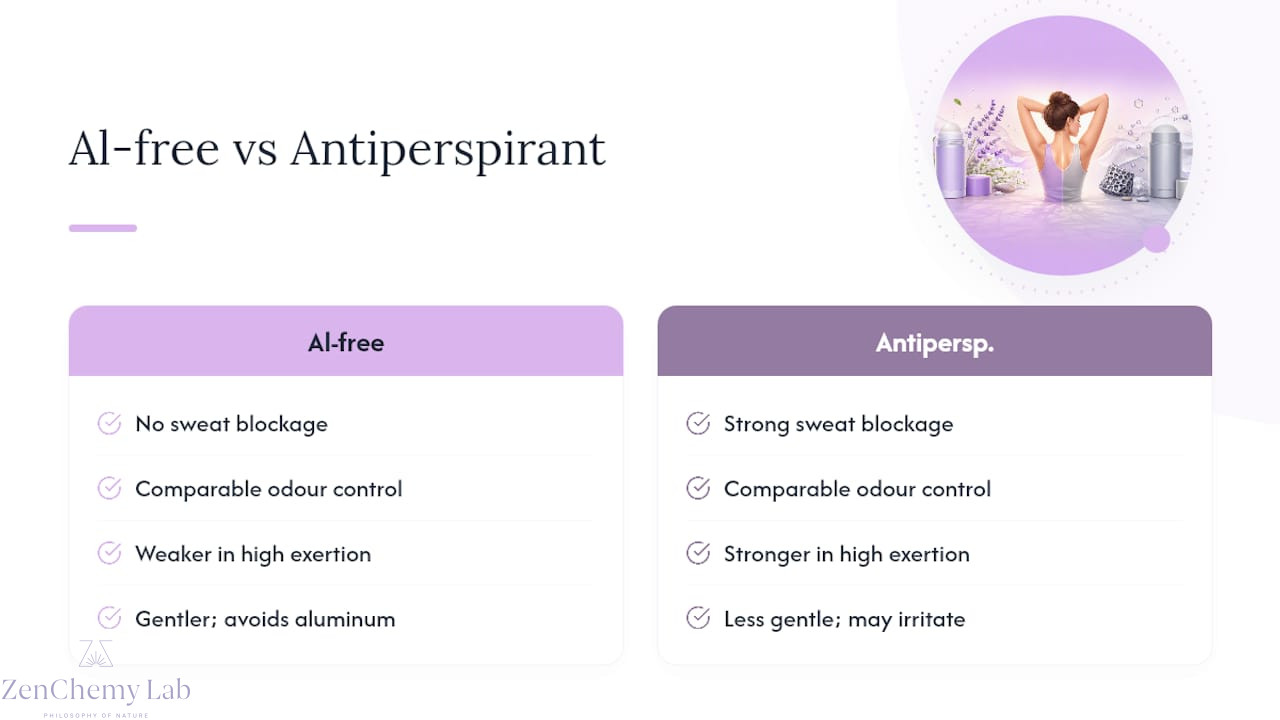
If the metric is odour control under normal, non-extreme conditions, well-formulated aluminum-free deodorants often perform comparably for a full workday. The difference shows up most in high-exertion or high-heat scenarios, where more sweat volume gives odour-causing bacteria more material to work with, and absorbent bases can only soak up so much before reapplication is needed.
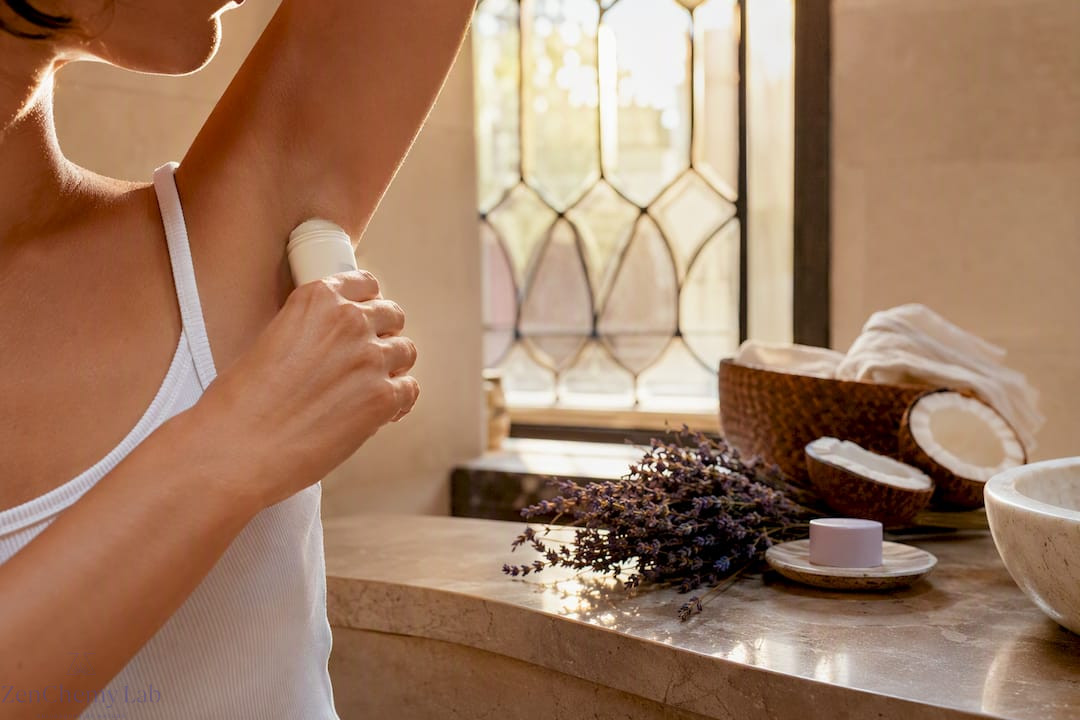
This is really a question of what problem you’re solving. Physicians generally frame it as a preference decision: antiperspirants remain the better choice when staying dry is the priority, while aluminum-free deodorants suit people prioritizing odour control or ingredient avoidance. Neither is objectively “better” in a vacuum. A person training for a marathon in August and a person working a low-sweat desk job have different real needs, and the honest answer is that the right product depends on which of those two people you are.
Does aluminum in deodorant cause health problems?
The two concerns that come up most are breast cancer and Alzheimer’s disease, and the current evidence doesn’t support either as a reason to avoid aluminum-based antiperspirants.
On breast cancer, the 2014 Critical Reviews in Toxicology assessment found no correlation between aluminum-containing antiperspirants and increased risk, a finding that has held up as the more rigorous counterpoint to the social-media version of this claim. On absorption specifically, a small surgical study examining excised apocrine gland tissue after aluminum chloride application found no detectable stained aluminum compounds within the glands, suggesting the compound doesn’t penetrate glandular tissue in meaningful amounts, at least in that limited sample of ten patients.
Alzheimer’s disease concerns trace back to older aluminum exposure research that has not held up under more recent scrutiny, and no major health authority currently lists antiperspirant use as an established Alzheimer’s risk factor.
None of this means aluminum is risk-free for every person in every circumstance. Health Canada’s guidance on aluminium-containing substances notes that specific vulnerable groups, including people with severe kidney dysfunction, may need tailored precautions, since impaired kidney function can affect how the body clears absorbed aluminum. For the general population, though, current guidance doesn’t restrict antiperspirant use on safety grounds.
Alex’s take: the trade-off nobody frames honestly
Most articles on this topic pick a side: aluminum is dangerous, or the fear is overblown and antiperspirants are fine. Both framings miss the more useful truth, which is that this decision has almost nothing to do with risk and almost everything to do with what you’re trying to solve.

The evidence on aluminum and cancer or Alzheimer’s is reassuring, not damning either way. What actually deserves your attention is the ingredient swap happening inside the aluminum-free category itself. Baking soda gets recommended constantly because it’s cheap and effective, and it’s also the single biggest cause of the “natural deodorant doesn’t work for me” complaints people post online. Most of those people never tried a magnesium hydroxide formula before giving up on the entire category.
Prioritize the active ingredient over the marketing language on the front of the package. “Natural” tells you nothing about whether a formula will irritate your skin. The ingredient list does.
— Alex
Zenchemylab’s aluminum-free deodorant for sensitive, everyday use
If the ingredient breakdown in this guide left you wanting a formula built around magnesium hydroxide rather than baking soda, that’s exactly the gap Zenchemylab’s approach fills. The Canadian-made aluminum-free deodorant is formulated specifically for sensitive underarm skin, avoiding the alkaline irritation that sends so many first-time natural deodorant users back to aluminum.
Zenchemylab builds every product, including this deodorant, around the same principle covered throughout this guide: fewer, better ingredients instead of a long list of fillers. If magnesium is your preferred active, pair it with the Magnesium Oil Spray for a complementary body-care routine. For a broader look at how evidence-based ingredient choices show up across skincare, read Zenchemylab’s guide on natural beauty and sustainability. Ready to try the switch properly? Order a Canadian-made aluminum-free deodorant today and give your skin the two-week adjustment window it deserves.
Sources
- Aluminum-Free Deodorant vs. Antiperspirant: What’s the Difference? — Scripps Health
- Critical Reviews in Toxicology — 2014 review on aluminum and breast cancer risk
- Study examining aluminum chloride in apocrine glands — PubMed
- Health Canada — Aluminium-containing substances: information and guidance

1 Comments