Your evening skincare ritual works because it follows one order every night: remove makeup and SPF, cleanse, treat, moisturize, and seal with an optional oil or overnight mask. Night is when your skin repairs itself and absorbs active ingredients most efficiently, which makes sequencing matter more than product count. Adjust the treatment step to your skin type, and the rest of the ritual stays the same.
TL;DR:
- Using lukewarm water and a double cleanse when wearing makeup or SPF ensures thorough removal without damaging the skin barrier.
- Exfoliating only one to three times weekly with chemical exfoliants reduces irritation and boosts product absorption, especially for oily and dull skin.
- Applying active ingredients to fully dry skin and waiting 10 to 20 minutes after retinoids or acids minimizes irritation risks.
- Skin cycling with treatment and recovery nights supports barrier health and long-term results, especially for those new to retinoids or acids.
- Adjusting moisturizer richness and exfoliation frequency according to seasonal changes helps maintain balance without altering core routines.
Table of Contents
- How to build your evening skincare ritual, step by step
- What does skin cycling actually look like in a week?
- Why does product order matter so much?
- How often should you actually exfoliate?
- How should dry, oily, combination, and sensitive skin adjust the ritual?
- Can your evening ritual actually help you unwind?
- What should you do if your skin reacts badly?
- Where Zenchemylab fits into your evening ritual
- Do night-shift workers need sunscreen after their evening ritual?
- Do you need gua sha, jade rollers, or cleansing brushes?
- Should your ritual change with the seasons?
- Repair and rest: what actually matters in an evening ritual
- Ready to build your evening ritual with botanical ingredients?
- Sources
How to build your evening skincare ritual, step by step
A nighttime skincare routine is really just five decisions made in the right order. Get the sequence right and even a modest product lineup outperforms an expensive one applied haphazardly.
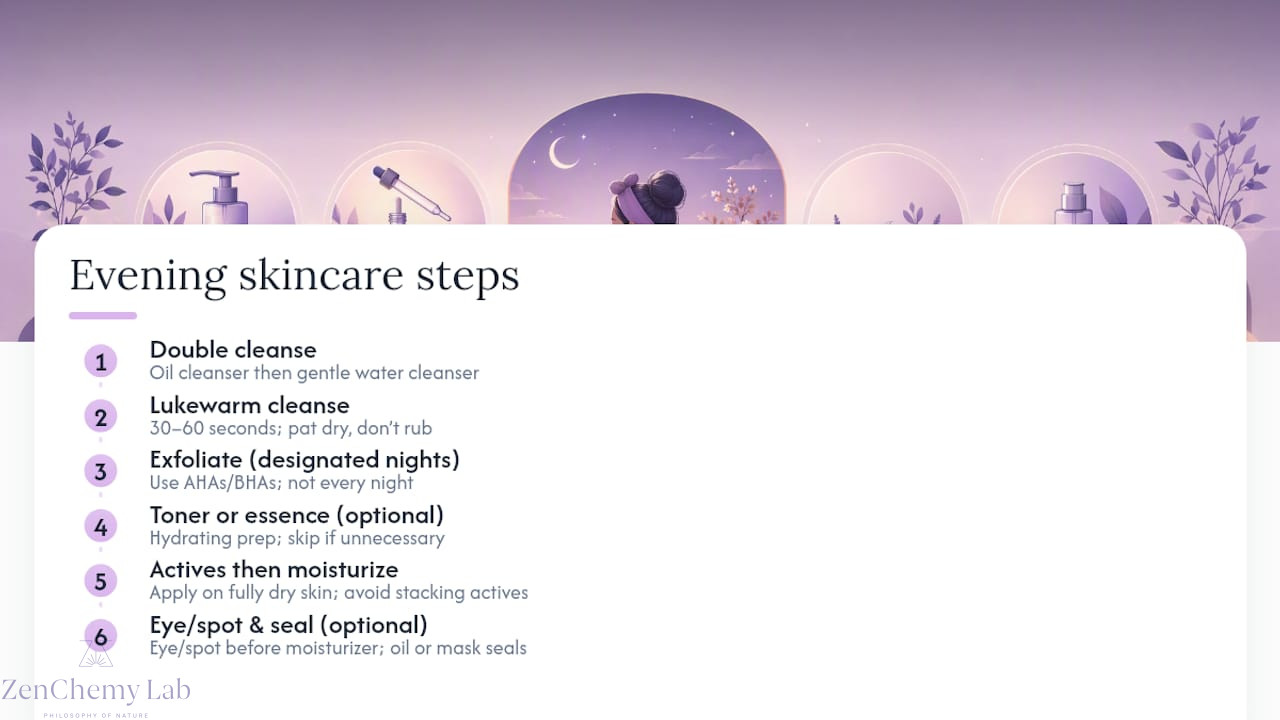
1. Double cleanse if you wore makeup or SPF. Start with an oil-based cleanser to dissolve sunscreen, sebum, and makeup, then follow with a gentle water-based cleanser to lift away what the oil loosened. Dermatologists and skincare experts recommend this two-step method specifically because a single cleanse tends to leave residue that clogs pores overnight. Skipped makeup and sunscreen days? A single gentle cleanse is enough.
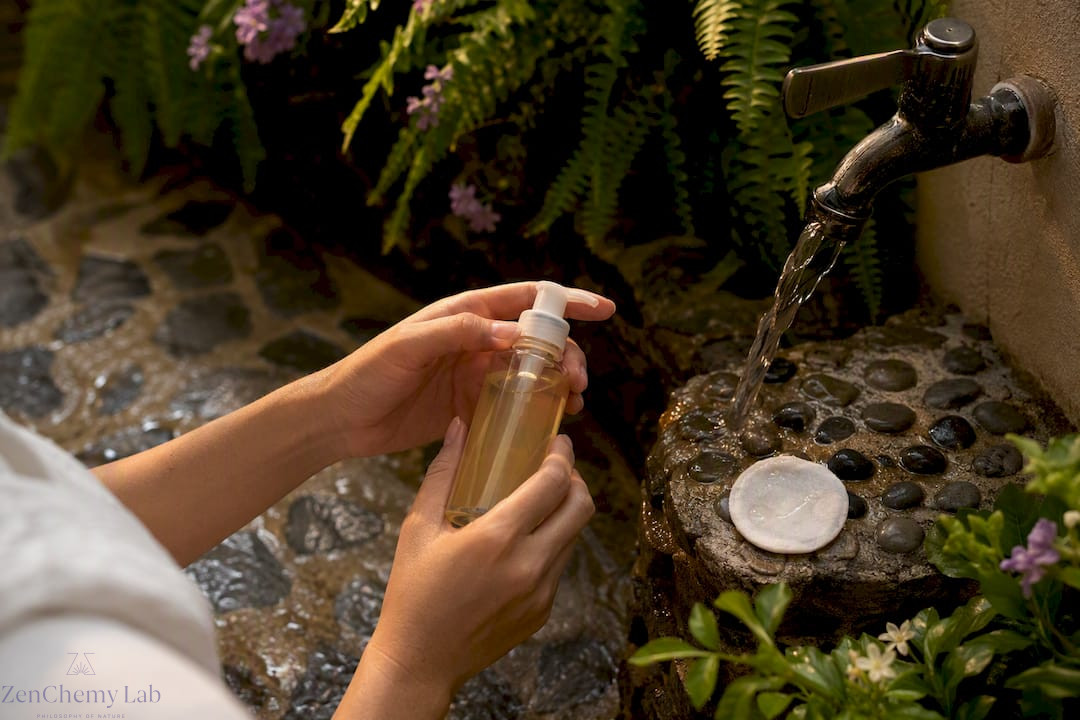
2. Cleanse with lukewarm water for 30 to 60 seconds. Hot water strips lipids from your skin barrier; lukewarm water removes grime without that damage. Pat dry, don’t rub.
3. Exfoliate on designated nights only, never every night. Chemical exfoliants (AHAs and BHAs) increase cell turnover and help other products penetrate deeper, but they belong on specific treatment nights, not the full weekly rotation.
4. Apply toner or essence if your skin likes it. This step is optional. A hydrating toner like a rose facial toner preps skin to absorb what comes next, but plenty of good routines skip it entirely.
5. Apply treatment serums on clean, dry skin. This is where retinoids, AHAs/BHAs, and niacinamide go. Apply actives to fully dry skin, since damp skin absorbs ingredients faster and unevenly, which raises irritation risk for stronger actives. Never stack two aggressive actives (say, a retinoid and a strong acid) on the same night.
6. Treat the eye area and any specific spots separately. Eye creams and spot treatments go on before your moisturizer, applied with light pressure.
7. Moisturize to lock everything in. This step matters regardless of what came before it. A moisturizer traps water in the skin and reinforces the barrier while you sleep.
8. Finish with a facial oil or sleeping mask on recovery nights. Oils and overnight masks work best when they’re the final layer, sealing in hydration for skin that’s not actively treating that night.
Pro Tip: Wait 20 to 30 minutes after applying retinoids or strong acids before layering on moisturizer if you’re new to that active. Once your skin builds tolerance, you can shorten that gap or apply moisturizer immediately after.
What does skin cycling actually look like in a week?
Skin cycling means rotating active treatment nights with recovery nights so your barrier gets a chance to rebuild between doses of retinoids or acids, as explained in Skin Health Benefits of Peptide Therapy Explained. A routine that alternates active nights with recovery nights reduces chronic irritation without sacrificing results, and it’s easier to sustain long term than nightly heavy treatment.
A reasonable weekly schedule for most people includes several treatment nights using retinoids or exfoliating acids, multiple recovery nights focusing on hydration and barrier repair without active ingredients, and some simple nights with just cleansing and moisturizing. For those new to retinoids, it’s advisable to begin with infrequent use and gradually increase as the skin adapts. Flaking, stinging that doesn’t fade, or persistent redness are signs to drop back a night and lean into recovery instead. Estheticians generally favour this flexible approach over rigid daily schedules, since it prioritizes barrier repair on the nights your skin needs it.
Why does product order matter so much?
Layer thinnest to thickest. Applying products from lightest to heaviest lets each formula absorb before the next one blocks it, which is why a watery serum always goes before a rich cream, never after.
- Rinse-off products (cleansers, exfoliating masks) are the exception. Order among them matters less since they don’t stay on the skin.
- Apply strong actives to fully dry skin. Water on your face speeds up absorption of ingredients like retinoids, which increases irritation risk for sensitive users.
- Wait roughly 10 to 20 minutes after a strong acid or retinoid before your next layer, longer if you’re a beginner.
- Treatment night example: cleanse, dry skin, retinoid, wait 15 minutes, eye cream, moisturizer.
How often should you actually exfoliate?
Chemical exfoliants outperform physical scrubs for most skin concerns because they work at a cellular level instead of just buffing the surface, and clinical literature confirms exfoliation increases both cell turnover and how well subsequent products absorb.
- BHA (salicylic acid): best for oily and acne-prone skin, since it cuts through sebum in pores.
- AHA (glycolic, lactic acid): better for dry or dull skin, working mainly on the surface.
- Physical scrubs: use sparingly, if at all. They’re easy to overdo and can cause micro-tears.
- Most people do well with chemical exfoliants one to three times weekly, adjusted for tolerance and skin type.
- Never exfoliate on the same night as a retinoid. Stacking the two multiplies irritation risk without adding benefit.
Tight, shiny, or stinging skin after cleansing is the clearest sign of over-exfoliation. Drop actives entirely for a few nights and focus on bland moisturizers until your skin settles.
How should dry, oily, combination, and sensitive skin adjust the ritual?
Your skin type shapes texture and frequency, not the sequence itself.
- Dry skin: richer creams, occlusive balms, and serums combining hyaluronic acid with glycerin to pull in and hold moisture.
- Oily or acne-prone skin: gel cleansers, BHA on treatment nights, and moisturizers labelled non-comedogenic so pores stay clear.
- Combination skin: apply lighter gel textures on the T-zone and richer cream on drier cheeks, same products, different zones.
- Sensitive skin: introduce one active at a time, choose fragrance-free formulas, and always patch test a new product on your inner arm for 24 to 48 hours before applying it to your face.
Can your evening ritual actually help you unwind?
Slowing down for skincare does more than treat your skin. Ritualized, sensory practices support nervous-system downregulation, which is part of why a paced routine can ease the transition to sleep better than a rushed one.
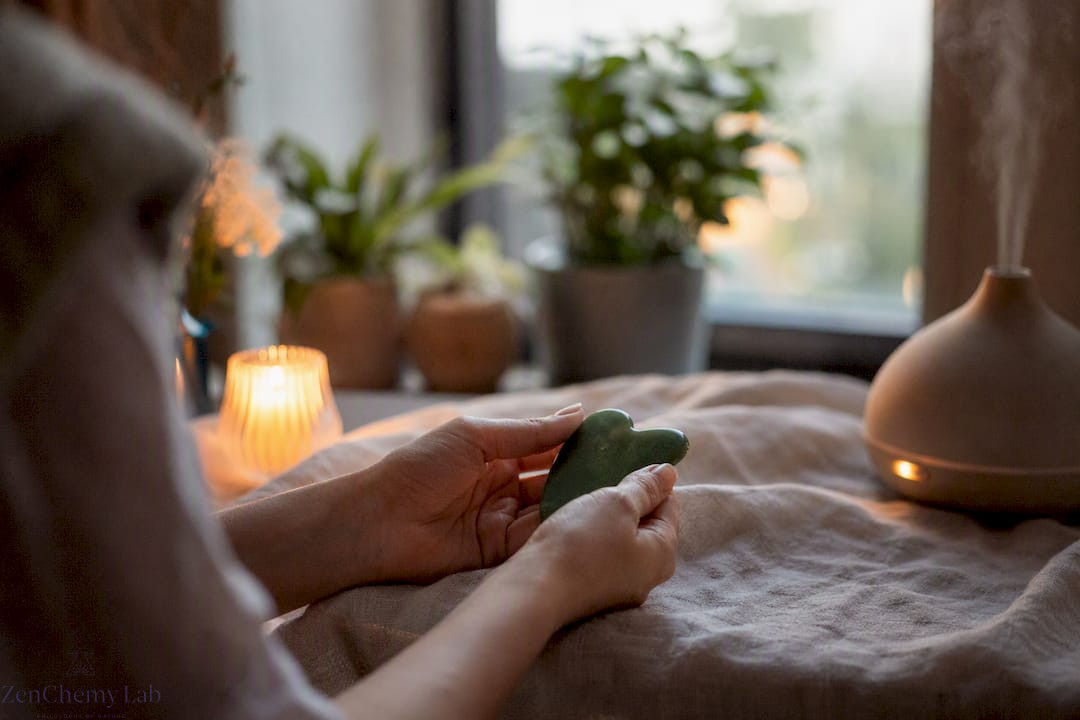
Try a few slow breaths while your cleanser sits, a gentle gua sha pass along your jaw, or a calming scent if you don’t have fragrance sensitivities. Skip scented products entirely if your skin reacts to them. There’s no ritual benefit worth a breakout.
What should you do if your skin reacts badly?
Tightness, stinging, visible flaking, or redness that lingers past a few hours signals barrier damage, not deeper skin renewal.
- Stop all actives immediately, including retinoids and acids.
- Moisturize generously and skip exfoliation completely until skin calms.
- Lean on barrier-supporting ingredients like ceramides and fatty acids.
- Reintroduce one active at a time, once weekly, watching for repeat irritation before adding anything else.
- Persistent reactions lasting more than a few days warrant a conversation with a dermatologist or your doctor.
Where Zenchemylab fits into your evening ritual
Zenchemylab formulates botanical serums, creams, and masks with non-toxic, cruelty-free ingredients built for exactly this kind of layered, skin-cycling-aware routine. Explore clean beauty formulations or ingredients suited to anti-ageing concerns for your treatment nights, and always check individual product pages for full ingredient lists and patch-test guidance before adding anything new.
Do night-shift workers need sunscreen after their evening ritual?
If your “evening” ritual happens before a daytime sleep shift, sunscreen still belongs in the sequence, just repositioned. Night-shift workers who sleep during daylight hours and are exposed to sunlight through windows, on their commute home, or during any daytime errands need SPF applied as the final step of their post-shift routine, not skipped because it’s technically morning for everyone else’s clock.
Treat sun exposure by light exposure, not by the position of the sun relative to your sleep schedule. If you’re heading home after a shift and it’s daylight outside, your ritual order becomes: cleanse, treat, moisturize, then sunscreen as the last layer before you leave for the day. Skip the facial oil or heavy sleeping mask that morning since sunscreen needs to sit directly on moisturized skin, not underneath an oil layer that can affect how evenly it sits.
If your sleep block happens at night like most people, and your “morning” starts before dawn, sunscreen goes on before you’re exposed to daylight, whenever that is on your particular clock. Reapply every two hours if you’re outside for extended periods, exactly as you would during a conventional daytime shift.
The core principle: SPF timing follows light exposure, and your skincare ritual timing follows your sleep and wake schedule. The two calendars don’t have to match everyone else’s, but they do need to match each other.
Do you need gua sha, jade rollers, or cleansing brushes?
None of these tools are required for an effective evening skincare ritual, but each adds a specific benefit if you enjoy the process.
Facial cleansing brushes provide deeper mechanical cleansing than fingers alone, useful for makeup-heavy days, but they can be too abrasive for sensitive or actively treating skin. Use them on recovery nights only, not alongside acids or retinoids.
Gua sha tools are flat stones dragged along the skin in upward strokes, typically used after applying a facial oil or serum so the tool glides instead of tugging. The main benefit is circulation and the slow, deliberate pace it forces into your routine, which supports the wind-down effect discussed earlier.
Jade rollers work similarly to gua sha but roll rather than scrape, making them a gentler entry point if you’re new to facial tools. Keep either tool in the fridge for a mild cooling effect that helps with morning puffiness if you also use them then.
None of these tools replace cleansing, treating, or moisturizing. They’re additions layered onto an already sound ritual, not substitutes for it. If your budget or interest doesn’t stretch to extra tools, your skin does just as well without them, provided the core steps stay consistent.
Should your ritual change with the seasons?
Your skin’s needs shift with humidity and temperature, and your evening ritual should shift with them.
Winter calls for richer moisturizers, more frequent use of occlusive balms, and often a step back from aggressive exfoliation, since cold air and indoor heating both strip moisture and weaken your barrier’s ability to bounce back. Layering a hydrating serum under a heavier cream, or adding a facial oil most nights instead of occasionally, helps offset the dryness.
Summer usually allows lighter textures. Gel moisturizers and lighter serums feel more comfortable in heat and humidity, and oily or combination skin types often need less richness during warmer months. Exfoliation tolerance can also shift; some people handle more frequent acid use in summer when their skin produces more oil, while others find heat makes their skin more reactive.
Transitional seasons (spring and fall) are the trickiest because your skin’s needs can change week to week. Pay attention to how your skin feels rather than following a fixed calendar. Tightness after cleansing signals it’s time to add richness back in; excess shine signals it’s time to lighten up.
The ritual’s structure never changes, cleanse, treat, moisturize, seal. Only the texture and richness of what you’re using shifts with the season.
Repair and rest: what actually matters in an evening ritual
The biggest mistake in most evening skincare advice is treating every night the same. Conventional wisdom pushes a maximalist routine, cleanser, toner, serum, retinoid, eye cream, moisturizer, oil, every single night, and that approach backfires for most people within a few weeks.
What the research actually supports is restraint paired with consistency. A rotation of treatment and recovery nights outperforms nightly intensity because your skin barrier needs downtime to actually benefit from active ingredients. Skin cycling isn’t a trend, it’s a practical acknowledgment that skin needs recovery the same way muscle does after exercise.
If you take one thing from this, prioritize the recovery nights, not the treatment nights. Most people obsess over which retinoid or acid to use and neglect the barrier-support side of the ritual entirely. A consistent, unglamorous moisturizer used every night does more for long-term skin health than an expensive serum used inconsistently.
Simple, repeatable, and boring on most nights, that’s what actually works.
— Alex
Ready to build your evening ritual with botanical ingredients?
If you’ve been reaching for synthetic actives packed with ingredients you can’t pronounce, there’s a gentler route to the same repair-and-hydrate results: formulas built from botanical ingredients instead of lab-synthesized fillers. Zenchemylab makes that swap simple, offering handcrafted serums, creams, and masks formulated without the harsh additives that make barrier recovery harder on treatment weeks.

Whether you’re stocking a recovery-night lineup or looking for your first hydrating serum, the essential natural skincare routine guide walks through exactly how to build a routine around non-toxic, cruelty-free products from the ground up. Start there, then browse the shop for the pieces your current ritual is missing.
Sources
- PMC review article on skin and topical therapies
- The Best Nightly Skincare Routine, According to Experts | Vogue
- Can skin products improve your mental health? | Psychology Today