“Fragrance-free” is an ingredient claim — no fragrance materials or masking scents were added to the formula. “Unscented” is a sensory claim — the product has no noticeable smell, but it may still contain masking agents that neutralise base odours. If you have skin sensitivity, a fragrance allergy, or a respiratory condition, fragrance-free is the stronger label to look for. That said, no front-of-pack claim replaces a quick scan of the INCI ingredient list, and Health Canada confirms there is no single statutory definition for either term in Canadian cosmetics law.
- ✅ Prefer fragrance-free if you have eczema, contact dermatitis, or a confirmed fragrance sensitivity — then verify the INCI list for “parfum,” “fragrance,” or essential oil names.
- ✅ Always check the ingredient list, regardless of what the front label says. The Canadian Dermatology Association and Zenchemylab both recommend this as your first line of defence.
Key takeaways
Fragrance-free is the stronger, ingredient-based claim; unscented describes only the sensory result and may still contain masking fragrance agents — always verify the INCI list regardless of which label a product carries.
| Point | Details |
|---|---|
| Fragrance-free vs. unscented | “Fragrance-free” means no fragrance or masking agents were added; “unscented” means no noticeable smell but masking agents may be present. |
| INCI list is your best tool | Scan for “parfum,” “fragrance,” “aroma,” and essential oil names before buying any product. |
| No Canadian legal definition | Health Canada does not define either term in statute; front-of-pack claims are self-regulated by manufacturers. |
| Patch-test before regular use | Apply to the inner forearm, wait 48 hours, and stop use immediately if any reaction appears. |
| Zenchemylab’s approach | Zenchemylab formulates without masking agents and publishes full INCI lists, with a body care range suited to sensitive skin. |
Table of Contents
- What does “unscented” actually mean on a label?
- What “fragrance-free” usually means (and where it falls short)
- Common label terms: what they mean and which to trust
- What does Health Canada actually require on cosmetic labels?
- How to verify a product before you use it
- When should you choose fragrance-free vs. unscented?
- How Zenchemylab approaches fragrance-free formulation
- Zenchemylab: natural skincare built for sensitive skin
- The label gap nobody talks about
- Sources
What does “unscented” actually mean on a label?
“Unscented” describes what your nose detects, not what is in the bottle. Formulators achieve that neutral, odourless result in one of two ways: they either select raw materials with naturally low odour profiles, or they add masking agents — fragrance compounds specifically chosen to cancel out the smell of other ingredients rather than to add a pleasant scent.
Soap is a classic example. The saponification process (the chemical reaction that turns oils and lye into soap) produces glycerine and fatty acids, some of which carry a faint, waxy odour. A manufacturer who wants to sell that bar as “unscented” may add a small amount of a neutralising fragrance compound to eliminate the smell. The bar genuinely has no perceptible scent, so the claim is technically accurate. The same logic applies to some deodorants, where masking agents neutralise the odour of active ingredients like baking soda or zinc.
The problem for sensitive skin? Masking agents are still fragrance chemicals. They bind to skin proteins the same way any other fragrance molecule does, and they can trigger the same immune-mediated reactions. As McGill University’s Office for Science and Society explains, the semantic difference between “unscented” and “fragrance-free” is precisely this: one describes the smell, the other describes the ingredients.
Pro Tip: If you react to a product labelled “unscented,” masking agents are a likely culprit. Scan the INCI list for “parfum,” “fragrance,” or any ingredient name ending in “-ol” or “-al” that you do not recognize — these are common fragrance-molecule suffixes.
What “fragrance-free” usually means (and where it falls short)
Fragrance-free means the manufacturer did not add fragrance materials or masking scents to the formula. The EPA’s Safer Choice programmed defines it this way explicitly: a fragrance-free product contains neither scent-imparting chemicals nor the neutralising agents used to mask odour. That is a meaningfully stronger commitment than “unscented.”
Still, the claim has real limits you should know about.
A product can be labelled “fragrance-free” and still contain naturally scented ingredients. Botanical extracts, plant-derived oils, and certain active compounds carry their own characteristic odours. Lavender extract, for instance, contains linalool — a compound that is both a natural constituent of the plant and a documented fragrance allergen. If a formulator adds lavender for its skin-calming properties rather than its scent, they may still consider the product “fragrance-free” because no fragrance was intentionally added. For highly reactive skin, that distinction matters.
Three practical caveats to keep in mind:
- Naturally scented botanicals. Essential oils, plant extracts, and some vitamins (like tocopherol from certain sources) carry incidental odour. They may not appear under “parfum” on the INCI list, but they can still cause reactions.
- Incidental odour from raw materials. Refined butters, waxes, and carrier oils each have a faint natural smell. A truly odourless formula often requires careful raw-material selection, not just the absence of added fragrance.
- No Canadian legal standard. Health Canada does not define “fragrance-free” in statute, so the claim is self-regulated by manufacturers. Peer-reviewed dermatology research links fragrance chemicals to contact dermatitis in clinical populations, which is precisely why verifying the INCI list remains the only reliable step.
The EPA’s Safer Choice standard offers one model of third-party verification: manufacturers can add a “fragrance-free” notation to a Safer Choice-certified product only after independent verification that no scent-imparting or masking chemicals are present. That kind of certification is worth recognizing when you see it.
Common label terms: what they mean and which to trust
Not every “clean” or “gentle” claim on a label means the same thing. Here is a plain-language breakdown of the terms you will encounter most often on Canadian shelves and product pages.
| Label term | What it generally means | Consumer take |
|---|---|---|
| Fragrance-free | No fragrance materials or masking scents added | Strongest claim; verify INCI for essential oils and botanicals |
| Unscented | No perceptible smell; may contain masking agents | Weaker claim; always check INCI for “parfum” or “fragrance” |
| Odourless | Synonym for unscented in most contexts | Treat the same as “unscented” — check INCI |
| No added fragrance | No intentional fragrance addition; raw materials may still carry scent | Similar to fragrance-free but less standardised; verify INCI |
| Perfume-free | European equivalent of fragrance-free; no perfume compounds added | Reliable if from an EU-regulated product; check INCI regardless |
| Hypoallergenic | Formulated to reduce allergy risk; no legal definition in Canada | Marketing claim only; does not guarantee fragrance-free status |
| For sensitive skin | Suggests gentler formulation; no regulatory standard | Useful signal but not a substitute for INCI verification |
The terms to be most cautious about are “hypoallergenic” and “for sensitive skin.” Both are marketing descriptors with no binding definition under Canadian law. A product can carry either phrase and still contain parfum. When you see them, treat them as a starting point, not a conclusion, and go straight to the ingredient list.
What does Health Canada actually require on cosmetic labels?
Canada’s cosmetic labelling rules require manufacturers to list all ingredients using standardised INCI (International Nomenclature of Cosmetic Ingredients) names, in descending order of concentration. That requirement is your most reliable tool as a shopper. What Health Canada’s labelling guidance does not do is define “fragrance-free,” “unscented,” or “hypoallergenic” as legal claims. Those terms are self-regulated, which means their meaning depends entirely on the manufacturer’s own interpretation.
This is a meaningful gap compared to the European Union, where regulations require the declaration of 26 specific fragrance allergens on ingredient lists above defined concentration thresholds. Canadian labels carry no equivalent requirement. A product sold here can list the single umbrella term “parfum” to cover dozens or even hundreds of individual fragrance chemicals, with no obligation to name them. For Canadians with fragrance sensitivity, that makes the EU’s transparency model a useful reference point — but not a protection you can rely on at home.
Your Canadian label checklist:
- ✅ Find the INCI ingredient list (required by law — if it is missing, do not buy the product)
- ✅ Scan for “parfum,” “fragrance,” or “aroma” — these umbrella terms can hide many individual chemicals
- ✅ Look for essential oil names: lavender, bergamot, eucalyptus, lemon, tea tree, and similar
- ✅ Check for third-party signals: EPA Safer Choice fragrance-free notation, or the National Eczema Association Seal of Acceptance
- ✅ When in doubt, contact the manufacturer directly and ask for a full ingredient disclosure
How to verify a product before you use it
Step 1: Read the INCI list
Locate the ingredient list on the packaging or the product page. Scan specifically for:
- “Parfum,” “fragrance,” or “aroma” — umbrella terms that can represent dozens of individual chemicals
- Essential oil names — lavandula angustifolia (lavender), citrus bergamia (bergamot), melaleuca alternifolia (tea tree), eucalyptus globulus, and similar
- Linalool, limonene, geraniol, citronellol, eugenol — naturally occurring fragrance constituents that must be declared in the EU but not in Canada; their presence signals fragrance-active compounds even in “natural” products
A helpful resource for decoding INCI terms is Zenchemylab’s guide to reading skincare labels, which walks through umbrella terms and common synonyms in plain language.
As an NIH open-access review notes, the single word “parfum” on an INCI list can represent dozens to hundreds of individual chemicals. For highly sensitive individuals, that opacity alone is a reason to choose a product with a fully disclosed, parfum-free formula.
Step 2: Patch-test before full use
Even a verified fragrance-free product can cause a reaction in some people, particularly those with multiple sensitivities. Follow this protocol:
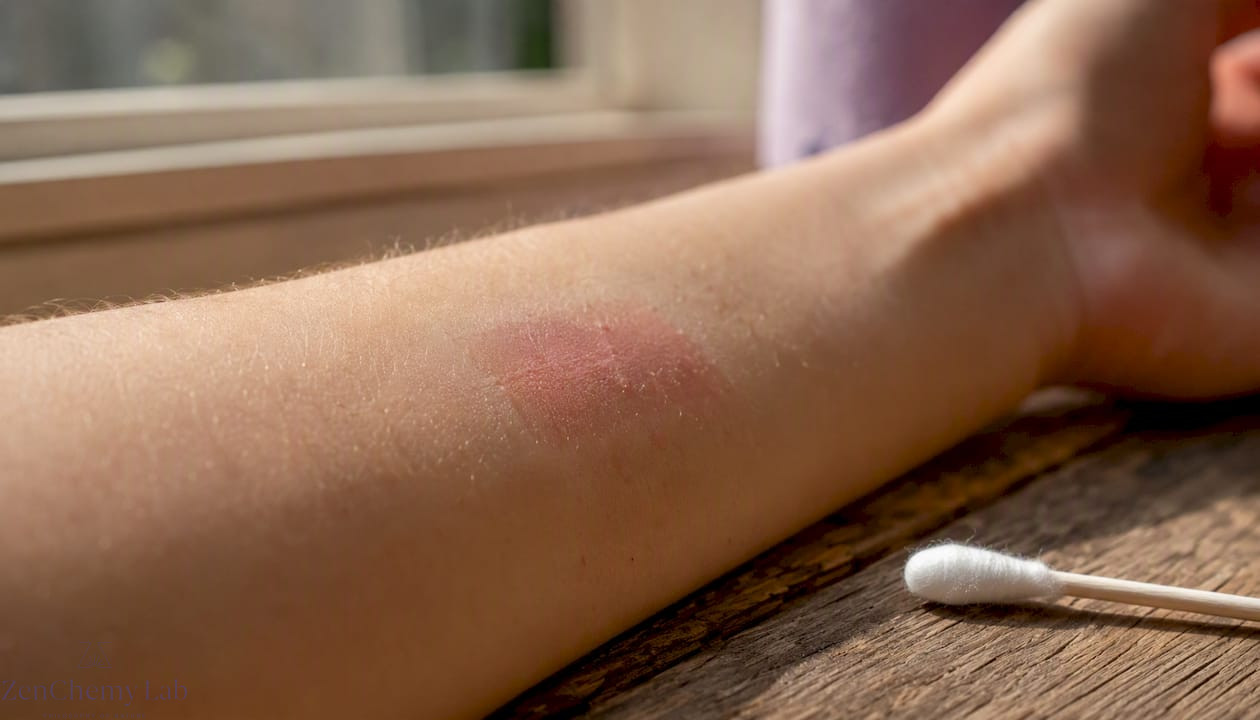
- Apply a small amount of the product to the inner forearm or behind the ear.
- Leave it undisturbed for 24 hours. Do not wash the area.
- Check at 24 hours and again at 48 hours for redness, itching, swelling, or any change in skin texture.
- If no reaction appears after 48 hours, the product is likely tolerable for your skin.
- If any reaction occurs, wash the area immediately with cool water and discontinue use. Consult a dermatologist if the reaction persists or spreads.
Foundational dermatology literature documents that fragrance allergy patterns vary widely between individuals, which is why patch testing remains the standard clinical recommendation before introducing any new personal-care product.
For workplace or childcare settings
If you are purchasing for a scent-free workplace or a childcare environment, request a Safety Data Sheet (SDS) or full ingredient disclosure from the manufacturer in writing. Product pages do not always reflect the most current formula — Wirecutter notes that reformulations are common, so checking the INCI at the point of purchase, every time, is the only reliable habit.
When should you choose fragrance-free vs. unscented?
The answer depends on your skin’s history and your environment.
Choose fragrance-free and verify the INCI list when you:
- Have a confirmed fragrance allergy or a history of allergic contact dermatitis. Peer-reviewed evidence consistently identifies fragrance chemicals as a leading cause of contact dermatitis in clinical populations.
- Have eczema. The National Eczema Association’s Seal of Acceptance identifies products vetted specifically for this condition — look for it on packaging.
- Are buying products for infants or young children, whose skin barrier is thinner and more permeable than adult skin.
- Work in or manage a scent-free environment (many Canadian workplaces and healthcare settings have formal scent policies).
Unscented may be acceptable when you:
- Have no known fragrance sensitivity and simply prefer a neutral-smelling product for personal comfort.
- Are using a rinse-off product (shampoo, body wash) where skin contact time is short and concentration at the skin surface is lower.
One point that surprises many people: “natural fragrance” and essential oils are not safer alternatives for fragrance-allergic individuals. Both synthetic fragrance molecules and botanical constituents like linalool can cause allergic contact dermatitis. The source of the chemical — plant or laboratory — does not change its ability to trigger an immune response. For more on which ingredients tend to suit reactive skin, Zenchemylab’s guide to natural ingredients for sensitive skin covers low-odour, well-tolerated options in detail.
Pro Tip: If a product is labelled “natural fragrance” rather than “fragrance-free,” treat it the same as “fragrance” on the INCI list. “Natural” describes the source, not the allergenic potential.
How Zenchemylab approaches fragrance-free formulation
At Zenchemylab, the commitment to clean, non-toxic formulations shapes every product decision, from raw material sourcing to the final bar or bottle. Here is what that looks like in practice:
- No masking agents. Zenchemylab does not add neutralising fragrance compounds to achieve an odourless result. Products intended to be fragrance-free are formulated that way from the ground up, using raw materials selected for their naturally low odour profiles.
- Low-odour emollients. Refined plant-based esters and butters with minimal inherent scent replace higher-odour alternatives, so the base formula itself contributes little to no fragrance character.
- Fragrance-free preservatives. Preservation systems are chosen to avoid fragrance-active compounds, a common hidden source of sensitization in otherwise “clean” products.
- Transparent INCI labelling. Every Zenchemylab product carries a full INCI ingredient list. If you want to verify a specific product’s suitability for your skin, the ingredient list is always available, and the team can be contacted directly for additional formulation details.
- Cruelty-free and non-toxic throughout. No ingredient is included for aesthetic or marketing reasons alone — every component earns its place by contributing to skin health or product stability.
Readers who want to explore Zenchemylab’s body care range will find products formulated with these principles in mind, including fragrance-free options for sensitive skin.
Zenchemylab: natural skincare built for sensitive skin
If you have spent time reading labels and still feel uncertain about what is actually in your products, Zenchemylab’s handcrafted skincare line offers a straightforward alternative. Every product is made with fully disclosed, non-toxic ingredients — no parfum, no masking agents, no ambiguity. The INCI list is right there, and the formulation philosophy behind each item is rooted in skin health, not scent marketing.
The natural skin collection is a practical starting point for anyone building a fragrance-free routine from scratch: artisan soaps, botanical face creams, body balms, and gentle washes, all made in small batches with ingredient-conscious buyers in mind. Browse the collection, check the ingredient list for any product that interests you, and reach out if you have questions about suitability for your skin type.
The label gap nobody talks about
The conventional advice on this topic stops at “choose fragrance-free over unscented.” That is correct, but it misses the more uncomfortable truth: even “fragrance-free” is an unregulated claim in Canada, and the ingredient list is the only document that actually tells you what is in the product.
What I find consistently underestimated is the essential oil problem. A significant portion of the “clean beauty” market has shifted from synthetic parfum to botanical extracts and essential oils, marketing this as a safer alternative. It is not, for allergic individuals. Linalool, limonene, and geraniol are naturally occurring in dozens of plant extracts, and they are also among the most common fragrance allergens documented in dermatology clinics. A product can be entirely synthetic-fragrance-free and still cause a reaction in someone sensitive to these compounds.
The practical upshot: if you have a confirmed fragrance allergy, “fragrance-free” on the front label is a starting point, not a finish line. Read the INCI list every time, look for essential oil names alongside “parfum,” and patch-test before committing to regular use. That three-step habit is more protective than any single label claim, regardless of how reassuring the packaging looks.