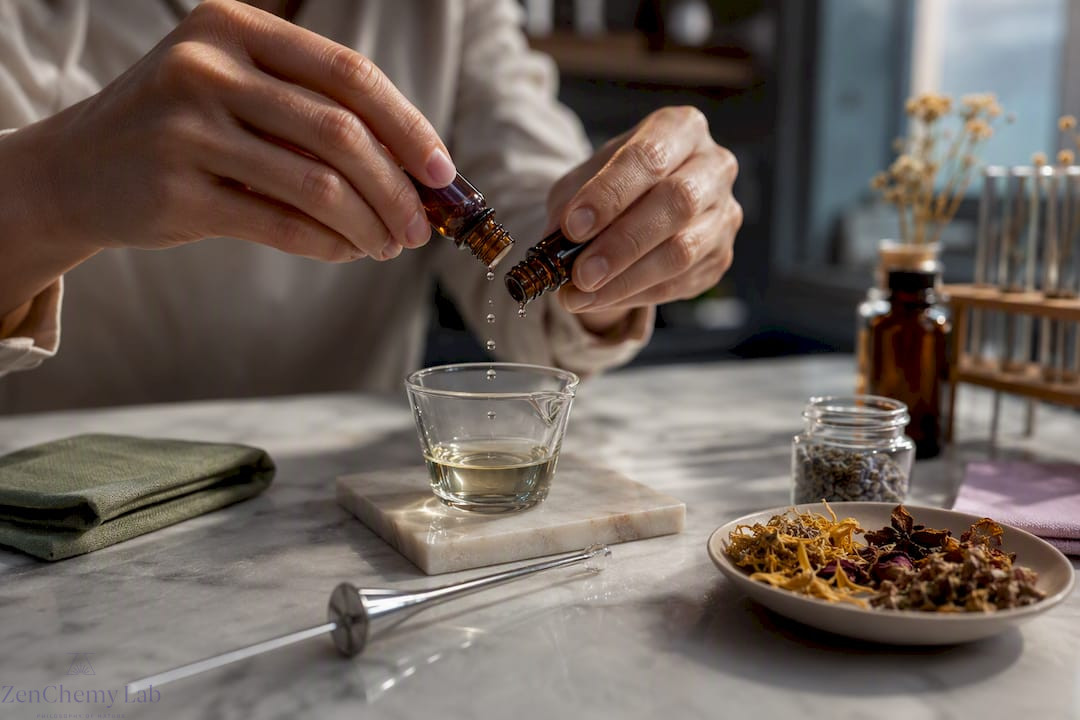
Essential oils are steam-distilled or cold-pressed plant extracts, best suited to aromatherapy, nebulizing diffusers, and carefully diluted skincare. Fragrance oils are lab-formulated scent blends, better suited to candles, wax melts, and reed diffusers where consistency and throw matter more than botanical origin. For skin contact of any kind, check the IFRA certificate and dilution guidance before you commit a batch.
TL;DR:
- Certified essential oils should include a Latin name, plant part, chemotype, origin, harvest batch, and GC/MS report to confirm chemical consistency.
- Fragrance oils are synthetic or nature-identical scent blends suitable for candles and diffusers, with safety and use limits documented by IFRA certificates and SDS sheets.
- Fragrance oils typically last longer and have a stronger scent throw in passive products, while essential oils excel in nebulizing diffusers for botanical authenticity.
- Both oil types can be blended safely if the total usage stays within the IFRA limit, but equipment and storage conditions significantly impact performance and longevity.
- Always verify documentation and test small batches before scaling, as safety and scent behavior depend on formulation and proper handling rather than natural or synthetic labels.
Table of Contents
- What are essential oils and how are they made?
- What are fragrance oils and how are they formulated?
- Scent range, longevity, and cost: how do they really compare?
- How safe are essential oils and fragrance oils on skin?
- How do you choose between essential and fragrance oils for your project?
- Can you mix fragrance oils and essential oils safely?
- What has ZenChemy Lab learned from testing scent in small batches?
- What actually matters when you’re choosing a scent oil
- Looking for plant-forward formulations with the paperwork already done?
- Sources
What are essential oils and how are they made?
Essential oils come from plants through steam distillation or cold pressing, two extraction methods that pull volatile aromatic compounds out of leaves, peels, resin, or flowers without adding synthetic material. What lands in the bottle is a concentrated mix of naturally occurring chemicals, terpenes, esters, and alcohols, whose exact profile depends on the plant, the growing season, and even the soil.
That variability is why a serious supplier publishes more than a pretty label. Look for:
- The Latin botanical name (Lavandula angustifolia, not just “lavender”)
- The plant part used (flower, leaf, peel, or root)
- Chemotype, when relevant (some plants produce chemically distinct oils depending on climate)
- Country of origin and harvest batch
- A GC/MS (gas chromatography, mass spectrometry) report confirming the actual chemical makeup
GC/MS testing matters because batch variability is real: two bottles labelled “lavender” can differ enough to change how they behave on skin or in a blend. Essential oils earn their place in nebulizing diffusers, where only pure plant oil should ever go, and in topical blends diluted to a safe percentage for the intended use.
What are fragrance oils and how are they formulated?
Fragrance oils are engineered scent compounds, built from a mix of synthetic aroma chemicals, natural isolates, and nature-identical molecules that a perfumer balances to hit a specific scent profile. Nothing about that makes them lesser. It means a formulator can create a “fresh linen” or “sea salt” scent that no plant on Earth actually produces, and can do it the same way every single batch.
Grade matters more than most buyers realize. Cosmetic-grade fragrance oils go through additional safety review for skin contact, and a legitimate supplier backs that up with paperwork:
- An IFRA certificate showing the maximum usage percentage by product category
- A safety data sheet (SDS) detailing composition and handling
- Clear labelling of intended use (candle, cosmetic, or both)
Fragrance oils tend to win for candles, reed diffusers, and long-lasting room sprays, anywhere a formulator’s fixatives and base notes help a scent hold its shape over hours instead of minutes.
Scent range, longevity, and cost: how do they really compare?
Choosing between essential and fragrance oils usually comes down to four practical factors, not brand loyalty.
- Scent range. Essential oils are limited to what botany actually produces. Fragrance oils can replicate a natural scent or invent one that doesn’t exist in nature at all, like “birthday cake” or “rain on concrete,” giving formulators far more creative range.
- Longevity and throw. In candles, wax melts, and passive diffusers, fragrance oils generally hold scent longer and throw harder because their fixatives resist burning off as quickly as volatile plant compounds. Essential oils shine in nebulizing diffusers instead, where subtlety and true botanical character are the whole point.
- Cost and supply. Essential oils that need enormous volumes of raw plant material, rose otto is a classic example, carry a price to match. Fragrance oils are produced at consistent cost regardless of weather, harvest, or geopolitics, which keeps pricing stable batch to batch.
- Technical compatibility. Heat behaviour in candle wax, pH shifts during cold-process soap saponification, and the mechanics of your diffusion equipment all affect real-world performance differently depending on which oil type you use.
None of this makes one category universally “better.” A rosemary essential oil brings real aromatherapeutic character to a diffuser blend; a well-built fragrance oil brings scent that survives a 60°C melt pool for six hours straight. The right choice depends entirely on what you’re making.
How safe are essential oils and fragrance oils on skin?
Safety comes down to documentation and dilution, not whether an oil is “natural” or “synthetic.” The IFRA (International Fragrance Association) sets maximum usage percentages by category: leave-on products (lotions, perfumes), rinse-off products (soap, shampoo), and no-contact products (candles) each carry different limits, because skin contact time changes the risk.
One of the most persistent myths in this space is that “natural” automatically means “gentle.” It doesn’t. Documented sensitizers like limonene and linalool occur naturally in citrus and lavender oils, and oxidation can make them more irritating over time, not less.
- Citrus essential oils oxidize faster once opened, raising sensitization risk with age
- A poorly formulated fragrance oil can still exceed IFRA limits if a supplier skips proper assessment
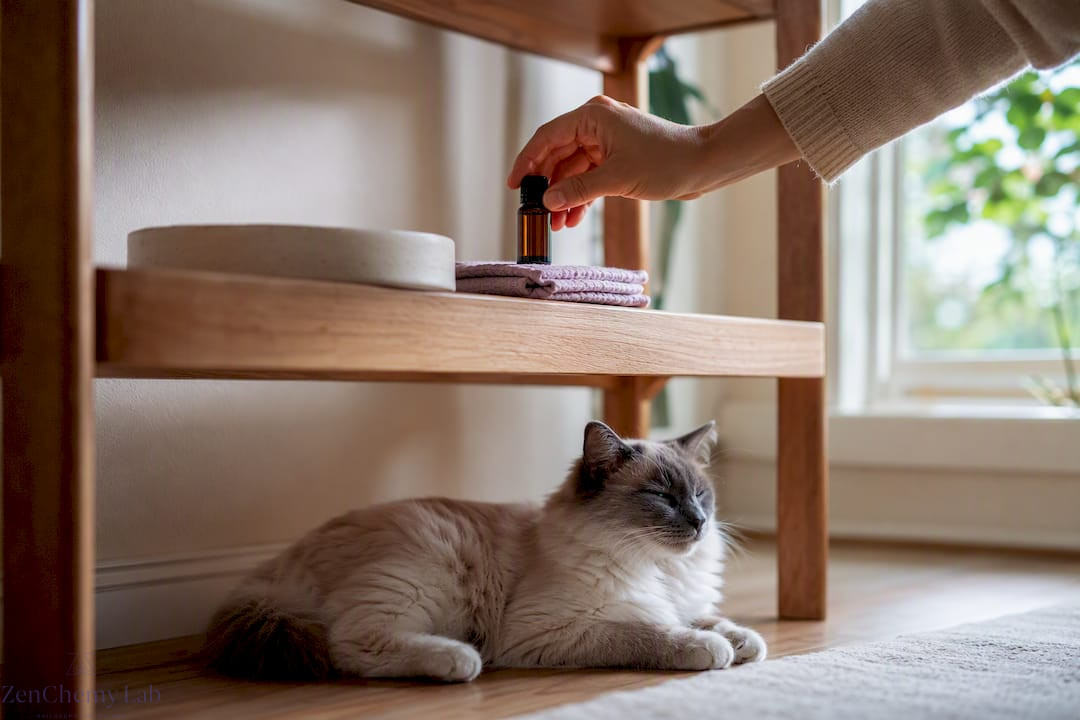
- Cats in particular are highly sensitive to many essential oils, including tea tree and citrus, because their livers process certain compounds poorly
- Ingesting or misusing concentrated essential oils can cause real toxicity, especially in small children
Pro Tip: A common safe starting dilution for topical blends is around 1 to 2 percent essential oil in a carrier, roughly 5 to 10 drops per ounce of carrier oil, though the right rate depends on the specific oil and product type, not a universal rule.
Keep any oil, either type, away from countertops pets can reach, and skip diffusing around cats altogether if you’re unsure.
How do you choose between essential and fragrance oils for your project?
Start with the outcome you want, then pick the oil type that gets you there.
- Define your product base first. Cold-process soap, candle wax, a body oil, and a reed diffuser each interact with scent differently, so name the base before you shop.
- Set your priorities. Rank longevity, budget, and botanical authenticity in order of importance for this specific project.
- Check sensitivity concerns. If the product touches skin, or if it’s going in a home with kids or pets, dilution and allergen review move to the top of the list.
- Request documentation before buying. Ask for the IFRA certificate, the SDS, and, for essential oils, a GC/MS report.
- Watch for red flags. No IFRA certificate on request, a vague “parfum” or “fragrance” label with zero breakdown, or a supplier who can’t explain candle-grade versus cosmetic-grade should send you elsewhere.
A supplier confident in their product answers these questions without hesitation.
Can you mix fragrance oils and essential oils safely?
You can blend the two, and many makers do, as long as the combined total stays within the IFRA limit for your product category rather than treating each oil’s allowance separately.
Equipment matters as much as the blend. Cold-air nebulizing diffusers require pure essential oils; fragrance oils can clog the atomizer. Ultrasonic diffusers tolerate fragrance oils since the water dilutes them, but expect more frequent cleaning.
- Store both oil types away from direct light and heat to slow oxidation
- Fragrance oils generally hold their profile longer in storage than essential oils
- Run a small 50 to 100 gram test batch before scaling up soap or candles, since heat and pH change how scent behaves
Pro Tip: Cure your test batch the same way you’ll cure the final product, then smell it again after a week. Scent morphing during saponification is common and easy to miss if you only sniff it fresh.
What has ZenChemy Lab learned from testing scent in small batches?
At ZenChemy Lab, we treat scent decisions the same way we treat ingredients: verify before you formulate. Before any botanical oil goes into a soap or body product, we ask suppliers for the same documentation this article recommends, GC/MS reports for essential oils, IFRA certificates and SDS for anything with fragrance components, and we run small test batches to watch for fade or morphing. That process shapes how we talk about safe essential oil use on skin and where essential oils actually belong in skincare formulation.
What actually matters when you’re choosing a scent oil

The advice that circulates most on this topic, “use essential oils because they’re natural, avoid fragrance oils because they’re synthetic,” gets the priority backwards. A well-formulated, IFRA-compliant fragrance oil can be safer to use on skin than an undiluted essential oil, precisely because a perfumer has already balanced and capped the sensitizing components for you. Nature doesn’t self-regulate for skin contact; formulation does.
Where conventional advice really falls short is treating “natural” and “synthetic” as a safety verdict instead of a starting point for a real question: does this specific oil, at this specific concentration, have documentation for this specific use? That question matters more for a leave-on face oil than for a candle, and more for a household with cats than one without.
If you’re deciding right now, prioritize the paperwork over the marketing language. A supplier’s stated IFRA percentage and SDS tell you more in thirty seconds than an “all-natural” label tells you in a full product description. Read our take on how natural ingredients actually compare to synthetic ones in skincare if you want the fuller picture beyond scent alone.
— Alex
Looking for plant-forward formulations with the paperwork already done?
If you’d rather skip the supplier vetting and batch testing altogether, Zenchemylab builds that verification into every product before it reaches your door. Every body oil, balm, and soap starts from documented botanical ingredients chosen for gentleness on skin, not just candle performance, so you’re not stuck reading IFRA percentages before your next bath night.

Our plant-forward skincare and body oil collection is built around the same principle this article pushes hardest: know what’s in the bottle before it touches your skin. If you make your own soaps or candles at home and want a botanical baseline to compare your blends against, browse the collection and see how a documented, gentle formulation actually feels.
Sources
- Health Canada — cosmetics safety (IFRA referenced)
- Poison Control — essential oils guidance
- CandleScience — difference for candle makers