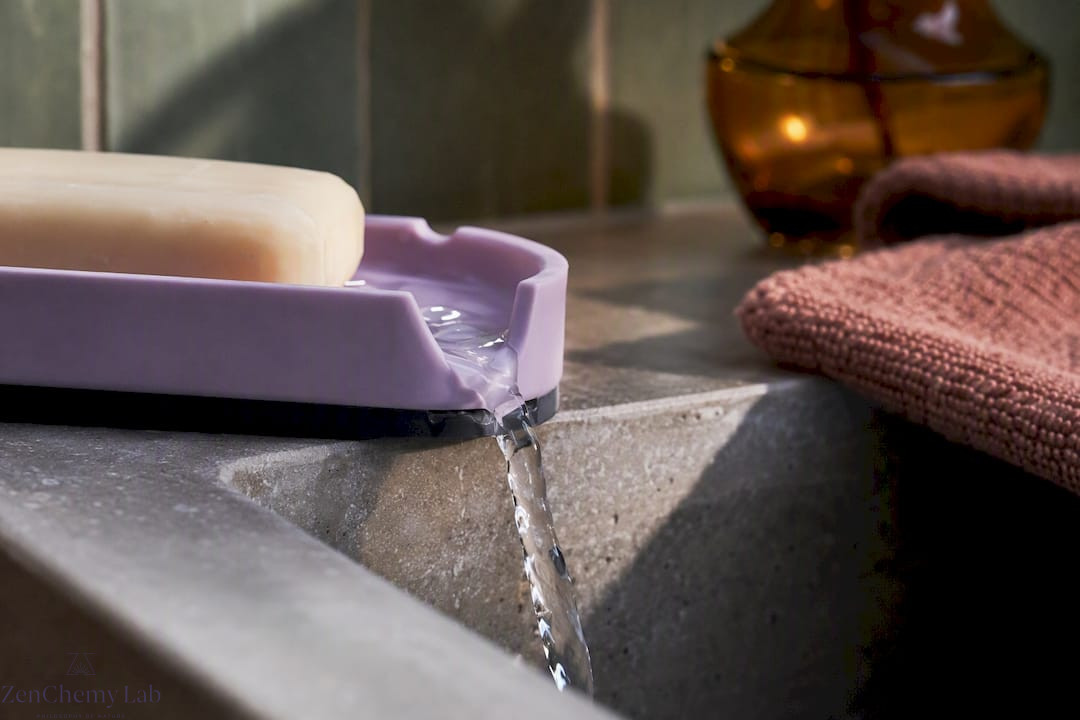
Soap turns mushy for one reason: it sits in standing water instead of drying between uses. The fix is a self-draining channel dish or a raised silicone/ceramic rack that actively moves water away from the bar rather than just lifting it a few millimetres. Silicone, single-piece hardwood, and ceramic with a built-in spout perform best for both drainage and durability. If your current dish holds a puddle, swap it tonight for a self-draining tray angled over the sink edge, or a silicone version with drainage channels.
TL;DR:
- Self-draining channel dishes with angled grooves and spouts outperform flat trays in keeping soap dry and usually cost more upfront but last longer.
- Solid single-piece silicone or bamboo dishes resist warping, mildew, and soap buildup better than glued slats or porous materials in consistently wet environments.
- Proper placement of the dish at the sink edge or shower wall, with correct drainage orientation and tilt, is essential to prevent water pooling and ensure effective drainage.
- Regular cleaning involving rinsing and air drying extends the life of the dish and prevents mildew or clogging, especially for catchment trays and removable parts.
- Dishes with true tilt and open airflow dry faster and stay cleaner, increasing soap lifespan and reducing maintenance compared to flat or poorly angled designs.
Table of Contents
- What are the main soap dish drainage styles?
- Which materials hold up best for soap dish drainage?
- How should you place a draining soap dish for best results?
- How do you clean a soap dish to stop mildew?
- How to choose the right soap dish: a short checklist
- Does soap dish size and shape affect drainage?
- Why does airflow around a soap dish matter?
- How does drainage angle or tilt reduce water pooling?
- What ZenChemy Lab’s approach to drainage design gets right
- Which ZenChemy Lab soap dish fits your bathroom?
- Sources
What are the main soap dish drainage styles?
Not all “draining” dishes actually drain. Understanding the difference between four common styles will save you from buying the wrong one twice.
- Self-draining channel dishes use angled grooves or a sloped floor to funnel water off the bar and out through a spout, usually positioned over a sink or tub. Product testing groups these as their own category because they consistently outperform flat trays on keeping bars dry.
- Slat or raised dishes lift the bar above a shallow well using ridges or bars. This stops the soap from sitting directly in a puddle, but the water still has to go somewhere, and often that’s your counter.
- Container or catchment dishes pair a raised insert with a lower tray that collects runoff, which you empty periodically. They work well but need regular emptying to stay useful.
- Wall or hanging mounts keep soap off wet surfaces entirely, using suction cups or adhesive hooks, and let gravity do the draining straight into the shower floor or tub.
Here’s the misconception worth clearing up: raised slats alone don’t guarantee a dry counter. Design experts note that these dishes can be mistaken for true self-draining options when they’re really just elevation without an exit path. Unless a slat dish sits inside a catchment tray or over a drain, the water pools somewhere nearby.
Which materials hold up best for soap dish drainage?
Material choice affects both how well water sheds off the bar and how long the dish itself survives daily soaking.
Silicone resists soap cling almost entirely, which means less scrubbing and no soap film building up in grooves. Most silicone trays are dishwasher safe, and design-focused reviews consistently recommend silicone alongside ceramic specifically because neither material lets soap stick and rot in place.
Solid wood and bamboo look warm and natural, but construction matters more than species here. A single carved piece resists warping far longer than slats glued into a frame, since glue joints are the first thing to fail when exposed to constant moisture. Testing has found single-piece wooden dishes hold up better than glued slat versions in wet environments over time.
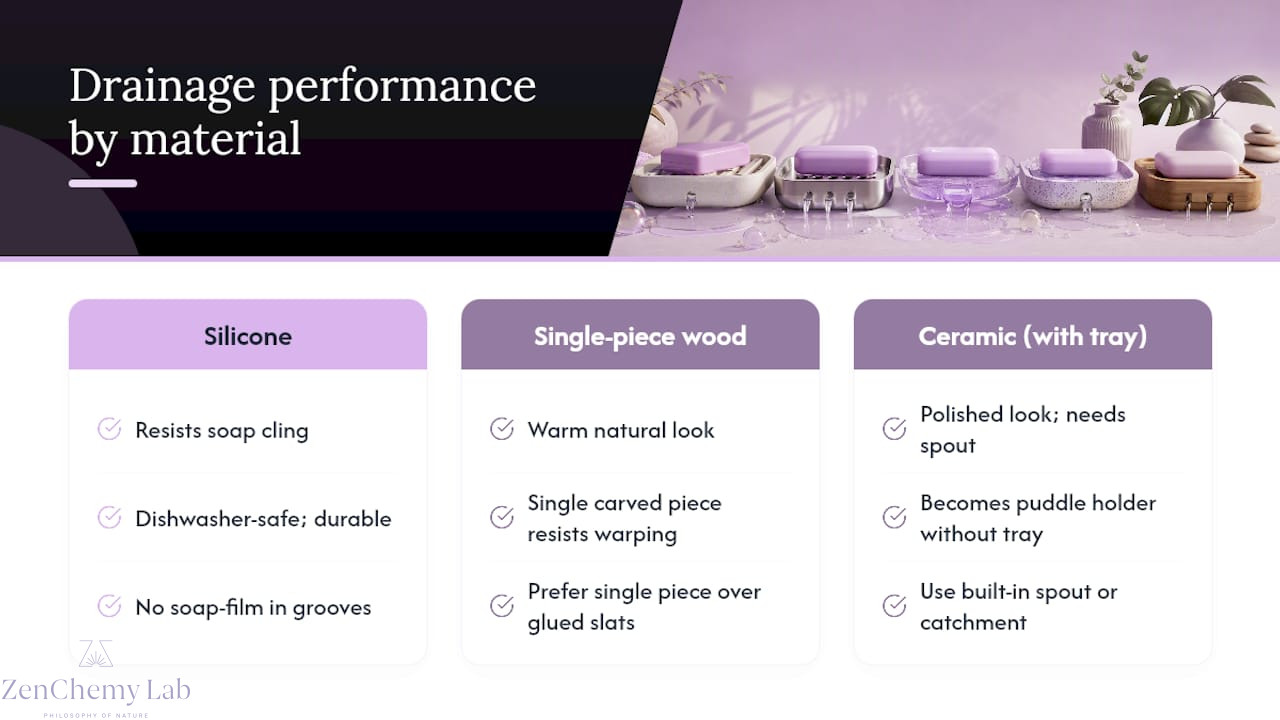
Ceramic offers a polished look but needs a built-in spout or a separate catchment tray underneath. Without one, ceramic just becomes an elegant puddle holder.
Metal racks can rust or corrode at chipped finish points, so check for a sealed or powder-coated surface before buying.
Pro Tip: Skip glued wooden slats for a shower stall or anywhere that never fully dries between uses. A single-piece bamboo dish, or a silicone tray, will outlast a glued build by years in that environment.
How should you place a draining soap dish for best results?
Even the best dish underperforms in the wrong spot. Follow these steps to match placement to your setup.
- Position self-draining trays at the sink edge, angled slightly so the spout or lowest point hangs over the basin, not the counter.
- Check the outlet direction before mounting. Channel dishes only work if the drainage point faces open water, not a wall or backsplash.
- For showers, use suction-mounted or wall-hung units placed where they won’t catch direct spray from the showerhead, which causes constant overspray pooling instead of controlled drainage. Retail designs built around edge placement rely on this exact alignment to work as intended.
- If your dish still drains onto a countertop, set it inside a small secondary tray or move it directly over the sink basin instead of the vanity top.
- For soap slivers too small to sit on any dish properly, switch to a mesh soap saver or pouch until the bar is finished.
How do you clean a soap dish to stop mildew?
Weekly upkeep is short, but skipping it is exactly how soap scum and mildew take hold.
- Silicone and ceramic: rinse under warm water, wipe with a cloth or brush, and let air dry fully before the next use. Both materials handle a dishwasher cycle if you want a deeper clean occasionally.
- Solid wood or bamboo: wipe dry after each use and apply a light food-safe mineral oil every few weeks to keep the grain from drying out or cracking.
- Catchment trays and removable racks: pull them apart monthly and scrub the hidden underside, where residue collects unseen.
Watch for replacement signs: mildew that won’t scrub out, wood that’s started to warp or crack, or a drainage spout that’s permanently clogged with hardened soap. Catching these early, and building a five-minute weekly rinse habit, is a small routine that doubles how long a bar of soap actually lasts.
How to choose the right soap dish: a short checklist
Buying the right dish comes down to matching design to where it’s going and how much upkeep you’re willing to do.
- Match the drainage style to the location. A self-draining channel dish belongs at the sink edge; a wall mount suits a shower better than a countertop tray does.
- Prioritize solid-piece wood or silicone if the dish will stay in a consistently wet spot, since both resist the warping and mildew that glued or porous materials develop.
- Read the product page closely for the drainage direction or angle, the material, the dimensions relative to your bar size, and any listed maintenance notes.
- Weigh budget against durability. A cheaper glued-slat dish might need replacing within a year, while a solid bamboo or silicone piece often costs more upfront but lasts several times longer.
- Check the return policy before buying online, especially for wall-mounted or suction designs where fit and grip strength can vary by shower surface.
Pro Tip: If a listing doesn’t mention where the water actually goes, drainage angle, spout, or open channel, assume it’s a basic raised tray, not a true self-draining design.
Does soap dish size and shape affect drainage?
Size and shape shape how fast water actually leaves the bar, not just how the bar sits.
A dish barely larger than your soap bar gives water almost nowhere to go except back onto the surface it just left. Oversized dishes with a wide flat floor create the opposite problem: water spreads out and lingers instead of running toward an exit point. The dishes that drain fastest tend to have a narrower footprint with a defined low point or channel, so gravity has a short, obvious path to follow.
Shape matters just as much. Round or oval dishes with a centre depression concentrate runoff into one spot, which works well when that spot lines up with a spout or the sink basin. Rectangular dishes with a single sloped edge behave similarly, directing water toward one exit rather than letting it wander. Flat, shallow dishes with minimal contour, regardless of size, almost always underperform because they don’t create enough of a gradient for water to move on its own.
If you’re switching from a flat dish to a contoured one, expect a noticeable difference within days. A bar that used to soften by midweek can hold its shape through a full week simply because the dish’s shape sends water away instead of letting it settle back onto the surface. Shape, more than sheer size, decides whether a dish drains on its own or needs you to tip it out manually.
Why does airflow around a soap dish matter?
Water that drains away is only half the job. The bar and the dish surface still need to dry, and that depends on air movement, not just gravity.
A dish tucked into a closed corner or crowded against a shower wall traps humid air right where the soap sits, slowing evaporation even after the excess water has run off. Raised designs with open sides or slotted bases let air pass underneath and around the bar, which speeds up drying considerably compared to a dish sitting flush against a flat surface.
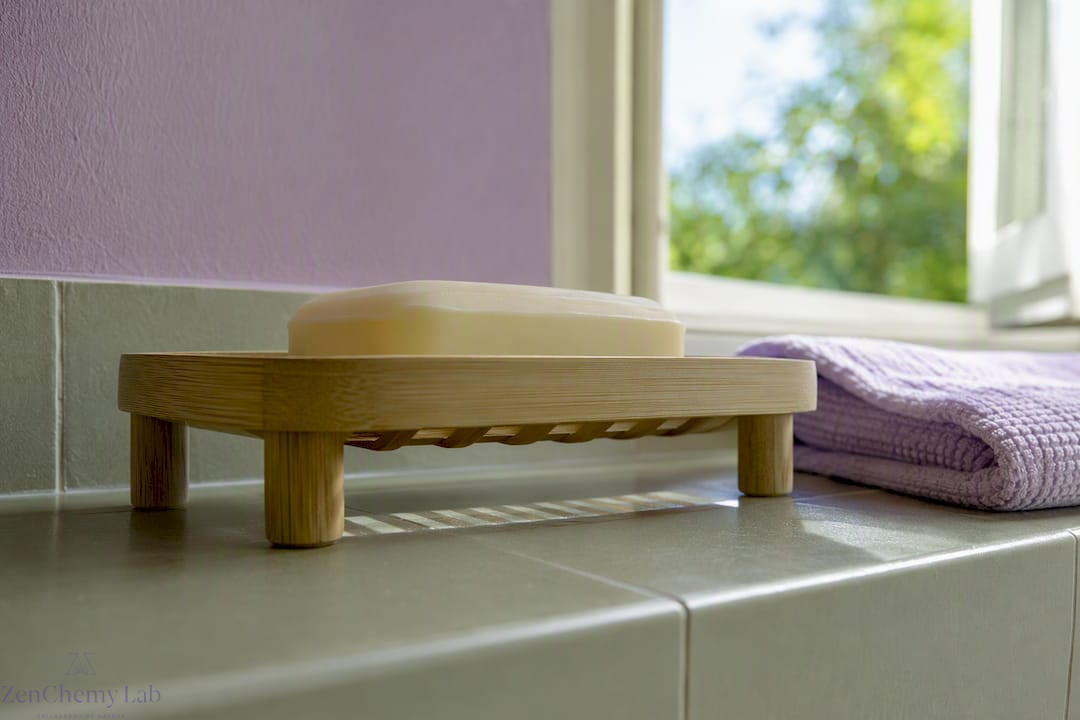
This is part of why elevated or slatted designs, even ones without active drainage channels, still help somewhat: the gap beneath the bar isn’t just for water to escape, it’s also space for air to circulate. Pairing that airflow with an exhaust fan or a cracked bathroom window after showers speeds up drying for the whole space, dish included.
Placement plays into this too. A dish near an open window or a well-ventilated wall dries faster than one wedged into a steamy shower corner that rarely gets fresh air. If mildew keeps returning no matter how often you clean, poor airflow around the dish itself, not just the material, is often the overlooked cause.
How does drainage angle or tilt reduce water pooling?
A flat surface is the enemy of good drainage, no matter how good the material is. Water needs a slope to follow, even a subtle one, or it simply sits.
Most effective self-draining dishes build in a tilt toward a single low point, whether that’s a spout, an open edge, or a suction-mounted drop-off into the sink. Silicone waterfall designs are built specifically around this principle, routing water down a sloped channel and back into the basin below rather than letting it collect on the dish itself.
The angle doesn’t need to be dramatic. Even a few degrees of tilt is often enough to keep water moving instead of pooling, provided the low point actually leads somewhere useful, like a sink or tub, rather than back onto a counter. This is also where placement and design intersect: a perfectly angled dish set on a flat countertop with no basin underneath will still leave a wet ring, because the water has to land somewhere.
If you notice water sitting in one spot on your current dish, check whether it’s genuinely tilted or just appears that way from the ridges. A dish that pools despite having raised slats usually has a level base underneath, which means the elevation is cosmetic rather than functional. True tilt, paired with correct placement, is what actually keeps a bar dry between uses.
What ZenChemy Lab’s approach to drainage design gets right
ZenChemy Lab builds its wooden, charcoal, and bamboo soap dishes around the same principle covered throughout this guide: soap needs airflow and an exit path for water, not just a surface to rest on. That focus on natural, non-toxic materials extends from the soaps themselves into the accessories meant to keep them usable longer.
What stands out in the wooden and bamboo dish designs is the preference for solid, single-piece construction over glued assemblies, which lines up with what durability testing on wet-environment dishes consistently finds. A dish that flexes or separates at a glue joint after a few months of daily use isn’t saving anyone money, even at a lower price.
The goal with any accessory in this category should be extending the life of a handcrafted bar, not undermining it with poor drainage.
— Alex
Which ZenChemy Lab soap dish fits your bathroom?
If you’ve read this far, you already know what to look for: solid construction, a real drainage path, and a material that won’t cling to soap. ZenChemy Lab’s bamboo soap dish holder is built as a single piece rather than glued slats, which suits sink-edge placement where the dish stays wet between multiple daily uses. For a shower stall with heavier splash exposure, a charcoal or bamboo option from the broader collection offers the same natural material without the maintenance issues that come with painted or laminated wood.

Anyone who’s tossed out a soggy, half-dissolved bar knows how quickly a poor dish erases the value of a good soap. ZenChemy Lab’s handmade soap dish range is designed specifically to pair with its handcrafted bars, so the drainage and the soap are working together instead of against each other. Browse the current bamboo and wooden dish options and pick the one that matches where your soap actually lives, sink, shower, or both.