
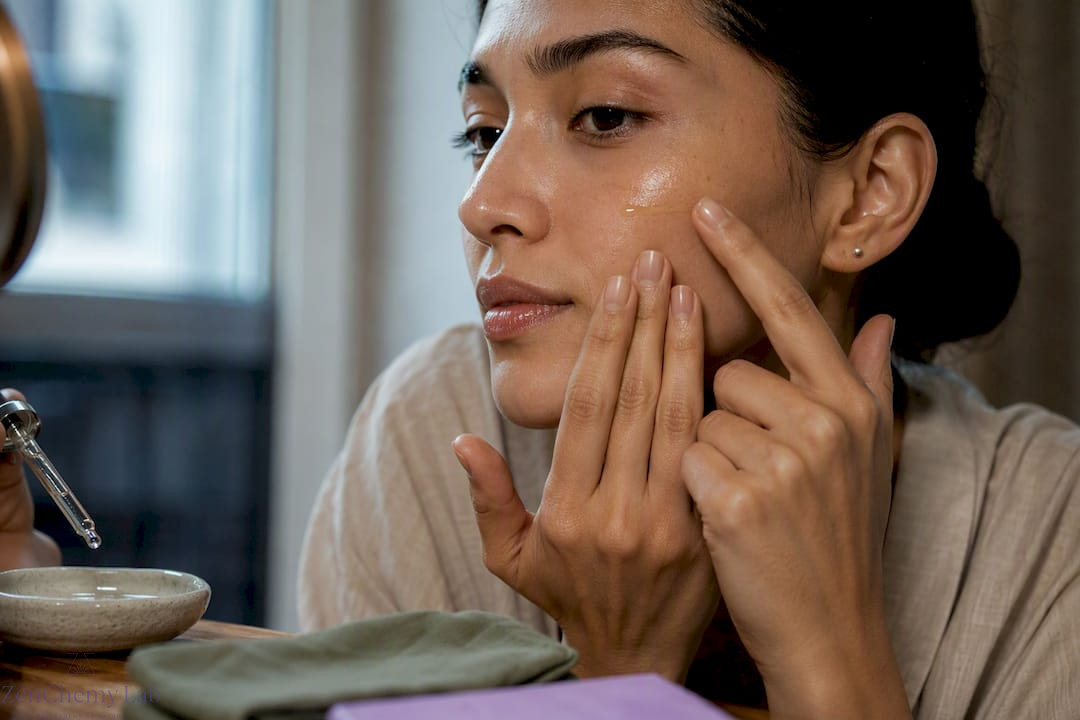
Serums are lightweight, often water-based treatments built to deliver concentrated actives deep into skin, while face oils are oil-based emollients that support the barrier and lock in whatever hydration is already there. The rule that ties them together: apply serums first because they’re lighter, then let your oil go last to seal everything in. Use both, and you’re treating skin from two different directions at once.
TL;DR:
- Face oils support the skin barrier and reduce water loss but do not deliver water, and should be applied after serums to seal in active ingredients.
- Serums penetrate the skin to target specific issues like hydration, dullness, or fine lines, whereas oils sit on the surface to soften and protect.
- In dry climates or winter, oils become more important to counteract rapid water evaporation, while in humid summer, lighter routines may omit oil altogether.
- Oily, sensitive, or reactive skin should choose lightweight, non-comedogenic oils and simple serums, patch test before full use, and avoid mixing oils directly into sunscreen.
- Layering should start with water-based serums on damp skin, followed by moisturizer, then oil as the last step, with morning and evening routines shifting slightly based on actives used.
Table of Contents
- What is a face oil?
- What is a serum?
- Face oil vs serum: how do they actually differ?
- Which should you use for your skin type?
- How do you layer face oil and serum correctly?
- What mistakes should you watch for?
- What should you look for in a natural formulation?
- The layering question everyone overcomplicates
- Where ZenChemy Lab fits into your routine
- Sources
What is a face oil?
A face oil is anhydrous, meaning it contains no water. It’s built from carrier oils and plant extracts rich in fatty acids and antioxidants, designed to sit on the skin’s surface and slow moisture loss rather than deliver it. This is what makes oils emollients, not humectants. They don’t pull water into skin the way a hyaluronic acid serum does. They plug the gaps in your skin’s barrier so the water already there stays put.
Different oils bring different strengths to that job:
- Squalane mimics your skin’s own sebum, absorbs quickly, and rarely clogs pores.
- Jojoba oil is structurally close to sebum too, which makes it a gentle fit for oily and combination skin.
- Argan oil and rosehip oil carry fatty acids and antioxidants that support elasticity and may soften the look of dark spots over time.
The benefits show up as barrier support, reduced transepidermal water loss (TEWL, the technical term for how fast water evaporates off your skin), a smoother texture, and that dewy finish people chase with highlighter. A small amount of a few drops is generally enough for most people. Using more can result in excess shine on the skin.
What is a serum?
A serum is typically water-based and formulated to carry a high concentration of one or two active ingredients past the surface layer of skin, where oils generally can’t reach. That’s the core distinction: serums are built to penetrate and deliver, while oils are built to sit and seal.
Not all serums do the same job. Broadly, they split into a few families:
- Hydrating serums (hyaluronic acid, glycerin) work as humectants, pulling water into the skin’s outer layers.
- Antioxidant serums (vitamin C) target dullness and environmental damage.
- Barrier and tone serums (niacinamide) calm redness and refine pore appearance.
- Treatment serums (peptides, retinoids, exfoliating acids) target fine lines, texture, and pigmentation directly.
Serums are the right call when you need targeted correction, not surface polish. Board-certified dermatologists often point to serums as the better starting point for repairing compromised skin, because their smaller molecules and active ingredients get to work below the surface rather than staying on top of it.
Face oil vs serum: how do they actually differ?
The mechanism is the whole story here. Oils are occlusive and emollient, meaning they form a barrier and soften skin from the outside. Serums are humectant and active-driven, meaning they pull moisture in or trigger a specific change at the cellular level. One works like plastic wrap over a bowl. The other works like a delivery truck.
You’ll feel the difference immediately. Oils add slip and a visible glow the moment they touch skin. Serums tend to feel thinner, absorb faster, and show their results over days or weeks rather than seconds.
A few pairings show how this plays out in practice:
- Hyaluronic acid serum + squalane oil: the serum pulls in water, the oil keeps it from evaporating. This is the classic hydration combo for dry or dehydrated skin.
- Niacinamide serum + a light oil like jojoba: good for skin that’s oily but still dehydrated, a combination more common than people assume.
- Retinol serum + rosehip oil at night: the oil helps buffer retinol’s drying effect while supporting overnight repair.
Climate shifts the balance, too. In dry winter air or low-humidity climates, oils earn a bigger role because TEWL accelerates. In humid summer months, many people drop the oil entirely and let the serum and a lighter moisturizer carry the routine.
Pro Tip: If your skin looks fine in summer but flakes the moment the furnace turns on, that’s your signal to add oil back in, not to switch serums.
Which should you use for your skin type?
The honest answer depends less on trend and more on what your skin is actually short on: water, oil, or both.
- Dry or mature skin benefits from a hydrating serum layered under a restorative oil like rosehip or argan. The serum floods in moisture; the oil, rich in fatty acids that support skin resilience, keeps it from disappearing by evening. This combination matters more in winter, when indoor heating strips moisture faster than skin can replace it.
- Oily or acne-prone skin does better with a lightweight serum (niacinamide is a common favourite) and, if oil is used at all, a non-comedogenic option like squalane or jojoba. Non-comedogenic oils can suit oily and acne-prone skin when the barrier needs support, but heavier essential-oil blends are worth skipping if you’re prone to congestion.
- Sensitive or barrier-compromised skin should stick to simple, low-ingredient serums and calming, fragrance-free oils, patch-tested before full use. Essential-oil-heavy blends are more likely to irritate reactive skin, so read labels carefully before adding anything botanical to a compromised barrier.
Morning routines usually favour serums with antioxidant or hydrating properties, since oil under sunscreen can feel heavy and isn’t always necessary before SPF. Evening is when oils earn their keep, sealing in whatever active work your night serum just did.
How do you layer face oil and serum correctly?
The general rule is simple: lightest texture first, heaviest last. Water-based serums go on damp, freshly cleansed skin. Moisturizer follows. Oil, being the heaviest and most occlusive step, goes on last, whether that’s in your morning or evening routine.
Here’s how that plays out step by step:
- Cleanse. Start with a clean, slightly damp face. Serums absorb better into damp skin.
- Apply your serum. Press two to three drops into skin, focusing on areas needing targeted treatment. If using an active like retinol or an AHA, save it for the evening.
- Moisturize. A standard moisturizer locks in the serum and adds its own hydration layer.
- Apply face oil (optional). Warm two to four drops between your palms before pressing, not rubbing, into skin. Warming the oil helps it spread evenly and absorb faster.
- Finish with sunscreen in the morning. Never mix oil directly into your SPF to thin it out, since oil can change how sunscreen spreads and reduce its protective coverage. If you use oil in the morning, let it settle for a minute or two before applying sunscreen on top.
For evening routines, the order shifts slightly: active serum first, moisturizer next, then oil as the final seal. Facial oils work best when layered over damp skin, humectant serums, or moisturizers, rather than applied to bare skin as a stand-in for either. For a deeper breakdown of exactly what goes where, this guide on serum or moisturizer first walks through the order in more detail.
Pro Tip: Pat oil in with your palms instead of your fingertips. The larger surface area distributes it more evenly and wastes less product.
What mistakes should you watch for?
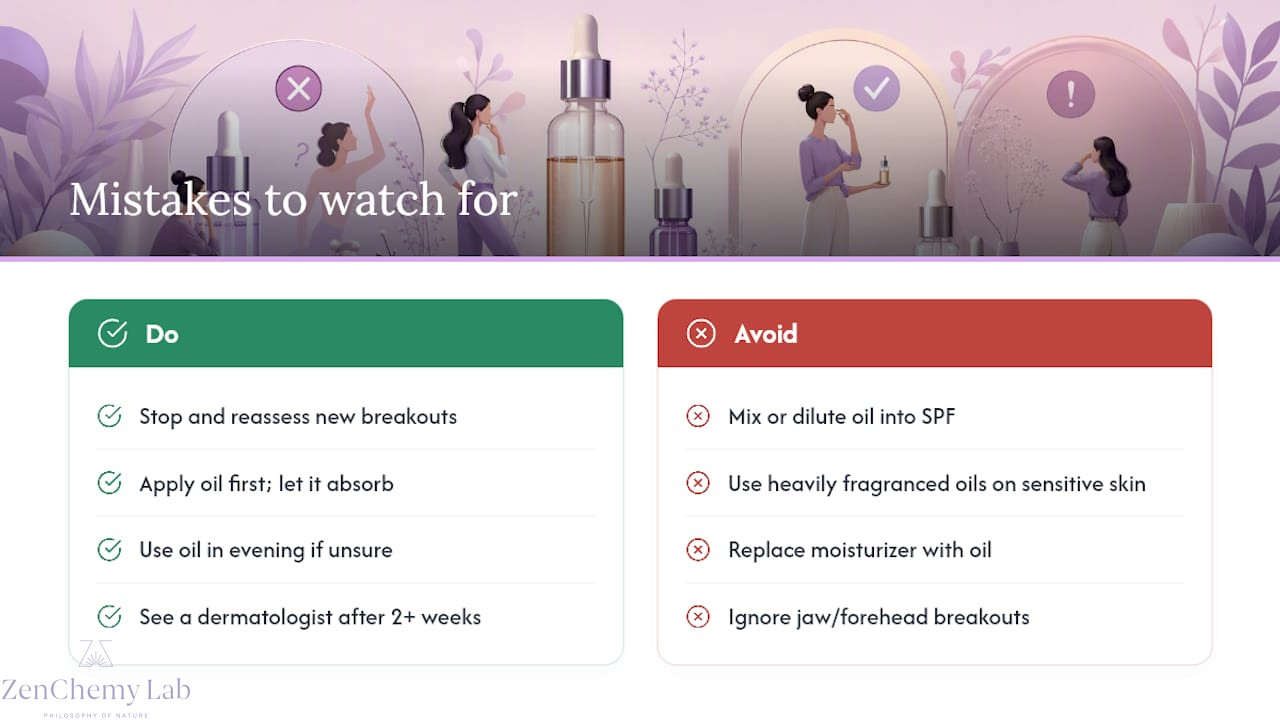
Comedogenicity is the first thing to monitor. If you notice new breakouts along the jaw or forehead within a week or two of adding an oil, stop and reassess before assuming it’s unrelated. Fragrance and essential oils are the next flag: Vogue India’s reporting on face oils notes that heavily scented, essential-oil-forward blends are more likely to irritate sensitive or reactive skin than fragrance-free formulas.
The sunscreen rule deserves repeating because it trips up so many people: never dilute or mix oil directly into SPF. If you’re using both, apply the oil first and let it absorb fully before sunscreen goes on, or push oil to your evening routine entirely and keep mornings simple. And a common beginner mistake worth naming directly: oil cannot fully replace a moisturizer, because it doesn’t supply the glycerin or hyaluronic acid that actually pulls water in. If irritation persists past two weeks of consistent, correct use, that’s the point to talk to a dermatologist rather than keep troubleshooting alone.
What should you look for in a natural formulation?
Reading a label well starts with knowing what should and shouldn’t be there. A genuine face oil should list its carrier oils near the top and carry no water, since anhydrous formulas are what defines the category. For serums, check that the active ingredient (niacinamide, hyaluronic acid, vitamin C) appears early in the ingredient list, not buried near the bottom in trace amounts.
Formulation quality also comes down to what’s missing. Stability matters for botanical actives, which degrade faster than synthetic ones without the right preservation approach. Non-comedogenic claims should be backed by the actual oil profile, not just a label sticker. A maker that focuses specifically on botanical face oils and serums, rather than treating them as a side product line, tends to pay closer attention to these details, which matters most for anyone with reactive or sensitive skin.
The layering question everyone overcomplicates
Most of the confusion around face oil vs serum comes from treating them as competing products instead of complementary tools. They’re not rivals. They’re solving different problems, and the industry’s habit of marketing them as alternatives to each other is what causes people to buy one and skip the other, when the better move for most skin is usually both.
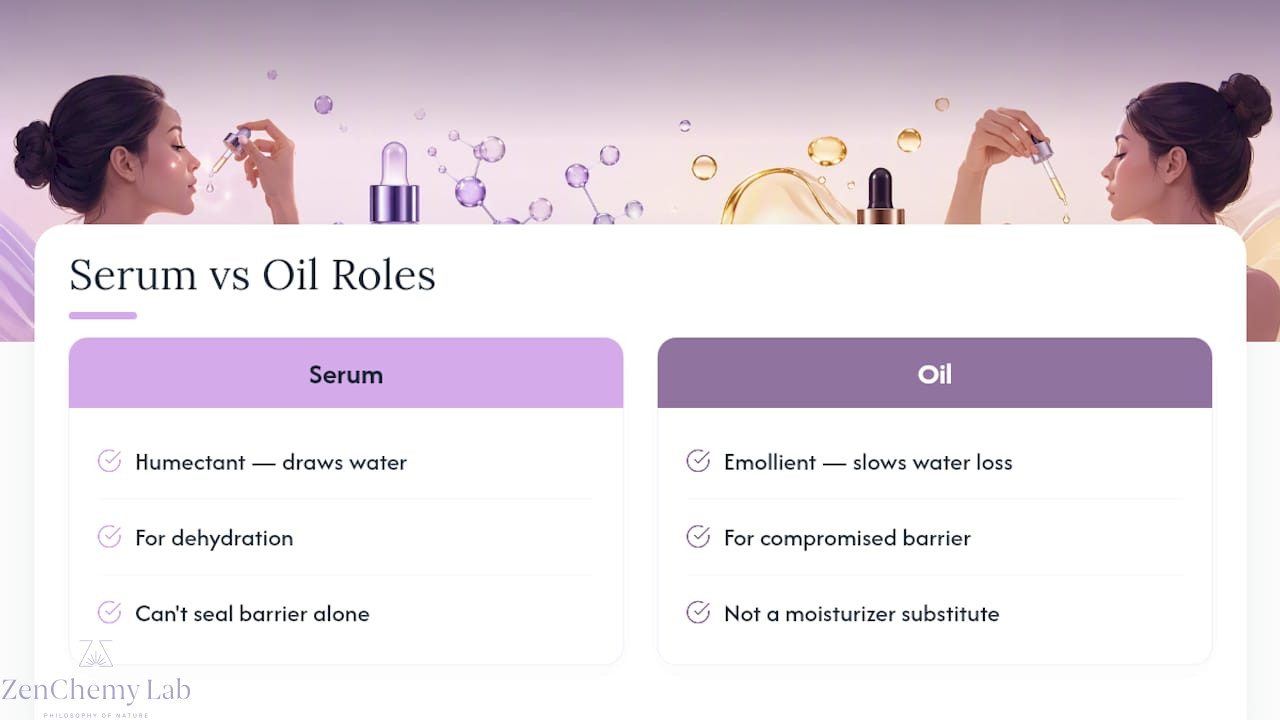
Where conventional advice falls short is the assumption that oil is a luxury add-on for glow and nothing else. That undersells its actual job: slowing water loss on a barrier that serums alone can’t seal. The reverse mistake, treating oil as a moisturizer substitute, is just as common and arguably worse, since it leaves skin looking hydrated on the surface while losing water underneath.
If you take one thing from this, prioritize matching the tool to the problem rather than chasing whichever product has the better packaging. Dehydration calls for a humectant serum. A compromised barrier calls for an emollient oil. Most people need both at different points in the same routine, not a choice between them.
— Alex
Where ZenChemy Lab fits into your routine
If you’re drawn to botanical formulations over synthetic ones, some skincare approaches focus on carrier oils chosen for their fatty acid profile, and gentle serums formulated without harsh fillers. That matters most if you’ve been burned before by a face oil that broke you out or a serum packed with more fragrance than active ingredient.

ZenChemy Lab’s collection of botanical face oils and natural serums is worth a look if you’re rebuilding your routine around ingredient quality rather than marketing claims. For a broader look at where natural formulations are heading, the ZenChemy Lab guide to natural beauty tips for 2026 breaks down how science and sustainable sourcing intersect in current formulations. If ageing skin is your main concern, this partner guide to anti-aging routines after 30 pairs well with the fatty-acid guidance covered above. Start by browsing the face oil collection and picking one formulation to add to your evening routine this week.
Sources
- Do you really need a face oil in your skincare routine? (Vogue India)
- Serums for dry skin (Allure)
- How facial oils help skin (Paula’s Choice Australia)


1 Comments