
If you’re battling filmy skin and a bar that refuses to lather, switch to a syndet body wash or a soap formulated with a chelator, or install an in-shower filter. Hard water minerals bond with plain fatty-acid soap to form insoluble scum, which is why suds disappear and residue stays behind. Skip ahead to the soap types and practical fixes below for the exact swaps worth making first.
TL;DR:
- Syndet body washes or natural bars with chelators like sodium citrate reliably produce foam in hard water, unlike traditional fatty-acid soaps.
- Adding a diluted vinegar rinse after washing helps dissolve mineral salts on skin and hair caused by hard water buildup.
- Checking water hardness with a test strip or jar shake test confirms whether hard water is affecting your skin or soap performance before changing routines.
- Choosing soaps with lower superfat content and visible chelators improves rinsability and reduces residue in mineral-heavy water conditions.
- Whole-house ion-exchange softeners eliminate mineral ions but require installation and ongoing maintenance, making filters or chelators better short-term solutions.
Table of Contents
- What is hard water, and why does it fight with soap?
- How hard water affects your skin and hair
- Which soaps and body washes actually work in hard water?
- How do I know if my water is actually hard?
- Practical fixes to reduce residue right now
- What to check before you buy a soap or body wash
- How ZenChemy Lab formulates for hard water
- What most hard-water advice gets wrong
- Try a hard-water-friendly bundle from ZenChemy Lab
- Sources
- FAQ
What is hard water, and why does it fight with soap?
Hard water carries dissolved calcium and magnesium, picked up as groundwater filters through limestone and chalk deposits. Those minerals aren’t harmful to drink, but they’re chemically incompatible with traditional soap.
Ordinary bar soap is made of fatty-acid salts. When those salts meet calcium and magnesium ions, they swap partners and form a new compound: an insoluble mineral soap, commonly known as soap scum. It won’t rinse away in water, so it clings to skin, tile, and fabric instead of washing down the drain. The U.S. Geological Survey’s explanation of water hardness describes this reaction as the reason hard water ties up soap molecules before they can do their job.
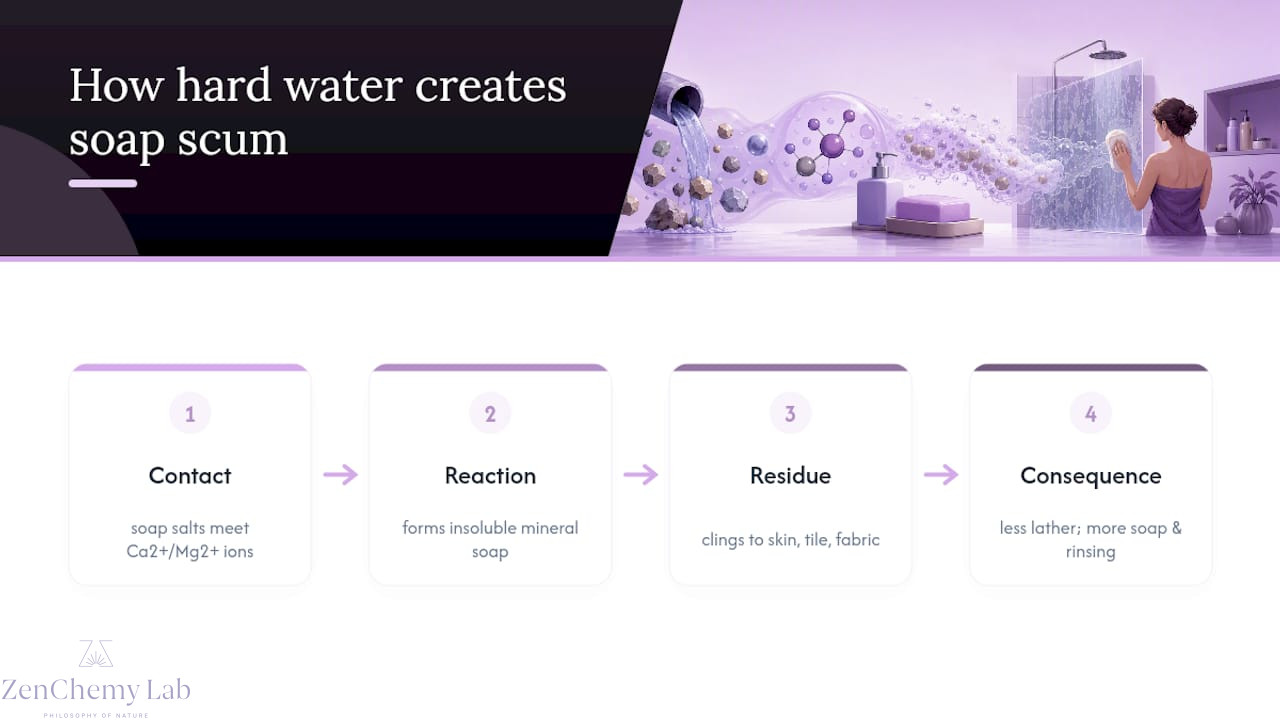
This is also why lather disappears so fast in hard water. Every gram of soap first has to “use up” its reaction with dissolved minerals before any of it is free to actually clean or foam. That’s a losing trade for your skin and your wallet: you use more product for a worse result. The USGS also notes that hard water demands more soap and more rinsing time than soft water, which explains that slippery feeling soft water gives you that hard water never quite delivers.
How hard water affects your skin and hair
Soap scum doesn’t just sit on your bathtub, it sits on you. That filmy layer of insoluble mineral soap can trap on skin after rinsing, and for many people that shows up as tightness, flaking, or a dull, straw-like texture in hair that never quite feels clean. Hard water essentially adds an extra layer of residue on top of whatever your cleanser already leaves behind, which compounds dryness for anyone already dealing with a compromised skin barrier.
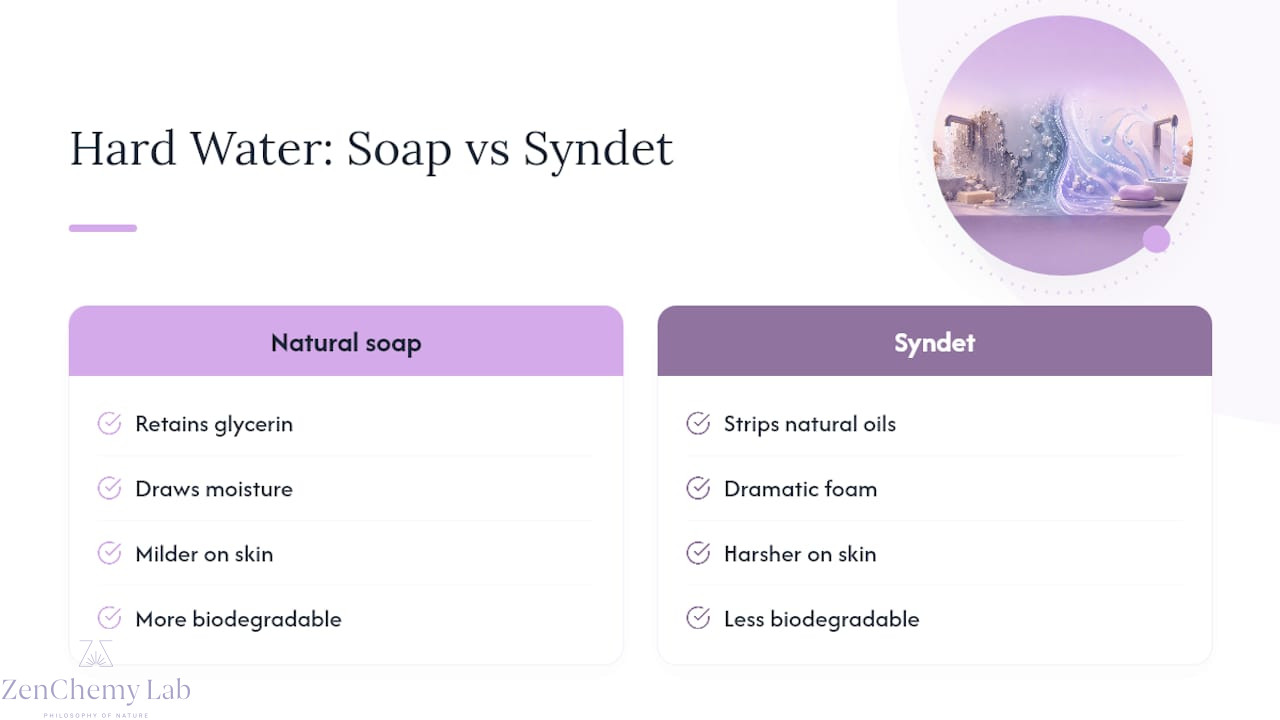
Here’s where formulation matters more than marketing. Traditional saponified soap retains glycerin as a natural byproduct of the soap-making process, and glycerin draws moisture into skin even when hard-water residue makes the lather look thin. That’s a real advantage over some synthetic detergents that strip natural oils in the name of a bigger, more dramatic foam.
A 2025 peer-reviewed comparison found that natural soap fatty-acid salts were less toxic to human keratinocytes and more biodegradable than certain synthetic detergents, which supports something soapmakers have argued for years: a milder ingredient list often means gentler contact with skin cells, even if it doesn’t foam like a syndet. If you already deal with eczema, sensitivity, or seasonal dryness, hard water residue combined with a harsh cleanser is a rough combination. The fix usually isn’t a stronger soap. It’s a better-matched one.
Which soaps and body washes actually work in hard water?
Not every cleanser reacts the same way to calcium and magnesium. Some formulations are built specifically to sidestep the scum problem, and knowing what to look for on a label saves you from buying the wrong bottle twice.
Syndet body washes use mild synthetic surfactants instead of true soap, so there’s no fatty-acid salt to react with hard-water minerals in the first place. They lather consistently regardless of your water supply, which is why they’re often the fastest fix for households that don’t want to change plumbing or hunt for a new soap recipe.
Reformulated natural bars solve the same problem differently. Soapmakers add chelators like citric acid or sodium citrate, which bind to calcium and magnesium before those ions can react with the soap itself. A 1% addition of citric acid by oil weight is a common starting point in castile soap formulation for hard water, and it measurably improves rinsability.
When shopping, prioritize:
- Bars or washes listing sodium citrate, citric acid, or EDTA as chelating agents
- Modest additions of coconut or castor oil, which boost lather even in mineral-heavy water
- Low superfat percentages, since excess free oil worsens residue in hard water
- Liquid or syndet formats when you want guaranteed foam with zero formulation guesswork
Avoid pure castile bars with no chelator added, and be wary of heavily superfatted “moisturizing” bars marketed without any mention of hard-water performance. They’re often the ones leaving the chalky film on your shower door.
How do I know if my water is actually hard?
Before you overhaul your entire routine, confirm the problem. Hard water symptoms (dry skin, dull hair, cloudy glassware) can overlap with other causes, so a quick test saves you from switching products for nothing.
- Use a test strip. Drugstore and hardware store kits measure hardness in grains per gallon or parts per million; anything above 120 ppm (roughly 7 grains per gallon) counts as hard.
- Try the soap-jar test. Shake a small amount of liquid castile soap with tap water in a clear jar. If it forms a cloudy curd instead of a rich, sudsy foam, your water is hard. This is the same shake test soapmakers use to spot mineral content in seconds.
- Call your water utility or a lab. If you want an exact number rather than a range, municipal water reports list hardness, and private well owners can send a sample to a local testing lab for a precise reading.
Practical fixes to reduce residue right now
Some solutions cost nothing and work today. Others require a bigger investment but solve the problem for good. Here’s how they stack up.
Short-term, no-cost fixes:
- Dilute solid castile soap with extra water before use to limit the amount of soap available to react with minerals
- Add a diluted vinegar rinse after washing, since the acidity helps dissolve calcium salts already on skin
- Rinse longer and warmer than usual; hard water needs more time to carry residue away
- Use a washcloth or loofah for gentle friction, which physically lifts precipitate that plain water alone won’t rinse
Formulation-level fixes:
- Choose bars with a chelator already built in, rather than trying to compensate with more product
- Pick lower-superfat bars or a liquid soap for hard water specifically labelled for mineral-heavy conditions
Hardware fixes:
- Shower filters reduce some scale and improve lather modestly, and they’re cheap and renter-friendly
- Whole-house ion-exchange softeners remove hardness ions outright and restore soap performance reliably, though they need installation, ongoing salt refills, and maintenance, according to Water Doctors’ breakdown of hard-water lather problems
If you’re renting, a shower filter or a chelator-formulated bar gets you most of the benefit without touching the plumbing. Budget shoppers get the best return from a vinegar rinse and a better-matched soap, since that costs almost nothing. If your skin is already sensitive, skip the syndet-only route and look for a natural bar with both a chelator and a modest superfat. That combination protects the skin barrier while still cutting residue.
Pro Tip: Keep a small bottle of diluted white vinegar (one part vinegar to four parts water) in the shower. A quick splash after rinsing dissolves leftover mineral film in seconds, without any scrubbing.
What to check before you buy a soap or body wash
Reading a label for five extra seconds saves you a wasted purchase. Here’s what actually predicts hard-water performance:
- Chelator listed: sodium citrate, citric acid, or EDTA near the top of the ingredient list
- Surfactant type: syndet surfactants (like sodium cocoyl isethionate) foam regardless of water hardness; pure fatty-acid soap needs the chelator workaround
- Superfat level: lower superfat (1 to 3%) generally rinses cleaner in hard water than heavily superfatted bars
- Glycerin content: a sign of true saponified soap, and a genuine skin-hydration benefit worth keeping even if lather looks modest
- Transparent labelling: brands that state hard-water suitability outright have usually formulated for it on purpose, not by accident
Buy a trial size before committing to a full-size bar or a multi-pack. Run the soap-jar test with the actual product if you can, and introduce any new bar gradually over a week or two rather than swapping your whole routine overnight, especially if your skin reacts easily to new formulas.
How ZenChemy Lab formulates for hard water
Handcrafted soap doesn’t have to mean fighting your water supply. At ZenChemy Lab, formulation choices lean toward balanced oil blends and modest superfat levels precisely because heavy free-oil content is what leaves extra film behind in mineral-rich water. Bars built with a thoughtful ratio of cleansing oils to conditioning oils tend to rinse cleaner without sacrificing the glycerin-retaining benefits that make saponified soap gentler on skin than many stripped-down detergents.
For anyone unsure whether a bar or a liquid format suits their water better, starting with a smaller size makes sense before committing to a full routine change. Run the soap-jar test at home first, then judge how a gentle, well-balanced formula performs against your actual tap water rather than against a marketing claim.
What most hard-water advice gets wrong
Most guides jump straight to “get a water softener” and stop there, as if hardware were the only real solution. That advice ignores renters, budget-conscious households, and anyone who wants an answer this week, not after a plumber’s quote. The formulation fix deserves equal billing: a chelator-containing bar or a syndet wash solves the daily lather problem immediately, at a fraction of the cost.
The bigger blind spot is treating “more lather” as the only goal worth chasing. Foam volume is not a proxy for cleaning power or skin gentleness, and chasing it by switching to the harshest detergent on the shelf trades one problem for another: stripped, reactive skin. What the evidence actually supports is prioritizing formulation, chelators, balanced oils, sensible superfat, over sheer foam. Test your water first, match the soap to what you find, and let hardware upgrades be the long-term project they actually are rather than the only fix you consider.
— Alex
Try a hard-water-friendly bundle from ZenChemy Lab
ZenChemy Lab’s handcrafted bars use balanced oil blends and moderate superfat levels designed to rinse cleaner in mineral-rich water. If you’ve confirmed hard water with the jar test above, a small trial size lets you judge real-world performance before committing to a full routine change.

Browse the natural skin care collection to find a bar or wash sized for testing, and pair it with a vinegar rinse for the first few washes while your skin and your water find their balance. Confirm the fit with your own soap-jar test, then decide whether a full-size bar earns a permanent spot in your shower.
Sources
- Hardness of water – U.S. Geological Survey
- Natural soap is clinically effective and less toxic and more biodegradable in aquatic organisms and human skin cells than synthetic detergents – PMC
- Castile Soap Hard Water | Soap Making Guide
FAQ
What soap is best for hard water?
A syndet body wash or a natural bar formulated with a chelator like sodium citrate or citric acid performs best, since both avoid the insoluble soap scum that plain fatty-acid soap forms with calcium and magnesium.
How do you deal with showering in hard water?
Switch to a chelator-containing or syndet cleanser, add a diluted vinegar rinse after washing, and consider a shower filter for modest scale reduction without any plumbing changes.
Does dish soap remove hard water stains?
Some dish soaps cut through mineral film on surfaces because of their strong synthetic surfactants, but that’s a surface-cleaning result, not a skin-care one, and dish soap is too harsh for regular use on skin or hair.
What can I wash my hair with if I have hard water?
Look for a sulfate-free, syndet-based shampoo or a chelating shampoo, since these lather predictably regardless of mineral content and reduce the dullness and buildup hard water leaves behind.

1 Comments