
TL;DR:
- Essential oils provide beneficial antimicrobial, anti-inflammatory, and antioxidant effects in skincare but pose risks if misused. Proper dilution, patch testing, and storage are essential to prevent allergic reactions, sensitisation, and phototoxicity. Both natural and synthetic fragrances require careful scrutiny, with informed application respecting individual sensitivities.
You might assume that because something comes from a plant, it’s gentle and straightforwardly safe. Essential oils challenge that assumption every day. The role of essential oils in skincare is genuinely complex: these concentrated plant extracts carry real therapeutic potential, including antioxidant, anti-inflammatory, and antimicrobial properties, but they also carry risks that even experienced natural beauty enthusiasts underestimate. This guide will walk you through what the science actually shows, how to use essential oils safely, and what to watch for so your skin gets the benefits without the consequences.
Table of Contents
- Key takeaways
- What essential oils actually do in skincare
- Benefits of essential oils: what the evidence shows
- Risks and safety: what you need to know
- How to use essential oils in skincare safely
- Natural vs. synthetic: a comparison worth having
- My honest take on natural skincare and essential oils
- Discover Zenchemylab’s botanical skincare collection
- FAQ
Key takeaways
| Point | Details |
|---|---|
| Potent but not risk-free | Essential oils offer real skin benefits, but require careful dilution and informed use to avoid reactions. |
| Safety starts with dilution | Undiluted application raises your risk of permanent sensitisation, not just temporary irritation. |
| Know your allergens | Linalool and limonene are common allergens with patch test positivity rates reaching 7%. |
| Phototoxicity is real | Citrus oils can cause burns and hyperpigmentation; avoid sun exposure for 12 to 18 hours after use. |
| Storage protects efficacy | Oxidised oils become more allergenic; store in dark, airtight containers away from heat. |
What essential oils actually do in skincare
Essential oils are highly concentrated volatile plant extracts, obtained through steam distillation or cold pressing. A single drop contains dozens of active chemical compounds, which is why their effects on skin can be so pronounced. They are never used in their pure form in reputable skincare products; they are always diluted in carrier oils, emulsions, or other formulations before reaching your skin.
The role of essential oils in skincare products falls into several distinct categories:
- ✅ Antimicrobial action: Tea tree oil (Melaleuca alternifolia) targets acne-causing bacteria and has well-documented antibacterial effects.
- ✅ Anti-inflammatory support: Oils like chamomile and lavender contain compounds that reduce redness and calm reactive skin.
- ✅ Antioxidant protection: Frankincense and rosehip seed oil contain constituents that neutralise free radicals, protecting skin from environmental ageing.
- ✅ Skin barrier support: Certain oils reinforce the lipid layer of the skin, reducing transepidermal water loss (TEWL).
- ✅ Aromatherapy benefits: Beyond direct skin contact, the role of aromatherapy in skincare extends to the nervous system. Inhaling certain scents during a skincare routine measurably reduces cortisol, which in turn may reduce stress-related flare-ups in conditions like acne and eczema.
The role of aromatherapy in self-care is not just mood-setting. Chronic stress compromises the skin barrier and accelerates inflammation. When your skincare ritual incorporates calming scents, it supports your skin both topically and systemically. You can explore botanical skincare for sensitive skin to see how this translates into formulation choices that respect reactive complexions.
Benefits of essential oils: what the evidence shows
The benefits of essential oils in skincare go beyond folklore, though the depth of clinical evidence varies by oil. Here is what research actually supports:
Lavender oil contains linalool and linalyl acetate, compounds with demonstrated anti-inflammatory and analgesic properties. Studies show lavender reduces skin irritation and supports wound healing.
Tea tree oil is among the most studied essential oils for skin. Its primary active constituent, terpinen-4-ol, disrupts bacterial cell membranes and has shown efficacy comparable to benzoyl peroxide for mild to moderate acne, with fewer side effects.
Frankincense (Boswellia) has boswellic acid derivatives that inhibit inflammatory pathways, making it relevant for ageing skin and conditions characterised by chronic low-grade inflammation.
Rosehip oil is technically a carrier oil but contains naturally occurring retinoids and essential fatty acids that support cell turnover and collagen maintenance. It blurs the line between carrier and active ingredient.
- 🌿 Oils suited to oily or acne-prone skin: tea tree, geranium, clary sage
- 🌿 Oils suited to dry or mature skin: frankincense, sandalwood, rose
- 🌿 Oils suited to sensitive or reactive skin: chamomile, lavender (low concentration), calendula
Pro Tip: If you are new to essential oils for skin, start with lavender or chamomile at a 1% dilution in a carrier oil like jojoba or sweet almond. These are among the best-tolerated oils and give your skin time to adjust before you experiment with more active options like tea tree or citrus.
The role of aromatherapy in skincare also reinforces self-care rituals. When you associate a scent with a calming routine, your nervous system begins to respond to that cue alone, deepening the relaxation response over time. This is not incidental. It is one reason nature’s role in your beauty routine goes well beyond what happens at the skin’s surface.
Risks and safety: what you need to know
This is where the conversation about essential oils gets more honest. Natural does not mean harmless. Essential oils are among the most common causes of fragrance-related skin reactions, and the risks are specific and documented.

Fragrance allergy affects 4 to 8% of the general population. Among that group, common essential oils like lavender and tea tree cause contact dermatitis in 2 to 5% of exposed individuals. These numbers might sound small, but when you’re applying a product daily, repeated low-level exposure is exactly how sensitisation develops.
Key safety risks to understand:
- ⚠️ Allergens in common oils: Linalool and limonene are ubiquitous in popular essential oils. Patch test positivity for these compounds reaches up to 7%, and EU regulations require labelling when concentrations exceed 0.001% in leave-on products and 0.01% in rinse-off products.
- ⚠️ Phototoxicity from citrus oils: Cold-pressed bergamot, lemon, and lime oils contain furocoumarins. Applied before sun exposure, they can cause burns and hyperpigmentation. You should avoid sun exposure for 12 to 18 hours after using these oils topically.
- ⚠️ Neat application risks: Undiluted use raises the risk of permanent sensitisation, not just irritation. Even months of tolerating an oil neat can suddenly result in an irreversible allergic response.
- ⚠️ Oxidation increases allergenicity: Oils degrade with air, heat, and light exposure, and oxidised oils are significantly more likely to trigger reactions. An old bottle of improperly stored tea tree oil is more problematic than a fresh one, even at the same concentration.
- ⚠️ Sensitive populations: Children, pregnant people, and eczema sufferers require lower dilutions or avoidance of certain oils entirely due to higher skin permeability and sensitivity.
The EU has responded to this with concrete limits. Tea tree oil concentration is capped at 2% in rinse-off products, 1% in face wash formulations, and just 0.1% in face creams. This matters when you’re selecting products, not just making your own blends.
Pro Tip: Before introducing any new essential oil blend, apply a small amount of the diluted preparation to the inner forearm and wait 24 to 48 hours. If you notice redness, itching, or swelling, discontinue use. This simple step, known as patch testing, catches individual sensitivities before a full facial application causes a serious reaction.
| Risk | Cause | Prevention |
|---|---|---|
| Contact dermatitis | Allergens like linalool, limonene | Patch test; keep concentrations low |
| Phototoxicity | Furocoumarin compounds in citrus oils | Avoid sun for 12 to 18 hours post-application |
| Permanent sensitisation | Repeated neat (undiluted) use | Always dilute; follow recommended ratios |
| Increased allergenicity | Oil oxidation from poor storage | Store in dark, airtight containers below 20°C |
| Heightened reactions | Vulnerable skin (children, eczema, pregnancy) | Use lower dilutions or avoid specific oils |
How to use essential oils in skincare safely
Knowing how to use essential oils in skincare correctly separates a genuinely beneficial routine from one that gradually harms your skin. Here is a practical sequence to follow:
- Choose high-quality oils. Look for oils sold in dark amber or cobalt glass bottles with the Latin plant name, country of origin, and extraction method listed. These details signal a supplier who understands quality. Avoid oils sold in clear plastic packaging or without botanical names.
- Dilute correctly for your context. A standard dilution for facial use is 0.5% to 1% in a carrier oil. Body applications can go to 2%. For sensitive skin or any vulnerable population, stay at 0.5% or below. That works out to roughly 3 drops of essential oil per 10 ml of carrier oil for a 1% blend.
- Patch test every new oil. Apply the diluted blend to your inner forearm. Wait 24 to 48 hours before applying it to your face or a larger area. Do not skip this step even for oils you’ve used before, especially if you have a new bottle from a different batch or supplier.
- Layer thoughtfully. If you use active ingredients like retinoids or AHAs, avoid applying essential oils directly on top. The combination can heighten irritation on already sensitised skin.
- Respect phototoxic oils. If your routine includes bergamot, cold-pressed lemon, or lime oil, apply them only in the evening and allow at least 12 hours before sun exposure.
- Store properly. Keep essential oils sealed, away from light, and ideally below 20°C. Discard any oil that smells noticeably different from when you opened it. Oxidised oil is not just less effective; it is more likely to cause a reaction.
- Know when to stop. If your skin develops persistent redness, stinging, or breakouts after incorporating a new oil, discontinue and give your skin a two-week reset before trying again.
Pro Tip: If you are exploring the role of essential oils in soap or other rinse-off formats, the shorter skin contact time does reduce exposure risk, but it does not eliminate it. The role of essential oils in soaps is primarily antimicrobial and sensory, rather than deeply therapeutic, since most active constituents rinse away. This is still worth knowing if you’re comparing product formats. You can browse precious oils products crafted with these principles in mind.
Natural vs. synthetic: a comparison worth having
One of the most persistent myths in the natural skincare space is that synthetic fragrances are inherently worse than essential oils. The reality is more nuanced, and understanding it helps you make genuinely informed choices.
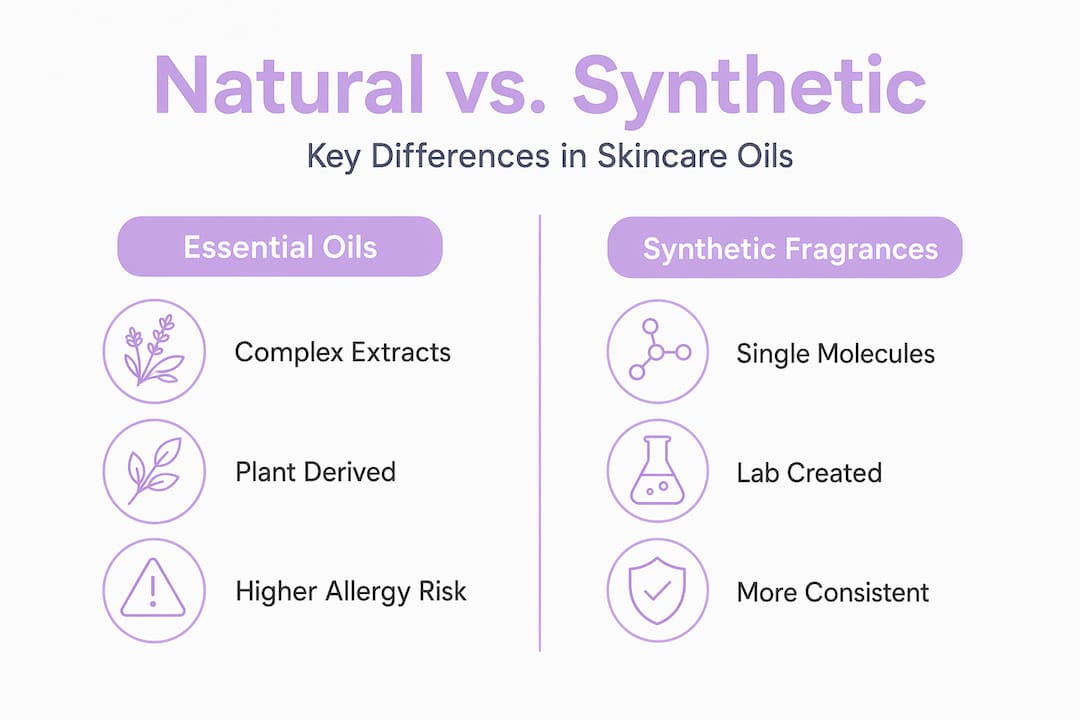
Essential oils are whole plant extracts. They contain hundreds of compounds, some beneficial, some potentially irritating, and some regulated. Synthetic fragrances, by contrast, are composed of isolated compounds, often designed to mimic natural scents with greater consistency. Interestingly, whole essential oils may have a buffering effect where other constituents in the oil reduce the irritancy of individual allergen compounds, something that does not occur with isolated synthetic versions.
| Factor | Essential oils | Synthetic fragrances |
|---|---|---|
| Composition | Complex whole-plant extracts | Isolated or synthesised compounds |
| Allergen potential | Present; includes regulated allergens | Present; may be lower or comparable |
| Buffering effect | Possible within whole oil | Generally absent |
| Labelling transparency | Latin name required; allergens above thresholds must be declared | Allergens above thresholds must be declared |
| Therapeutic benefit | Some evidence-backed bioactivity | Primarily sensory; limited bioactivity |
| Consistency | Varies by harvest, region, season | Highly consistent |
The takeaway is not that one category is safer. It is that both require scrutiny. The distinction between essential oil components and isolated fragrance allergens matters for how you read ingredient labels and make purchasing decisions. If you have fragrance sensitivity, both categories warrant caution, not just the synthetic aisle.
My honest take on natural skincare and essential oils
I’ve spent years working with botanical formulations, and my clearest observation is this: the natural skincare world is incredibly enthusiastic about essential oils, and not nearly enthusiastic enough about understanding them fully.
I see two patterns repeatedly. The first is people applying oils neat because it “feels more natural” or more potent. The second is people dismissing safety information because an oil is labelled organic or artisanal. Both approaches lead to the same outcome eventually: sensitised, reactive skin that no longer tolerates the ingredients it once benefited from.
What I genuinely believe is that essential oils deserve the same respectful attention you would give to any active ingredient. They work. The evidence for anti-inflammatory effects, antimicrobial action, and even the indirect skin benefits of aromatherapy is real. But potency cuts both ways. The oils that do the most good at the right concentration are also the ones that do the most harm when misused.
My advice is to build your routine slowly. Start with one oil, patch test it, observe your skin for two weeks, and then decide. The best results I’ve seen come from people who treat their skin as something to learn about, not something to fix with maximum ingredients as quickly as possible.
— Alex
Discover Zenchemylab’s botanical skincare collection

At Zenchemylab, every product begins with the same question: does this ingredient actually serve your skin? Our natural skin collection is built around botanicals and carefully selected essential oils, formulated at concentrations that prioritise your skin’s health. If you are looking for glowing skin products that honour both efficacy and safety, our range reflects everything this article covers. You can also explore our skincare routine guidance to put your new knowledge into a practical daily framework. Quality formulation is not a marketing claim at Zenchemylab. It is the starting point.
FAQ
What is the role of essential oils in skincare?
Essential oils function as antimicrobial, anti-inflammatory, and antioxidant agents in skincare, with effects that vary by oil type and concentration. They are always diluted before use and work best when matched to your specific skin type and concern.
Can essential oils cause skin reactions?
Yes. Fragrance allergy affects 4 to 8% of the general population, and common oils like lavender and tea tree cause contact dermatitis in 2 to 5% of exposed individuals. Patch testing before full use significantly reduces this risk.
Why should you avoid using essential oils undiluted?
Undiluted application can cause permanent sensitisation, meaning even trace amounts of the oil can trigger an allergic reaction indefinitely afterward. Always dilute in a carrier oil before applying to skin.
Are citrus essential oils safe to use during the day?
Cold-pressed citrus oils containing furocoumarins are phototoxic and can cause burns or hyperpigmentation when skin is exposed to sunlight. Apply them only in the evening and allow 12 to 18 hours before sun exposure.
How do essential oils in soaps differ from those in leave-on products?
The role of essential oils in soaps is primarily sensory and antimicrobial, as the brief skin contact during rinsing limits deeper absorption. Leave-on products maintain prolonged skin contact, increasing both the therapeutic potential and the exposure risk, which is why concentration limits are stricter.