
TL;DR:
- Natural emollients are lipid-rich ingredients that fill skin gaps, protect the barrier, and prevent moisture loss. They work by forming a protective film that traps water, supporting skin repair depending on their fatty acid profile. Proper application, such as to damp skin and in the right amount, enhances hydration and skin health.
Natural emollients are defined as lipid-rich ingredients that soften, smooth, and protect the skin by filling the microscopic gaps between skin cells. They sit at the heart of any effective moisturising routine, working alongside the stratum corneum and the Natural Moisturizing Factor (NMF) to prevent moisture loss and restore barrier function. Whether your skin feels tight after washing or chronically dry through the winter months, understanding the role of natural emollients gives you the knowledge to choose ingredients that actually work. Zenchemylab builds its entire body care philosophy around these plant-derived powerhouses.
How do natural emollients work to protect the skin barrier?
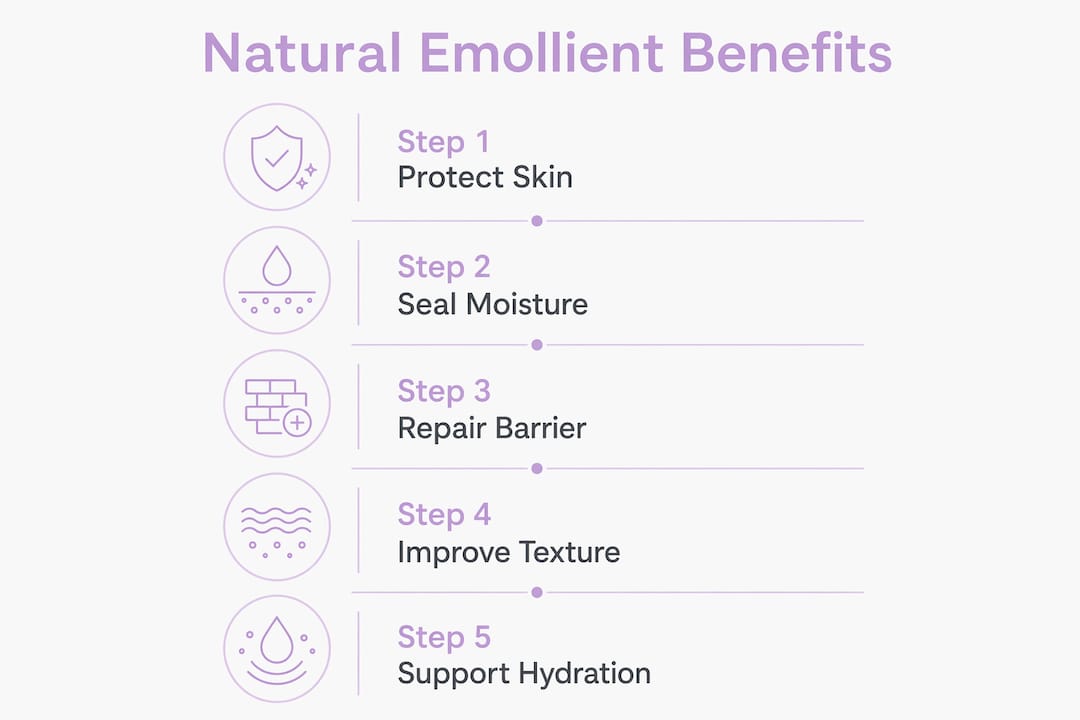
Natural emollients work by forming a protective layer over the skin surface, trapping moisture and preventing transepidermal water loss (TEWL). Think of the skin barrier as a “brick and mortar” structure. The skin cells are the bricks, and lipids are the mortar holding everything together. When that mortar breaks down, water escapes and irritants get in.
The fatty acid composition of an emollient determines how well it repairs that mortar. Oils high in linoleic acid outperform oleic-acid-dominant oils for barrier repair, particularly in conditions like atopic dermatitis. Linoleic acid is a structural component of ceramides in the stratum corneum, so replenishing it directly supports barrier development. Oleic acid, while nourishing, can actually increase skin permeability at high concentrations.
The NMF also plays a critical role in skin hydration. PCA makes up about 12% of the NMF complex, supporting moisture retention even when environmental humidity drops. Natural emollients that complement NMF components keep the skin supple across changing seasons. You can learn more about this process in Zenchemylab’s guide on skin lipid barrier repair.
How long an emollient keeps skin hydrated depends on its formulation type. Lotions and creams hydrate for 1–4 hours, while ointments and sprays can maintain that effect for up to 8 hours. This means heavier formulations suit very dry or compromised skin, while lighter lotions work well for daily maintenance on normal skin types.
| Formulation type | Hydration duration | Best suited for |
|---|---|---|
| Lotion | 1–4 hours | Normal to slightly dry skin |
| Cream | 1–4 hours | Combination to dry skin |
| Ointment | Up to 8 hours | Very dry, eczema-prone, or compromised skin |
| Spray | Up to 8 hours | Large body areas, sensitive skin |
Pro Tip: Apply your emollient within three minutes of stepping out of the shower. Damp skin absorbs lipids more readily, and you lock in the water that is already sitting on the surface.
What are the best natural emollient ingredients?
The most effective natural emollient ingredients each bring a distinct fatty acid profile and a set of therapeutic benefits that go well beyond basic moisturisation. Natural herbal ointments containing shea butter, beeswax, and coconut oil deliver occlusion, anti-inflammatory action, antioxidant protection, and antimicrobial effects in a single application. That multi-function performance is what sets plant-based emollients apart from single-mechanism synthetic alternatives.
Here is a breakdown of the standout ingredients you will find in quality natural skincare:
- ✅ Shea butter — Rich in oleic and stearic acids, shea butter provides deep occlusion and carries triterpene compounds with documented anti-inflammatory properties. It suits dry, mature, and eczema-prone skin.
- ✅ Beeswax — Forms a breathable, water-resistant film on the skin surface. It locks in moisture without clogging pores and adds structure to balms and creams. Zenchemylab uses beeswax in several of its healing balm formulations.
- ✅ Coconut oil — High in lauric acid, which carries antimicrobial properties. It absorbs relatively quickly and works well as a base for botanical cosmetics.
- ✅ Olive oil — Predominantly oleic acid with squalene and polyphenols. Its antioxidant content protects against oxidative stress, though it is best used in blends rather than alone on barrier-compromised skin.
- ✅ Squalane — A stable, plant-derived analogue of skin’s own squalene. It is lightweight, non-comedogenic, and absorbs without residue, making it ideal for oily or acne-prone skin types.
- ✅ Aloe vera, Neem, and Turmeric extracts — Plant-based moisturising lotions combining these botanicals improve skin texture, reduce irritation, and protect against environmental damage through synergistic herbal action.
Each of these ingredients contributes to the top natural body care ingredients that Zenchemylab prioritises in its formulations. The key is choosing the right ingredient for your skin type and concern, not simply reaching for the most popular one.
How to use natural emollients effectively in your routine
Applying a natural emollient correctly makes a measurable difference in how well it works. The timing, technique, and frequency all affect absorption and long-term results. Follow these steps to get the most from your products:
- Apply to damp skin. Apply immediately after washing while the skin is still slightly damp. This seals in surface moisture and improves lipid absorption into the stratum corneum.
- Smooth in the direction of hair growth. Always apply emollients in the same direction as hair growth. Rubbing against the grain can block hair follicles and trigger folliculitis, a common but easily avoided reaction.
- Use the right amount. A thin, even layer is enough for most formulations. Heavier ointments need only a small amount spread across the skin. Applying too much does not increase benefit and can feel uncomfortable.
- Match frequency to formulation. Lighter lotions and creams may need reapplication every few hours, especially in dry climates or heated indoor environments. Ointments applied at night can carry you through to morning.
- Layer strategically. Apply emollients after any water-based serums or toners but before sunscreen. This preserves the hydration gradient and does not interfere with SPF performance.
Building these steps into your natural body care routine takes less than two minutes and significantly improves skin comfort over time.
Pro Tip: If you use a medicated topical treatment, apply it first and wait a few minutes before layering your emollient. The emollient can act as a vehicle, increasing absorption of active ingredients, which may intensify effects beyond what is intended.
Natural emollients versus synthetic alternatives: what is the difference?
Natural and synthetic emollients both moisturise the skin, but they differ in safety profile, therapeutic range, and environmental impact. Natural herbal ointments provide a multi-function approach including occlusion, anti-inflammatory action, antimicrobial protection, and wound healing support. Synthetic formulations typically target one mechanism and rely on additional active ingredients to match that range.
Skin compatibility is another key distinction. Natural emollients generally cause less irritation on sensitive skin, partly because their fatty acid profiles mirror the skin’s own lipid composition. Synthetic emollients, while effective, can contain petroleum derivatives or silicones that sit on the skin surface without integrating into the barrier.
Sensory acceptability also shapes whether people actually use a product consistently. Non-greasy texture and rapid absorption drive compliance. Natural formulations that balance botanical actives with good skin feel outperform heavier synthetic ointments in daily use. You can read Zenchemylab’s deeper analysis on natural versus synthetic skincare for a full scientific breakdown.
| Factor | Natural emollients | Synthetic alternatives |
|---|---|---|
| Skin compatibility | High; mirrors skin’s own lipids | Variable; may cause irritation |
| Therapeutic range | Multi-function (anti-inflammatory, antimicrobial) | Typically single-mechanism |
| Environmental impact | Biodegradable; plant-derived | Often petroleum-based; slower to degrade |
| Sensory profile | Varies; can be rich or lightweight | Often engineered for specific texture |
| Preservation needs | Some NMF humectants self-preserve | Usually require added preservatives |
One formulation advantage worth noting: high concentrations of natural humectants like Sodium PCA and Sodium Lactate lower water activity enough to inhibit microbial growth, enabling preservative-free product development. This is a genuine benefit for people with preservative sensitivities.
Key takeaways
Natural emollients repair and protect the skin barrier by filling lipid gaps, reducing TEWL, and complementing the NMF, with efficacy determined by fatty acid composition, formulation type, and correct application technique.
| Point | Details |
|---|---|
| Fatty acid composition matters | Linoleic-acid-rich oils repair the skin barrier more effectively than oleic-dominant oils. |
| Formulation type sets duration | Ointments hydrate for up to 8 hours; lotions and creams last 1–4 hours. |
| Application technique prevents problems | Apply to damp skin in the direction of hair growth to maximise absorption and avoid folliculitis. |
| Natural emollients offer multi-function benefits | Shea butter, beeswax, and coconut oil provide occlusion, anti-inflammatory, and antimicrobial effects together. |
| NMF humectants can self-preserve | Sodium PCA and Sodium Lactate at high concentrations reduce the need for added preservatives. |
Why I think most people are using their emollients wrong
After years of working with natural skincare formulations and talking with people about their routines, the single most common mistake I see is applying emollients to completely dry skin. It seems logical. Your skin feels tight, you reach for a cream. But dry skin has already lost the surface water that an emollient is designed to seal in. You end up with a film over dehydrated skin rather than a genuinely hydrated one.
The second mistake is choosing an emollient based on how it smells or feels in the jar rather than its fatty acid profile. A beautifully scented oil dominated by oleic acid might feel luxurious, but if your skin barrier is compromised, it can actually worsen permeability. Linoleic-acid-rich oils like rosehip or hemp seed are less glamorous but far more effective for repair.
What I have found genuinely works is treating emollient application as a two-step process: hydrate first with a water-based mist or toner, then seal immediately with your chosen emollient. This approach respects the biology of the stratum corneum rather than fighting it. The importance of skin hydration goes beyond comfort. It directly affects how your skin ages, heals, and responds to environmental stress.
Natural emollients are not a luxury add-on. They are the foundation of a functional skin barrier. Choose them based on science, apply them with intention, and your skin will respond.
— Alex
Natural emollient-rich products from Zenchemylab
Zenchemylab formulates its body care products around the same natural emollient principles covered in this article. Every product in the natural skin care collection is crafted with plant-derived lipids, botanical extracts, and NMF-supporting humectants chosen for their barrier-repair credentials.

From beeswax creams to shea butter balms, the body care range reflects a commitment to ingredients that work with your skin’s biology rather than masking dryness with synthetic film-formers. Each product is handcrafted in small batches, so the botanical actives remain potent and the formulations stay as close to nature as possible. If you are building a routine grounded in real skin science, this is where to start.
FAQ
What is the role of natural emollients in skincare?
Natural emollients fill the lipid gaps between skin cells, reduce transepidermal water loss, and support the skin barrier. They soften and smooth the skin while protecting it from dryness and irritation.
How do emollients work differently from humectants?
Emollients coat the skin surface and seal in moisture, while humectants attract water molecules from the environment or deeper skin layers. Most effective moisturisers combine both functions.
Which natural emollient is best for dry skin?
Shea butter and beeswax-based ointments are the most effective for very dry skin because they provide long-lasting occlusion and anti-inflammatory support. Ointment formulations hydrate for up to 8 hours compared to 1–4 hours for creams and lotions.
Can natural emollients cause breakouts?
Comedogenicity depends on the specific ingredient and your skin type. Squalane and beeswax are generally non-comedogenic, while coconut oil and shea butter can clog pores for some people. Patch testing a new product on a small area first is the most reliable way to assess compatibility.
Are natural emollients safe for sensitive or eczema-prone skin?
Natural emollients generally show better tolerability on sensitive skin than synthetic alternatives, partly because their fatty acid profiles are closer to the skin’s own lipids. Ingredients like shea butter, squalane, and colloidal oat are well-documented for use in eczema management.