
TL;DR:
- Paraben-free cosmetics do not automatically mean safer; their safety depends on the full formulation and preservative system.
- Despite regulatory review showing parabens are safe at permitted levels, consumer demand for natural ingredients drives the popularity of paraben-free products.
Paraben-free cosmetics are products formulated without parabens, the synthetic preservatives most commonly used to prevent bacterial and mould growth in personal care products. The shift toward paraben-free beauty products has grown steadily as consumers question ingredient safety, particularly around endocrine disruption claims. Regulatory bodies including the FDA, WHO, and the EU’s Scientific Committee on Consumer Safety (SCCS) have all reviewed paraben safety and established concentration limits. Understanding what the science actually says, and what “paraben-free” truly means on a label, helps you make confident choices for your skin and your health.
Why paraben-free cosmetics have become a consumer priority
Parabens are a family of synthetic compounds used as preservatives in cosmetics since the 1950s. Their job is straightforward: prevent bacteria, yeast, and mould from growing inside a product and making it unsafe to use. The most common types are methylparaben, ethylparaben, propylparaben, and butylparaben. Each has a slightly different molecular weight, which affects how well it penetrates the skin and how quickly the body processes it.
The concern that launched the paraben-free trend came largely from a 2004 study that detected parabens in breast tumour tissue. That finding was widely misreported as proof of harm. The study did not establish a causal link. Regulatory reviews that followed, including assessments by the SCCS and Health Canada, found no confirmed risk at the concentrations used in cosmetics, with over 300 studies supporting their safety.
Consumer demand for paraben-free beauty products has continued to grow regardless, driven by a preference for simpler, more natural-sounding ingredient lists. That preference is valid. Personal choice matters in skincare. The key is making that choice based on accurate information rather than fear.
What are parabens and how do they work in cosmetics?
Parabens work by disrupting the cell membranes of microorganisms, preventing them from reproducing inside a product. They are effective at very low concentrations, which is one reason formulators have relied on them for decades.
Approved types and regulatory limits
The EU’s SCCS allows methylparaben and ethylparaben up to 0.4% individually, or 0.8% in combination. Propylparaben and butylparaben are permitted at lower concentrations and are banned in products for children under three in the EU. Health Canada and the FDA follow similar frameworks. The longer-chain variants, isopropylparaben and isobutylparaben, are restricted or banned in several jurisdictions due to stronger estrogenic activity.
Common products that contain parabens include:
- ✔ Moisturisers and lotions
- ✔ Shampoos and conditioners
- ✔ Foundations and concealers
- ✔ Sunscreens
- ✔ Body washes and shower gels
CDC biomonitoring data confirms that parabens are detectable in over 99% of Americans. That sounds alarming until you understand the pharmacokinetics: parabens have a half-life under 24 hours and do not bioaccumulate in tissue. The body metabolises and excretes them rapidly.
Pro Tip: When reading an ingredient list, parabens always end in “-paraben.” Methylparaben and ethylparaben are the most common and the most studied. Longer names like isobutylparaben deserve closer attention given their restricted status in the EU.
Are paraben-free cosmetics safer? What the evidence actually says
The honest answer is: not necessarily. “Paraben-free” does not automatically mean safer. The safety of a cosmetic depends on its full formulation, not a single ingredient.
The endocrine disruption claim
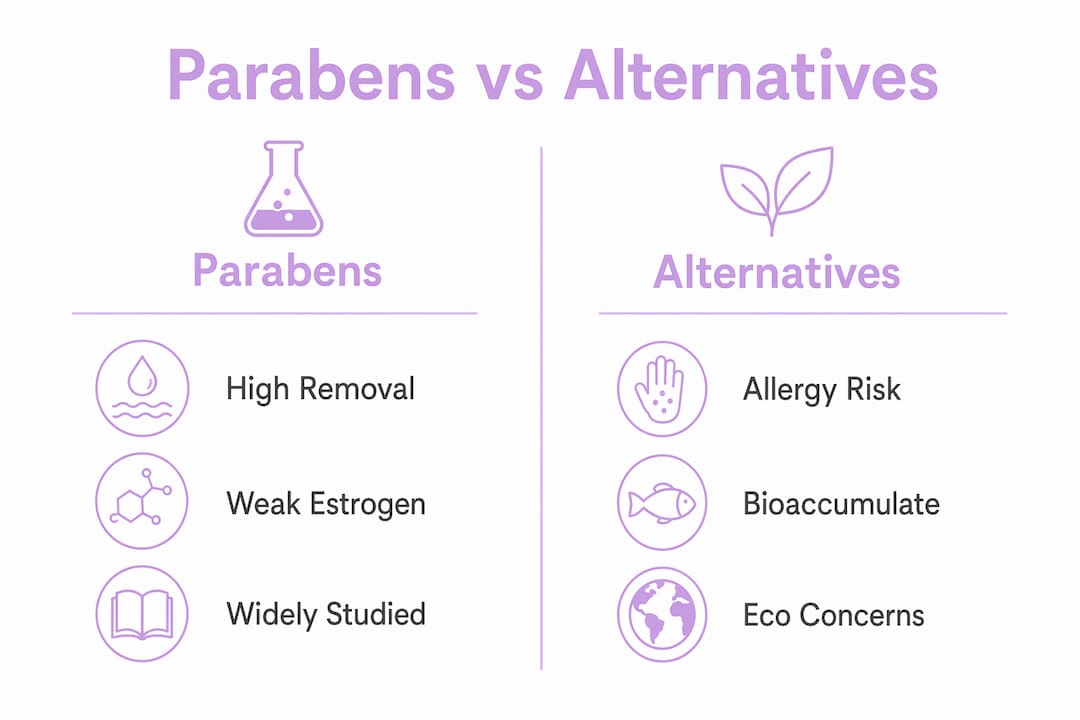
Parabens do exhibit weak estrogenic activity. The critical detail is how weak. The estrogenic activity of parabens is vastly weaker than natural human estrogen, making the endocrine disruptor claim unsubstantiated at real consumer exposure levels. Butylparaben is the most potent of the approved variants, yet its estrogenic activity is estimated to be 10,000 to 100,000 times weaker than oestradiol, the body’s primary oestrogen.
Allergy rates: parabens versus alternatives
This is where the data becomes genuinely surprising. NACDG surveillance data from 2021, covering 50,000 patients, places parabens near the bottom of the contact-allergy rankings for cosmetic preservatives. Alternatives like methylisothiazolinone (MI) and formaldehyde releasers cause significantly more allergic reactions. After public pressure led many brands to replace parabens with MI, a wave of contact dermatitis cases followed, prompting regulatory concern across Europe and North America.
“Parabens are among the least allergenic preservatives available to cosmetic formulators. The rush to replace them has, in several documented cases, produced products that are harder on skin, not easier.”
Cosmetic Dermatology Review
People with eczema, rosacea, or reactive skin may still benefit from avoiding parabens, not because of confirmed systemic risk, but because any preservative can act as a trigger in sensitised skin. For those readers, exploring natural ingredients for sensitive skin is a practical next step.
Pro Tip: If you have a known preservative sensitivity, ask your dermatologist for patch testing before switching products. The culprit may not be parabens at all.
What does “paraben-free” really mean on a label?
“Paraben-free” is an unregulated marketing claim in most markets, including Canada. No government body requires a product labelled “paraben-free” to meet any specific safety standard beyond what applies to all cosmetics. The label tells you what is absent. It says nothing about what is present.
Why preservatives are non-negotiable in water-based products
Any product that contains water needs a preservative system. Water is a growth medium for microorganisms. Without adequate preservation, Pseudomonas aeruginosa and Staphylococcus aureus can multiply rapidly inside a moisturiser or serum, causing skin infections and, in rare cases, serious illness. This is not a theoretical risk. Contaminated cosmetics have caused documented infections globally.
What “preservative-free” actually means
- Anhydrous products (oils, balms, waxes, and dry powders) contain no water and genuinely require no preservative. A facial oil or a solid lip balm can be safely preservative-free.
- Water-based products claiming to be preservative-free typically use alternative antimicrobial agents, often natural ones like rosemary extract or vitamin E, which have limited broad-spectrum efficacy.
- Multi-ingredient preservative blends are common in paraben-free formulations. These may include phenoxyethanol, ethylhexylglycerin, or sodium benzoate. Each has its own safety profile and concentration limits.
- Packaging matters enormously. Airless pumps and single-use sachets reduce contamination risk and can allow lower preservative concentrations. Wide-mouth jars introduce bacteria with every finger dip.
Pro Tip: A product labelled “paraben-free” and “preservative-free” that also contains water is a red flag. Check the full ingredient list and look for a recognised antimicrobial agent. If you cannot find one, the product may be inadequately preserved.
Proper storage also extends product safety. Learning how to store natural skincare correctly reduces microbial risk regardless of the preservative system used.
How to choose safe and effective paraben-free cosmetics
Choosing a paraben-free product wisely means reading past the front-of-pack claim and evaluating the full ingredient list. The paraben-free label does not ensure the absence of other irritants, including synthetic fragrances, which are a leading cause of cosmetic contact allergy.
What to look for when selecting paraben-free skincare:
- ✔ A clear preservative system: Look for phenoxyethanol (up to 1%), sodium benzoate, or benzyl alcohol. These are well-studied alternatives with established safety profiles.
- ✔ Fragrance-free or naturally scented: “Fragrance” on a label can represent dozens of undisclosed chemicals. Choose products that list individual botanical extracts instead.
- ✔ Appropriate packaging: Airless pumps and opaque containers protect product integrity and reduce the preservative load needed.
- ✔ Certifications and transparency: Look for brands that publish full ingredient rationale, not just a “clean” claim. Certifications from COSMOS Organic or ECOCERT indicate third-party ingredient verification.
- ✔ Skin-type match: Paraben-free is particularly worth prioritising if you have sensitive or reactive skin, eczema, or a history of preservative sensitivity.
The HERMOSA study found that switching to paraben-free products produced a 43.9% reduction in methylparaben and a 45.4% reduction in propylparaben urinary levels within just three days. That rapid clearance confirms the body processes parabens quickly. It also shows that product choices have a measurable, near-immediate effect on body burden if reducing exposure is your goal.
Environmental impact: parabens versus their alternatives
Parabens reach the environment primarily through wastewater from rinsing personal care products. Wastewater treatment plants (WWTPs) remove 92–98% of parabens from effluent. That is a high removal rate, yet parabens and their degradation products are still detected in treated water, river sediments, and marine organisms.
| Factor | Parabens | Common alternatives (e.g., phenoxyethanol, MI) |
|---|---|---|
| Wastewater removal rate | 92–98% | Variable; MI removal is lower |
| Biodegradability | Moderate to high | Variable by compound |
| Environmental detection | Detected in sediment and marine life | MI toxic to aquatic invertebrates |
| Regulatory status | Restricted in EU for some variants | MI restricted in leave-on products (EU) |
Chlorinated parabens, which form when paraben-containing water is treated with chlorine, are more persistent and potentially more toxic than the parent compounds. This is a genuine environmental concern that the cosmetics industry is actively researching.
The eco-friendly beauty movement has pushed formulators toward biodegradable preservation systems, including fermentation-derived preservatives and plant-based antimicrobials. These options are promising, though their environmental profiles are still being characterised. The most sustainable choice combines effective preservation with minimal packaging waste and concentrated formulas that require less water.
Key takeaways
Paraben-free cosmetics are not inherently safer than paraben-containing products; safety depends on the full formulation, the preservative system used, and your individual skin sensitivities.
| Point | Details |
|---|---|
| Parabens are regulated and studied | The FDA, WHO, and SCCS allow parabens at established limits backed by over 300 studies. |
| “Paraben-free” is unregulated | The label is a marketing claim; always read the full ingredient list for the actual preservative system. |
| Alternatives carry their own risks | Methylisothiazolinone and formaldehyde releasers cause more contact allergies than parabens in clinical data. |
| Water-based products need preservation | Unpreserved water-based cosmetics can harbour Pseudomonas aeruginosa and Staphylococcus aureus. |
| Environmental removal is high but incomplete | WWTPs remove 92–98% of parabens, yet degradation products persist in waterways. |
The part the “clean beauty” conversation keeps getting wrong
I have spent years reading cosmetic safety literature, and the paraben debate is one of the clearest examples of a fear-driven trend outrunning the evidence. The original 2004 study that triggered the panic was a detection study, not a toxicology study. Finding a substance in tissue is not the same as proving it caused harm. That distinction got lost almost immediately in media coverage, and the cosmetics industry responded to consumer pressure rather than scientific consensus.
What troubles me more than parabens themselves is what replaced them. Methylisothiazolinone is genuinely more allergenic. Formaldehyde releasers are genuinely more irritating. The consumers who switched to “paraben-free” products to protect their skin sometimes ended up with products that were harder on their skin, not gentler. That is the uncomfortable irony at the centre of this conversation.
My honest advice: if you have sensitive skin or a documented preservative allergy, paraben-free products are worth choosing, and there are excellent formulations available. If you are switching because of vague endocrine disruption fears, the science does not support the urgency. Read the full ingredient list every time. A product free of parabens but loaded with synthetic fragrance and MI is not a safer product. It is just a differently labelled one.
The chemical-free skincare conversation is evolving, and that is genuinely good. Transparency in formulation, better labelling standards, and consumer education are all moving in the right direction. Just make sure your choices are guided by evidence, not marketing copy.
— Alex
Natural skincare that goes beyond the label
Zenchemylab was built on the belief that what goes into a product matters as much as what stays out.
Every Zenchemylab formulation starts with raw botanical ingredients chosen for both safety and skin benefit. The focus is on natural beauty tips grounded in cosmetic science, not just clean-sounding claims. Whether you are looking for artisanal soaps, botanical body care, or a complete natural skincare routine, Zenchemylab’s product range is built around ingredient transparency and real skin results. Browse the full body care collection to find formulations that work with your skin, not against it.
FAQ
What are parabens in cosmetics?
Parabens are synthetic preservatives, including methylparaben, ethylparaben, propylparaben, and butylparaben, used to prevent bacterial and mould growth in personal care products. They have been used safely in cosmetics since the 1950s under regulatory concentration limits.
Are paraben-free cosmetics safer for sensitive skin?
Paraben-free products can benefit people with known preservative sensitivities or conditions like eczema, but they are not universally safer. Some alternative preservatives, such as methylisothiazolinone, cause higher rates of contact allergy than parabens in clinical data.
Do parabens accumulate in the body?
Parabens do not bioaccumulate. They have a half-life under 24 hours and are rapidly metabolised and excreted. The HERMOSA study confirmed that switching to paraben-free products reduces urinary paraben levels by over 43% within three days.
Can a water-based product be truly preservative-free?
No. Water-based products require a preservative system to prevent dangerous microbial growth. Only anhydrous products, such as facial oils, solid balms, and dry powders, can be genuinely preservative-free without safety risk.
How do I choose a good paraben-free product?
Read the full ingredient list, not just the front-of-pack claim. Look for a recognised preservative system such as phenoxyethanol or sodium benzoate, fragrance-free or botanically scented formulas, and packaging that minimises contamination, such as airless pumps.

1 Comments
ExoWatts
Great content! Keep up the good work!