
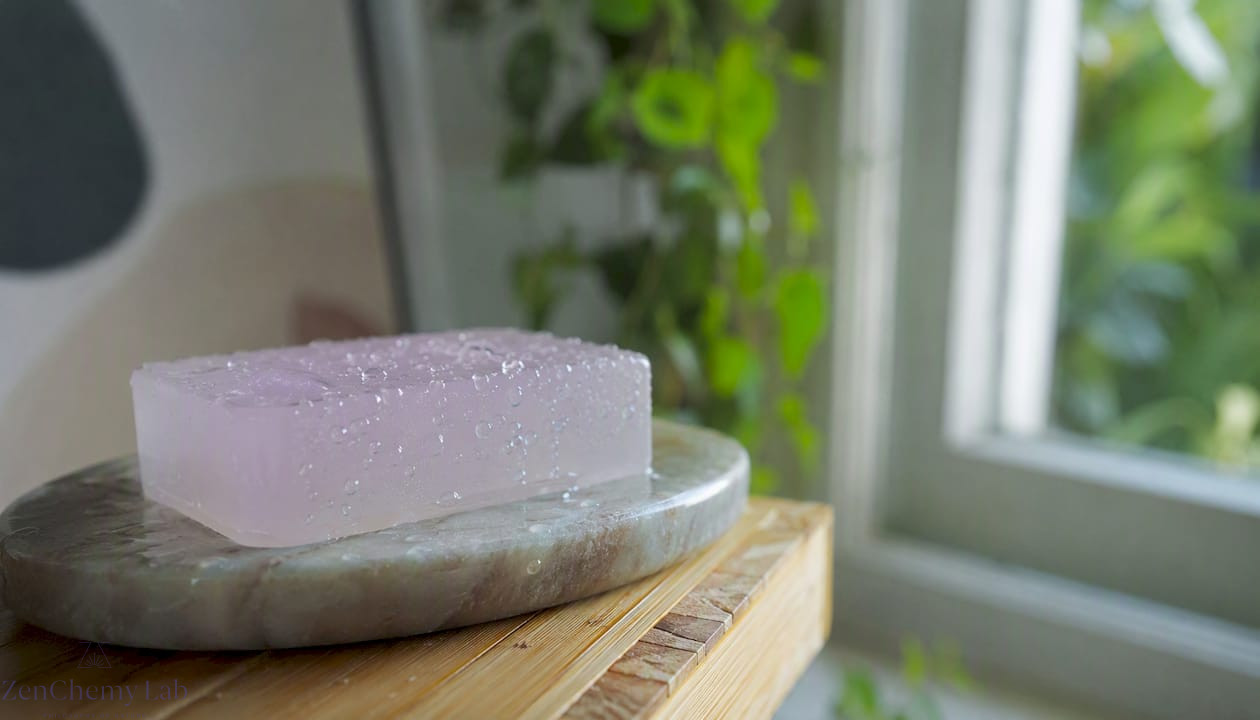
Glycerin soap is genuinely good for dry and sensitive skin. Glycerin (also called glycerol) is a humectant, meaning it draws water from the air and deeper skin layers into the stratum corneum, the outermost layer you can touch. That single property makes glycerin-forward bars meaningfully different from conventional detergent bars, which can strip the skin’s natural lipids and leave it tight, flaky, or reactive.
Here is what you need to know before you buy:
- ✅ Glycerin soap hydrates while it cleanses, reducing the tight feeling after washing.
- ✅ It supports the skin barrier, which the American Academy of Dermatology links to reduced irritation and slower visible ageing.
- ✅ It is non-comedogenic, so it suits most face and body skin types.
- ✅ Fragrance-free glycerin bars are among the gentlest options for eczema-prone or sensitised skin.
- ⚠️ Most glycerin bars are still alkaline. Short-term pH disruption is real, though glycerin’s presence moderates the drying effect.
- ⚠️ Additives (fragrance, dyes, preservatives) are the most common cause of reactions, not glycerin itself.
- ⚠️ Glycerin bars tend to dissolve faster if left sitting in water. A draining soap dish is not optional.
Key takeaways
Glycerin soap benefits dry and sensitive skin because glycerin is a humectant that retains moisture in the stratum corneum while cleansing, making it one of the most practical daily bar choices for reactive or dehydrated skin.
| Point | Details |
|---|---|
| Humectant action is the core benefit | Glycerin draws water into the outer skin layer, reducing tightness and flaking after washing. |
| Choose fragrance-free, short-ingredient bars | Additives like fragrance and dyes cause most reactions; glycerin itself is CIR-assessed as safe for topical use. |
| Store on a draining dish | Glycerin’s hygroscopic nature means bars dissolve faster in standing water; airflow extends bar life significantly. |
| Consult a dermatologist for persistent reactions | Spreading rash, blistering, or worsening eczema after use warrants professional advice before continuing. |
| Zenchemylab’s handcrafted bars retain glycerin naturally | Small-batch saponification keeps glycerin in the bar; fragrance-free options suit sensitive and dry skin. |
Table of Contents
- What is glycerin and how does it end up in your soap?
- How does glycerin actually work on your skin?
- Key benefits of glycerin soap for dry and sensitive skin
- Who benefits most, and who should be cautious?
- Known drawbacks and side effects to watch for
- How to choose glycerin soap in Canada
- How to use glycerin soap: face, body, and storage
- Safe ways to make or customise glycerin soap at home
- When to stop using glycerin soap and when to see a dermatologist
- What dermatologists and formulators say
- A Canadian artisanal soapmaker’s perspective
- Zenchemylab’s glycerin-forward artisan bars
- Sources
What is glycerin and how does it end up in your soap?
Glycerin (INCI: glycerin or glycerol) is a colourless, odourless, water-soluble compound naturally produced during saponification, the chemical process where oils or fats react with an alkali (sodium hydroxide for bars, potassium hydroxide for liquids) to form soap and glycerin simultaneously. In small-batch handmade soap, that glycerin stays in the bar. Commercial manufacturers often extract it for sale to the cosmetics and food industries and then add synthetic detergents back to the bar. That is why handmade bars tend to feel noticeably less stripping.
Three ways glycerin appears in a bar:
- Naturally retained: Cold-process or hot-process handmade soap where the glycerin formed during saponification is left in the finished bar.
- Added back: Melt-and-pour bases and some commercial bars list glycerin as an added ingredient after processing.
- Solvent-assisted transparency: Some clear bars use alcohols or propylene glycol to achieve clarity, not high glycerin content. A clear bar is not automatically a glycerin-rich bar.
How to read a label:
| Label term | What it means |
|---|---|
| Glycerin | Standard INCI name; acceptable from any source |
| Glycerol | Alternate INCI name; identical ingredient |
| Vegetable glycerin | Derived from plant oils (coconut, palm, soy); preferred by many consumers |
| Glycerin (vegetable) | Clearest label form; confirms plant origin |
Look for glycerin in the first half of the ingredient list. The further down it appears, the lower its concentration.
How does glycerin actually work on your skin?
Glycerin’s core job is water management. As a humectant, it attracts and binds water molecules to the stratum corneum, the outermost skin layer. This slows transepidermal water loss (TEWL), the constant, invisible evaporation of moisture through the skin. When TEWL is high, skin feels dry, looks dull, and becomes more vulnerable to irritants. Glycerin helps slow that process.
Think of the skin barrier as a “brick and mortar” wall: skin cells are the bricks, and lipids (ceramides, fatty acids, cholesterol) are the mortar. Glycerin does not rebuild the mortar directly, but it keeps the bricks hydrated so the wall stays flexible rather than cracking. Peer-reviewed research indexed on PubMed confirms that topical glycerol can improve skin hydration and barrier properties in controlled settings.
A note on pH: Most handmade glycerin bars sit between pH 9 and 10, well above skin’s natural pH of around 4.5–5.5. That gap temporarily disrupts the barrier. Glycerin does not neutralise the pH, but its humectant action cushions the drying effect, giving skin a better chance to recover between washes. For a deeper look at how soap pH affects your skin, the role of pH in skin care is worth reading.
Key benefits of glycerin soap for dry and sensitive skin
Glycerin soap’s advantages go beyond simple moisturising. Here is what the evidence and formulator experience actually support:
- Hydration during cleansing: Unlike surfactant-heavy bars that remove moisture along with dirt, glycerin bars help maintain water content in the outer skin layers throughout the wash.
- Barrier support: Regular use can reduce TEWL over time, which the AAD notes is linked to reduced irritation and healthier-looking skin.
- Non-comedogenic cleansing: Glycerin does not clog pores, making it suitable for acne-prone skin on both face and body.
- Reduced irritation for sensitised skin: People whose skin is drier from retinoids or benzoyl peroxide often find glycerin bars less aggravating than conventional cleansers, because the humectant action partially offsets treatment-related dryness.
- Gentleness for eczema and dermatitis: NIAMS guidance highlights that gentle cleansing and consistent moisturisation protect the barrier in sensitive and children’s skin, and fragrance-free glycerin bars fit that profile well.
Pro Tip: Pair your glycerin bar with a ceramide-rich moisturiser applied within two minutes of patting skin dry. Glycerin draws water in; the ceramide cream seals it there. That combination addresses both the humectant and occlusive steps in one simple routine.
Who benefits most, and who should be cautious?
Most likely to see real improvement:
- Dry and very dry skin types experiencing flaking, tightness, or rough texture.
- Sensitive skin prone to redness or reactivity after washing.
- People managing eczema or contact dermatitis who need a non-irritating daily cleanser.
- Skin recovering from over-exfoliation or barrier disruption.
- People with oily or combination skin who experience rebound oiliness from harsh cleansers. Stripping the skin of its natural oils triggers more oil production; a gentler bar can break that cycle.
Proceed with caution if:
- You react to fragrances, synthetic dyes, or preservatives. The glycerin itself is rarely the problem; the additives are. Always check the full ingredient list and choose fragrance-free bars. A fragrance-free skincare guide is a useful reference for understanding why this matters.
- You have a known allergy to a specific plant oil used in the soap base (coconut, palm, olive). The soap base matters as much as the glycerin.
- You are considering using pure, undiluted glycerin directly on skin. Concentrated glycerin can draw water out of skin cells rather than into them, causing irritation or blistering. Always use formulated products.
Patch-test any new bar on the inside of your wrist for 24–48 hours before using it on your face or a large body area. A reaction to a formulated product is almost always caused by an additive, not glycerin itself.
Known drawbacks and side effects to watch for
Glycerin soap is gentle, but it is not without trade-offs.
- pH mismatch: As noted above, most bars are alkaline. Skin typically recovers its natural pH within 30–90 minutes of washing, but repeated disruption without adequate moisturising can weaken the barrier over time. Pairing with a leave-on moisturiser helps. More on this in the pH-balanced soap guide.
- Additive risk: Fragrance is the leading cause of contact allergy in skincare. Dyes and certain preservatives (methylisothiazolinone, for example) are also common culprits. Scan for these on the label and avoid them if your skin is reactive. A helpful reference on ingredients that weaken the skin barrier covers many of the same offenders.
- Bar lifespan: Glycerin is strongly hygroscopic, meaning it actively pulls moisture from the air. In a humid bathroom, bars can “sweat” (develop a wet surface film) and dissolve faster if left in standing water.
- Pure glycerin risk: Undiluted glycerin applied directly to skin can cause stinging or blistering. Use it only in formulated products at appropriate concentrations.
Pro Tip: Store your glycerin bar on a draining soap dish or a wooden slat rack between uses. Airflow around the bar between washes can significantly extend its life, especially in humid Canadian bathrooms.
How to choose glycerin soap in Canada
Canadian consumers have more small-batch options than ever, but label literacy still matters.
Label checklist:
- ✅ “Glycerin,” “glycerol,” or “glycerin (vegetable)” appears in the first half of the INCI list.
- ✅ “Fragrance-free” or “unscented” is stated clearly (not just “natural fragrance,” which can still contain allergens).
- ✅ Short ingredient list with recognisable names.
- ✅ No synthetic dyes (look for FD&C or D&C colour numbers).
- ✅ No methylisothiazolinone or methylchloroisothiazolinone (common preservative allergens).
Handmade vs. commercial bars:
Handmade saponified bars retain glycerin naturally during the cold- or hot-process method. Many commercial “glycerin soaps” list glycerin as an added ingredient but rely on sodium lauryl sulphate or similar detergents as the primary cleanser. The handmade soap vs. commercially made soaps comparison explains this distinction clearly.
Sourcing and sustainability:
Vegetable glycerin is derived from plant oils, most commonly coconut, palm, or soy. If palm-derived ingredients concern you, look for RSPO (Roundtable on Sustainable Palm Oil) certification or bars that specify coconut- or olive-derived glycerin. Canadian artisanal makers often list their oil sources on their websites or product pages, which is worth checking before you buy.
Buying in Canada:
- Check local farmers’ markets and craft fairs for small-batch soapmakers who can answer ingredient questions directly.
- Look for Canadian e-commerce shops that publish full ingredient lists and sourcing notes.
- Under Canadian consumer labelling law, cosmetics must list all ingredients by INCI name. Any bar sold in Canada without a full ingredient list is non-compliant.
- Artisanal bars typically cost more than drugstore options, but the ingredient list is usually shorter and the retained glycerin content higher.
How to use glycerin soap: face, body, and storage
Daily routine basics:
- Use once or twice daily for body. For facial skin, once daily is often enough, particularly if you are also using active ingredients like retinoids or exfoliating acids.
- Work into a gentle lather in your hands first, then apply to skin. Avoid scrubbing directly with the bar on facial skin.
- Rinse thoroughly with lukewarm water. Hot water accelerates moisture loss after washing.
- Pat dry and apply moisturiser within two minutes.
Face-specific guidance:
Glycerin soap is generally suitable for facial use, but a few points apply. Avoid the eye area. If your skin is very reactive, dilute the lather further with water before applying. People using prescription retinoids or benzoyl peroxide can often tolerate a glycerin bar better than a conventional cleanser because the humectant action partially counteracts treatment-induced dryness.
Common questions:
- Can you use glycerin soap every day? Yes, for most skin types. If you notice increased dryness or irritation, reduce frequency and follow with a richer moisturiser.
- Is it safe for children? Fragrance-free glycerin bars are among the gentlest options for children’s skin. NIAMS guidance supports gentle, non-irritating cleansers for young or sensitive skin.
- What about babies? Consult your paediatrician before introducing any new product to infant skin.
Storage:
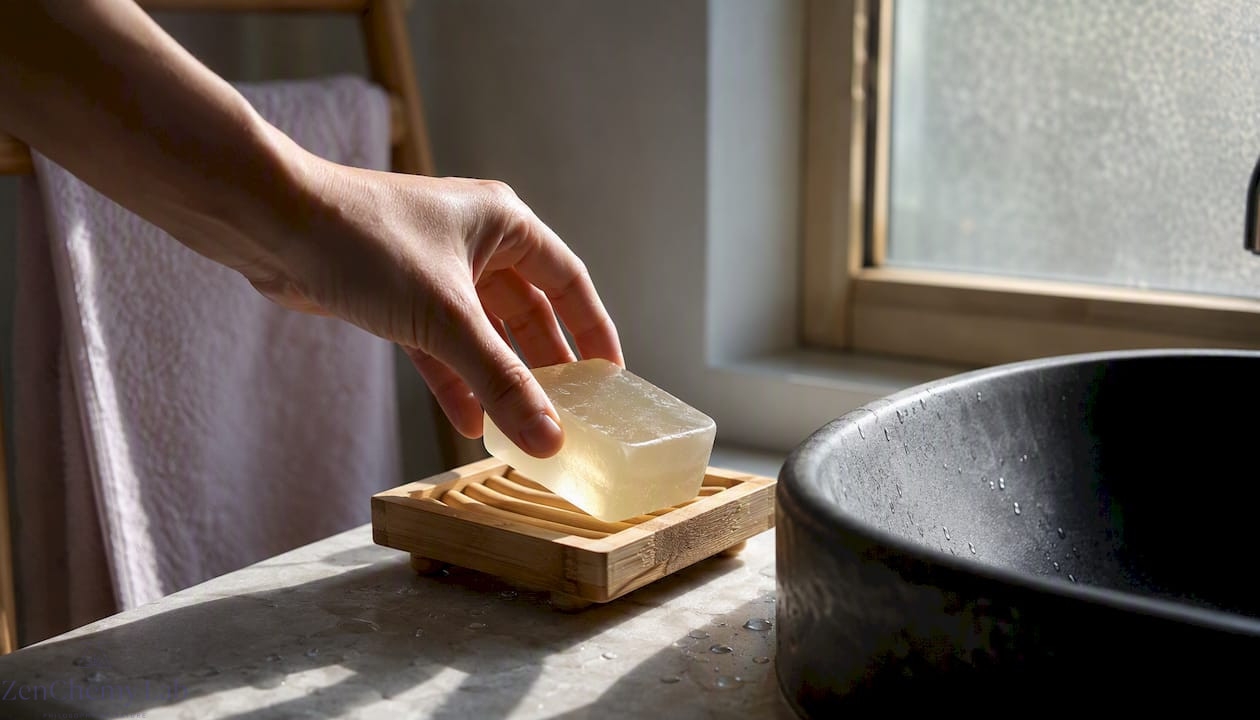
Keep the bar on a draining dish between uses. In humid bathrooms, a wooden slat or ridged ceramic dish that allows airflow underneath the bar makes a real difference to how long it lasts.
Safe ways to make or customise glycerin soap at home
DIY glycerin soap is accessible, but the method you choose determines both safety and skin results.
Two practical routes:
- Melt-and-pour (M&P) base: The safest starting point. Pre-made glycerin soap bases are melted, customised, and poured into moulds. No lye handling required. Choose a clear or white M&P base with a short ingredient list and no added fragrance.
- Cold-process with glycerin retention: More advanced. You formulate from scratch using oils, water, and sodium hydroxide (lye). When done correctly, all the glycerin formed during saponification stays in the bar. This route requires proper lye safety protocols: gloves, eye protection, and careful temperature management.
Gentle add-ins that maintain skin compatibility:
- Colloidal oat extract (soothing, barrier-supportive)
- Aloe vera gel (cooling, hydrating)
- Chamomile extract (calming for reactive skin)
What to avoid:
- Undiluted essential oils directly on sensitive or broken skin. Even “natural” fragrance compounds can trigger contact reactions.
- Synthetic dyes or colourants if you are making bars for sensitive skin.
- Pure glycerin applied undiluted to the face. In a formulated bar, concentrations are appropriate. Neat glycerin is not.
Safety and storage notes:
- If you are making cold-process soap, label bars clearly with ingredients and date made.
- Allow cold-process bars to cure for at least four weeks before use. Fresh soap has a higher pH and higher water content, both of which can irritate skin.
- Store finished bars in a cool, dry place with airflow. Glycerin’s hygroscopic nature means bars stored in sealed plastic bags in humid conditions can develop surface moisture and bacterial risk.
Melt-and-pour bases are the recommended starting point for beginners. The lye-handling step in cold-process soap requires careful preparation and is not suitable for an unventilated space or a first attempt without guidance.
When to stop using glycerin soap and when to see a dermatologist
Most reactions to glycerin bars are caused by additives, not glycerin itself. That said, some situations call for stopping use and seeking professional advice.
Stop using and consult a dermatologist if you notice:
- A spreading rash, hives, or swelling after use.
- Blistering, oozing, or signs of infection at the site of contact.
- Persistent stinging or burning that does not resolve within a few minutes of rinsing.
- Worsening eczema or dermatitis despite switching to a fragrance-free bar.
If you are using prescription topical therapies:
Worsening dryness or irritation while on a retinoid, benzoyl peroxide, or topical steroid is worth discussing with your prescriber before changing your cleanser. The interaction between your treatment and your cleanser matters, and a dermatologist can advise on the safest combination.
Patch-test any new bar for 24–48 hours on the inside of your wrist before full use. If no reaction appears after 48 hours, the product is likely tolerated, though a first-use reaction is still possible on more reactive areas like the face.
What dermatologists and formulators say
The professional consensus on glycerin in skincare is consistent and well-documented.
- The Cosmetic Ingredient Review (CIR) expert panel has assessed glycerin and concluded it is generally safe for use in topical cosmetic products when formulated as intended. That assessment covers the concentrations found in typical soap bars and moisturisers.
- Dermatology guidance from the AAD emphasises that barrier maintenance and hydration reduce irritation and support skin health over time, directly supporting the use of humectant-containing cleansers.
- Formulators note that glycerin interacts with surfactants in a bar to moderate their stripping effect. A bar that contains both a surfactant and glycerin will generally be less drying than one with the surfactant alone, though the ratio matters.
- Ingredient transparency is a consistent formulator recommendation: a short INCI list with clearly labelled vegetable glycerin is the clearest indicator of a genuinely gentle bar.
The skin repair and hydration relationship is well-established: humectants like glycerin are a foundational tool in barrier-repair routines, not a marketing claim.
A Canadian artisanal soapmaker’s perspective
Sourcing matters more than most buyers realise. When we prioritise vegetable glycerin from traceable plant oils and keep fragrance out of the formula entirely, we are not just making a marketing choice. We are removing the single most common cause of contact reactions in cleansers. Small-batch transparency means you can ask exactly where the glycerin came from and what oils were saponified. That conversation is not available at a drugstore shelf.

One practical note on bar care: a well-made wooden soap dish is not an accessory. It is part of the product. A bar sitting in pooled water loses glycerin and structure quickly. Pair your bar with a draining dish from the start, and it will last weeks longer.
Zenchemylab’s glycerin-forward artisan bars
If you have spent time reading ingredient lists and still feel uncertain about what you are buying, Zenchemylab’s handcrafted bars offer a straightforward answer. Each bar is made in small batches with non-toxic, cruelty-free ingredients, and the glycerin is retained naturally through the saponification process rather than added back after the fact.

Fragrance-free options are available for sensitive and reactive skin, and the ingredient lists are short enough to read in under a minute. Zenchemylab also carries soap dishes designed to extend bar life, so you get the full benefit of the glycerin content rather than watching it dissolve between washes. Browse the natural skin care collection to see current options, check ingredient lists, and read customer reviews. For a broader look at how glycerin bars fit into a full routine, the essential natural skincare routine guide is a useful next step.


1 Comments