
TL;DR:
- Authentic natural body care requires full ingredient transparency and certified organic content.
- Physical extraction methods retain more bioactive compounds and ensure ingredient purity.
- Avoid greenwashing by checking INCI lists, third-party certifications, and ingredient percentages.
Finding truly natural body care products shouldn’t feel like decoding a chemistry exam. Yet many labels hide synthetic additives behind vague claims like “nature-inspired” or “botanical blend,” making it genuinely hard to know what you’re putting on your skin. Greenwashing is widespread, and for anyone who cares deeply about ingredient purity and environmental responsibility, the confusion is real and frustrating. This guide walks you through exactly what you need, how to do it, and how to verify that your choices are as clean and sustainable as they claim to be. No guesswork, just clear steps grounded in evidence.
Table of Contents
- What you need for a natural body care routine
- Step-by-step process for making natural body care products
- How to avoid common mistakes and greenwashing pitfalls
- How to verify purity, sustainability, and real results
- Our perspective: Ingredient transparency is the true game-changer
- Discover artisanal natural body care in Canada
- Frequently asked questions
Key Takeaways
| Point | Details |
|---|---|
| Check certifications | Always ensure products meet standards like Naturland and NATRUE for sustainable, pure care. |
| Prioritise physical methods | Physical extraction preserves bioactives and avoids unnecessary chemicals in natural body care. |
| Avoid synthetic additives | Stay away from products containing synthetic dyes, perfumes, and ethoxylated surfactants. |
| Demand INCI transparency | Full ingredient disclosure is essential to keep your self-care routine genuinely natural. |
What you need for a natural body care routine
With the challenge of ingredient confusion in mind, let’s get clear on what you’ll need to begin your natural journey. Starting well means gathering the right materials and knowing which standards actually matter.
Tools and materials overview
| Category | Physical/traditional method | Chemical/industrial method |
|---|---|---|
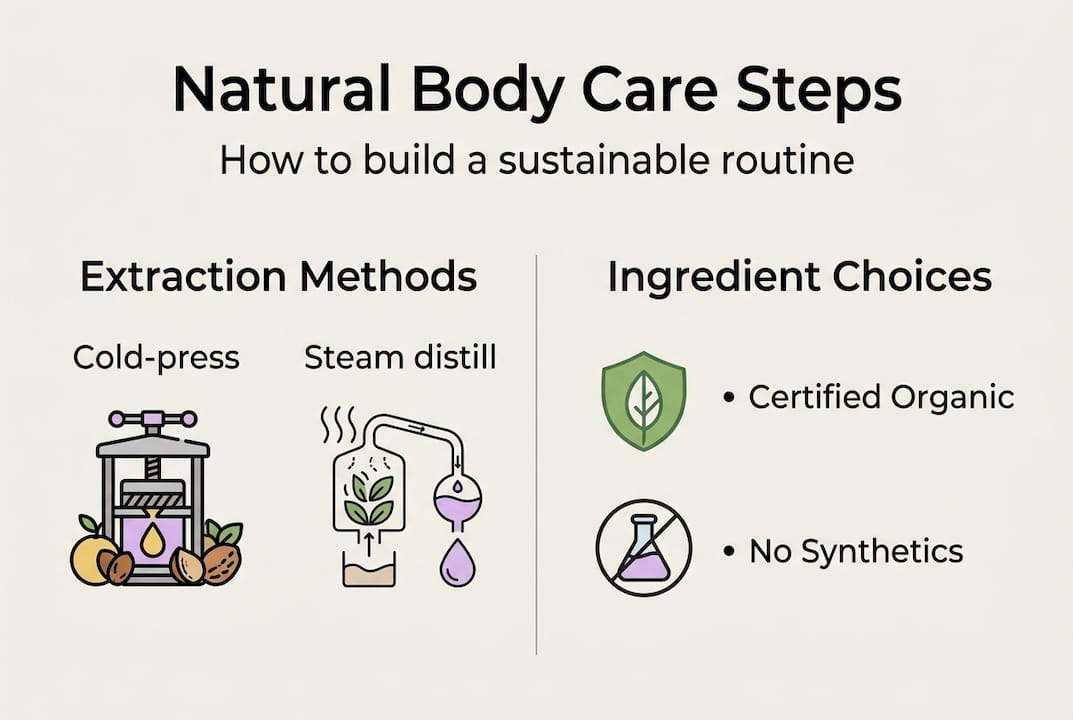
| Extraction type | Cold-press, steam distillation | Solvent extraction, ethoxylation |
| Surfactant type | Biodegradable, plant-derived | Synthetic, ethoxylated compounds |
| Certification suitability | ✅ Naturland, NATRUE approved | ❌ Typically excluded |
| Bioactive retention | High | Low to moderate |
As you can see, the method behind your ingredients matters just as much as the ingredients themselves. Physical extraction preserves the goodness in your botanicals. Chemical processing can strip it away entirely.
Your essential ingredient checklist
When you’re selecting ingredients, look for:
- ✅ Certified organic oils (such as cold-pressed jojoba, argan, or coconut)
- ✅ Biodegradable cleaning agents (coco-glucoside, decyl glucoside)
- ✅ Plant-based extracts verified through full INCI listings
- ✅ No synthetic dyes, synthetic fragrances, or nanoparticles
- ✅ Third-party certification logos from recognised bodies
Naturland standards require organic certification and prohibit synthetic dyes, perfumes, and nanoparticles in compliant products. This is the kind of clear benchmark that cuts through marketing language. Familiarising yourself with handmade cosmetic standards helps you recognise genuinely clean products from impostors.
Notably, only 27 out of 100+ reviewed body washes truly avoided synthetic additives in independent testing. That’s a small fraction. When you know what to look for, you can put yourself in that discerning group. Exploring top natural body care ingredients will help you build a solid, trustworthy ingredient vocabulary.
Step-by-step process for making natural body care products
Once you’ve assembled your materials and know what to look for, it’s time to move through the process itself. Whether you’re formulating at home or carefully selecting artisanal products, the same principles apply.
The five core steps
- Preparation — Gather all certified organic raw ingredients, tools, and reference your INCI list before you begin.
- Ingredient selection — Prioritise physically extracted oils and plant-based actives with verified certification.
- Method choice — Decide between a cold-process soap base, a botanical oil blend, or a surfactant-based cleanser using biodegradable agents only.
- Blending — Combine your ingredients at appropriate temperatures to preserve bioactive compounds. Never exceed recommended heat for cold-process formulations.
- Finishing — Allow proper curing time (typically four to six weeks for cold-process soap), label clearly with full INCI disclosure, and store in a cool, dry place.
Recommended input percentages
| Formulation component | Suggested percentage |
|---|---|
| Certified organic content (minimum) | 20% of final product |
| Plant-based surfactants | 10–30% |
| Carrier oils (organic) | 30–60% |
| Plant extracts and botanicals | 5–15% |
| Water phase | Balance to 100% |
Naturland-approved methods favour physical extraction and set a minimum of 20% organic content in the final product. That percentage is your baseline, not your ceiling. Aim higher when possible.
For building your natural routine for radiant skin, consistency in your ingredient ratios matters more than complexity. Simpler formulations with quality inputs often outperform elaborate ones with questionable synthetics.
Pro Tip: Choose physically extracted ingredients whenever possible. Cold-pressed oils and steam-distilled botanicals retain far more bioactive compounds than their chemically processed counterparts, meaning your skin receives the full benefit of each ingredient.
Also avoid ethoxylated surfactants entirely. They carry contamination risks, including trace amounts of 1,4-dioxane, and they don’t biodegrade cleanly. Among top sustainable body washes rated by independent reviewers, avoidance of ethoxylated compounds is a key shared trait. That’s not coincidence. And if you want to curate natural skincare routine results that last, this step is non-negotiable.
How to avoid common mistakes and greenwashing pitfalls
As you proceed, it’s essential to avoid common mistakes and understand how to spot misleading claims. The natural body care market is full of good intentions and, unfortunately, clever misdirection.
Greenwashing tactics to watch for
- ❌ “Natural-inspired” or “botanical” with no certification backing
- ❌ Vague fragrance listings (“parfum” or “fragrance” can hide hundreds of synthetic compounds)
- ❌ Front-of-label claims that don’t match the INCI list
- ❌ Certification logos that are self-awarded or unrecognised
- ❌ Incomplete ingredient disclosure (no percentages or full INCI)
- ❌ “Free from” claims without positive ingredient transparency
Pro Tip: Always check for a full INCI ingredient listing and look for certification logos from recognised third parties like Naturland or NATRUE. A brand confident in its formulation will never hide its ingredient list.
“At least 20% organic ingredients must be present in the final product” according to Naturland processing standards. If a product claims to be organic but doesn’t disclose percentages, that’s a red flag worth pausing on.
Real purity isn’t just about what’s left out. It’s about what’s transparently included. True purity in natural solutions shows up in the full ingredient list, not just the marketing copy on the front of a bottle.
The Consumer Reports natural body wash assessment confirms that certifications ensure ingredient purity and that INCI transparency is the clearest signal of whether a product genuinely avoids synthetics. Understanding the difference between natural vs synthetic skincare gives you even more confidence in reading those labels.
Practical greenwashing checklist
- ✅ Is the full INCI ingredient list visible on the label or website?
- ✅ Does a recognised third party certify the organic claims?
- ✅ Are synthetic fragrances and dyes explicitly absent?
- ✅ Is biodegradability addressed for surfactants and rinse-off products?
- ✅ Are organic content percentages disclosed?
How to verify purity, sustainability, and real results
After avoiding pitfalls, it’s important to confirm your choices deliver the purity and sustainability you expect. Verification isn’t scepticism; it’s good self-care practice.
Four steps to verify product quality
- Check certification — Look for Naturland, NATRUE, COSMOS, or equivalent third-party organic and natural certification on the packaging.
- Review ingredient percentages — Confirm the minimum 20% certified organic content in the final formulation.
- Request full INCI disclosure — A genuinely transparent brand publishes its full ingredient list, including water and minor components.
- Assess biodegradability — For rinse-off products especially, confirm that surfactants are plant-derived and biodegradable.
Biodegradable surfactants and avoidance of synthetic dyes are key markers of both purity and environmental health, according to Consumer Reports. Over 27 natural options were rated best for avoiding harmful synthetics in their assessment. It’s a meaningful signal when independent sources align with certified standards.
Exploring the purity and safety benefits of well-sourced ingredients helps you connect what’s on the label to what your skin actually experiences.
Signs of authentic, high-quality natural care
- 🌿 Texture — Natural products often feel richer or more varied in consistency because they contain whole plant lipids and waxes, not synthetic smoothing agents
- 🌿 Scent — Genuine botanical fragrance is subtle and varies slightly batch to batch; uniform, strong scent often signals synthetic fragrance
- 🌿 Skin response — Look for calm, balanced skin after use rather than temporary tightness or an artificial “squeaky clean” feel
- 🌿 Shelf life — Natural products without synthetic preservatives have a shorter shelf life, which is actually a sign of authenticity
Tracking your skin’s response over four to six weeks gives you a reliable picture of whether a product is genuinely working. Explore plant-based essentials to understand which botanicals are most likely to produce visible results for your skin type.
Our perspective: Ingredient transparency is the true game-changer
Having worked closely with natural formulations and certification standards, we’ve reached one firm conclusion: marketing claims mean almost nothing without ingredient transparency to back them up. The brands getting this right are the ones willing to show you every single ingredient, in order, with percentages when possible.
Certification matters, but it’s the floor, not the ceiling. Real trust is built when a brand has nothing to hide and chooses transparency anyway. We’ve seen this play out consistently in Canadian artisanal skincare, where small-batch makers who disclose everything tend to earn the deepest customer loyalty. There’s a reason for that.
Our honest advice: demand full ingredient disclosure before you buy anything. Read the discussion on cosmetic standards to understand what regulated, responsible production actually looks like. And if a brand won’t show you its full INCI list, it’s telling you something important. For anyone navigating sensitive skin solutions, transparency isn’t optional. It’s the whole point.
Discover artisanal natural body care in Canada
Convinced you want to start or deepen your natural routine? Here’s where to turn for trusted solutions.
At ZenChemy Lab, we believe great body care starts with knowing exactly what’s in every product. Canadian-crafted, ingredient-conscious, and built around traditional methods that preserve what nature intended.

Whether you’re looking for skincare tips to refine your daily routine or ready to build a radiant body care routine from scratch, we’ve got expert guidance to support every step. When you’re ready to experience the difference that truly natural formulation makes, explore our handmade artisan soap collection and see what ingredient transparency looks like in practice.
Frequently asked questions
How can I tell if a body care product is truly natural?
Look for a full INCI ingredient list, third-party certification such as Naturland, and confirmation of at least 20% certified organic content in the final formulation.
Why avoid ethoxylated surfactants in natural body care?
Ethoxylated surfactants carry contamination risks including 1,4-dioxane and don’t biodegrade cleanly; top natural options consistently exclude them for both safety and sustainability reasons.
What certifications matter for sustainable, pure body care?
Recognised certifications like Naturland and NATRUE provide verified assurance of organic content, ingredient purity, and responsible production methods.
Can I make my own natural body care products at home?
Yes — start with certified organic ingredients and use traditional extraction methods like cold-pressing or steam distillation to maximise bioactive retention in your finished products.

2 Comments