
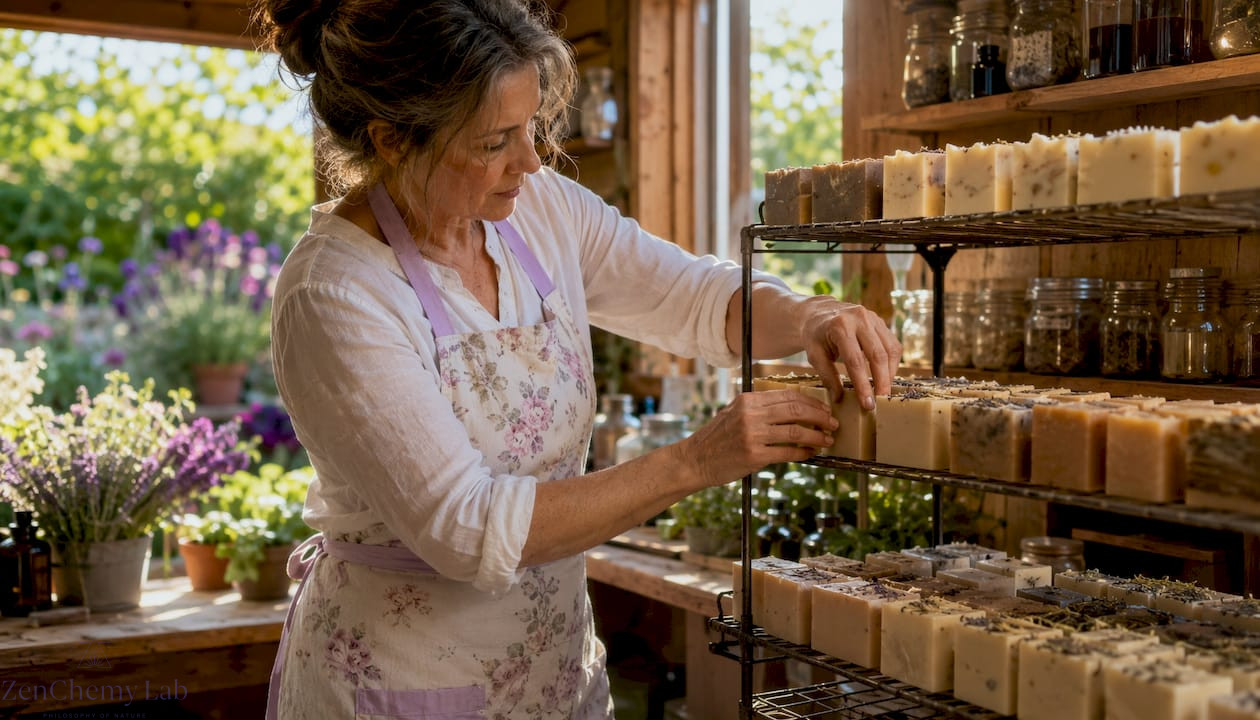
Soap curing is the post-saponification maturation period where a freshly made bar loses excess water, develops a firm crystal structure, and stabilises its pH, transforming from a soft, harsh block into a mild, long-lasting bar you’ll actually want to use. While saponification completes within 24–48 hours, the physical restructuring that makes soap genuinely good takes weeks. The result is a bar that lathers more richly, feels gentler on skin, and lasts far longer in the shower.
Here is what happens during a proper cure, at a glance:
- ✅ Water evaporates: bars lose some of their initial water weight, becoming firmer and more durable
- ✅ Crystal structures form: fatty acid salts reorganise into a stable network that gives the bar its hardness
- ✅ pH stabilises: alkalinity drops from a fresh 10–12 down to around 9–10, making the soap noticeably milder
- ✅ Lather matures: cured soap produces a creamier, more stable lather than a freshly poured bar
Skipping or shortening this stage is the most common reason homemade soap disappoints. Understanding the soap curing process is the first step toward making bars that genuinely rival artisanal quality.
Table of Contents
- What is soap curing, scientifically speaking?
- Does every type of soap need curing?
- How long does soap take to cure, and how do you know it’s ready?
- How to cure soap properly and store it for best results
- Can you safely shorten the curing time?
- Why patience in curing defines artisanal soap quality
- How soap crystalline restructuring shapes the final bar
- Key takeaways
- Discover naturally cured artisanal soap from Zenchemylab
What is soap curing, scientifically speaking?
Curing is primarily a physical process, not a chemical one. That distinction surprises most beginners.
Saponification, the reaction between oils and lye that creates soap, wraps up within the first day or two after pouring. By the time you unmould your bars, the chemistry is essentially done. What curing addresses is the internal structure of the bar and its water content, both of which take considerably longer to resolve.
Three overlapping processes drive the cure:
1. Water evaporation. Fresh soap holds a significant amount of water from the lye solution. As that moisture migrates to the surface and evaporates, the bar becomes harder, lighter, and more resistant to dissolving quickly in the shower.
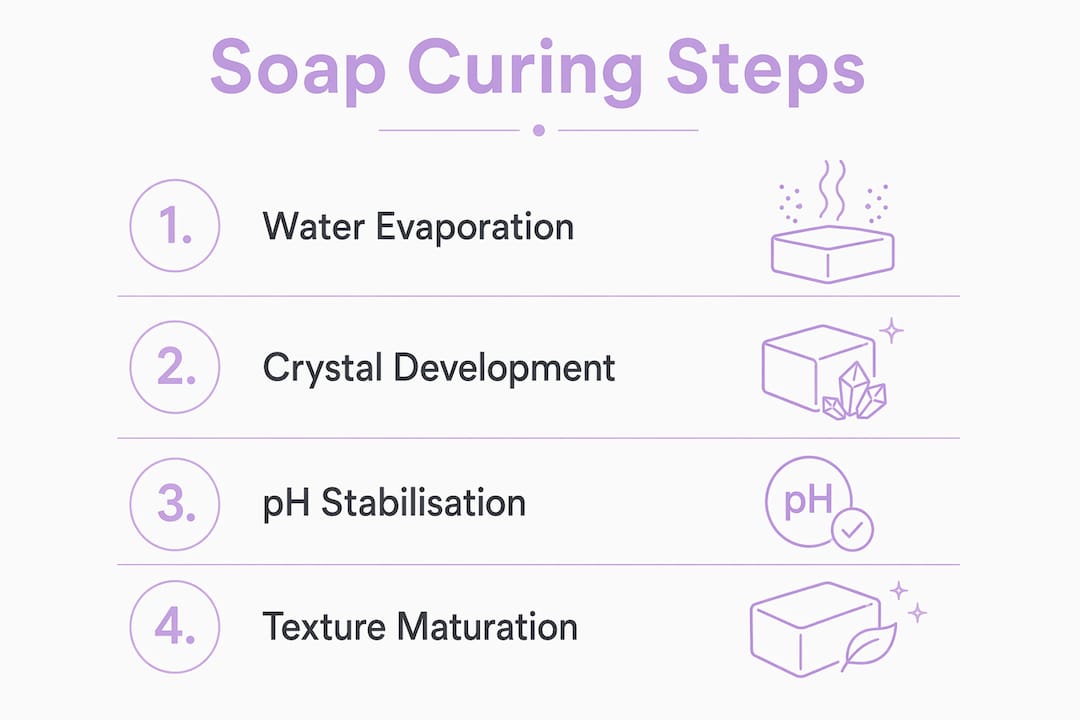
2. Crystal structure development. Soap is a mixture of different fatty acid salts. Saturated fats from oils like coconut or tallow form solid crystalline networks during curing, while unsaturated fats from olive oil remain in a more fluid phase around those crystals. This network is what gives a cured bar its characteristic firmness.
3. pH stabilisation. Atmospheric CO₂ reacts with residual alkalinity in the bar, gradually nudging the pH from 10–12 down to roughly 9–10. That shift is the difference between a bar that feels stripping and one that feels comfortable on sensitive skin.
Think of it like drying lumber or ageing cheese. The raw material exists, but time is what makes it usable and genuinely good.
Does every type of soap need curing?
Not all soap types require the same waiting period, and a few needs almost none at all. The method of production is the deciding factor.
Cold process soap needs the longest cure, typically 4–6 weeks, because it is mixed at low temperatures and poured without any external cooking step. All the water evaporation and crystal formation must happen naturally over time.
Hot process soap undergoes a cooking stage that accelerates saponification significantly. Because the chemical reaction is more complete before the soap is poured, hot process bars can be used sooner, usually within 1–2 weeks. That said, even hot process soap benefits from additional drying time for a harder, longer-lasting bar.
Liquid soap requires minimal curing. The dilution stage and the nature of potassium-based soap mean there is no crystal structure to develop in the same way. A brief rest to allow full saponification and clarity is usually sufficient.
Melt-and-pour soap needs no curing at all. The base is pre-made and pre-saponified; once poured and cooled, it is ready to use immediately.
| Soap type | Typical cure time | Primary purpose of curing |
|---|---|---|
| Cold process | 4–6 weeks | Water evaporation, crystal formation, pH drop |
| Hot process | 1–2 weeks | Drying and hardening |
| Castile (100% olive oil) | 6 months or more | Prevents slimy texture; develops firmness |
| Milk soap | longer curing period | Moisture retention from milk solids extends cure |
| Liquid soap | Minimal | Clarity and full saponification |
| Melt-and-pour | None | Pre-saponified base; ready after cooling |
Key reasons curing requirements differ:
- Cold process soaps contain more residual water and require natural evaporation
- Hot process cooking accelerates saponification, reducing the chemical waiting period
- High-olive-oil recipes produce softer bars that need extended time to firm up properly
- Melt-and-pour bases are manufactured to be immediately usable
Understanding which type you are working with saves you from either using soap too early or waiting unnecessarily long.
How long does soap take to cure, and how do you know it’s ready?
For most cold processed soap recipes, 4–6 weeks is the reliable baseline. The recipe’s oil profile, however, can shift that window considerably. High-coconut-oil soaps may be ready in about 4 weeks, while a traditional Castile soap made with 100% olive oil can need 6 months or more to shed its characteristic sliminess and develop a firm, creamy lather.
Environmental conditions also play a real role. High humidity slows water evaporation, effectively extending cure time. A cool, dry space with good airflow will always produce a faster, more even cure than a warm, damp bathroom shelf.
Reliable readiness indicators:
- Weight loss plateau: weigh your bars weekly. When the weight stops dropping, evaporation is complete. This is the most objective sign that curing is done.
- Physical hardness: a fully cured bar feels firm and dry to the touch, with no give when pressed.
- Mildness: the bar should feel comfortable on the inside of your wrist, with no stinging or tightening sensation.
- Zap test: touch the bar briefly to the tip of your tongue. A sharp, electric “zap” signals excess lye; no zap means the bar is safe and fully saponified.
- pH trend: a pH strip reading of 9–10 confirms the alkalinity has stabilised.
Pro Tip: Weigh each bar on the same day every week and record the numbers. When two consecutive weekly weights match, your soap has reached its water-loss plateau and is genuinely ready, regardless of what the calendar says.
Relying solely on a preset timeline can mislead you. A batch made in a humid Canadian summer may need an extra week or two beyond the standard 4–6 week window, while a winter batch in a dry, heated home might be ready slightly sooner.
How to cure soap properly and store it for best results
Getting the environment right matters as much as the waiting. Soap cured in poor conditions, even for the correct duration, will not reach its full potential.
Step-by-step curing method
- Unmould at the right time. Most cold process soaps are firm enough to unmould after 24–48 hours. If the bar still feels soft or sticky, give it another day before cutting.
- Cut bars to their final size. Cutting earlier rather than later gives each bar more surface area for evaporation.
- Place bars on an open rack or tray. Wire racks, wooden curing boards, or slatted shelves all work well. The goal is airflow on as many sides as possible.
- Space bars apart. Leave at least 2–3 centimetres between each bar so air can circulate freely.
- Turn bars weekly. Rotating them ensures even drying and prevents flat spots or moisture pooling on the underside.
- Maintain 40–60% humidity and a stable, moderate temperature. A cool room away from direct sunlight is ideal. Avoid bathrooms, which are too humid, and garages in winter, which can be too cold and damp.
- Weigh and record weekly. Track the weight plateau as described above.
Common mistakes to avoid
- ❌ Storing bars in airtight containers or plastic wrap during curing (traps moisture)
- ❌ Stacking bars directly on top of each other (blocks airflow, causes uneven drying)
- ❌ Placing bars in direct sunlight (accelerates discolouration and can cause rancidity)
- ❌ Assuming a hard bar is a cured bar (hardness can appear before water loss is complete)
- ❌ Curing in a humid bathroom or kitchen (slows evaporation and risks soda ash or DOS)
Storage after curing
Once fully cured, wrap bars loosely in breathable paper, beeswax wrap, or a simple paper band. Avoid plastic, which traps residual moisture and can cause the bar to sweat or develop dreaded orange spots (DOS, or dreaded orange spots, caused by rancid oils). Store in a cool, dry place away from direct light. Properly stored, a well-cured bar can last 1–2 years without significant quality loss.
Curing also stabilises scent and colour. As moisture equilibrates within the bar, fragrance molecules bind more firmly to the soap matrix, and natural colourants settle rather than bleeding or fading. A bar that smells faint early on often develops a noticeably stronger, truer scent after sufficient curing time.
Can you safely shorten the curing time?
The honest answer is no, not without trade-offs.
Curing is driven by physical processes, particularly water evaporation and crystal network formation, that cannot be meaningfully rushed. Applying heat to speed things up disrupts the very crystal structures forming inside the bar, producing a softer, less stable result.
There is one technique that genuinely reduces cure time without degrading quality: a water discount. By using less water in the lye solution than a standard recipe calls for, you start with less moisture to evaporate. The bar reaches its weight-loss plateau faster. The trade-off is that a lower water content accelerates trace, making the batter harder to work with and requiring more precise temperature control. It is not a technique for beginners.
What definitely does not work:
- Placing bars in a warm oven or dehydrator (disrupts crystal formation, can cause separation)
- Wrapping bars tightly to “sweat” them (traps moisture rather than releasing it)
- Using a fan on high to force rapid evaporation (creates uneven drying and surface cracking)
Under-cured soap is softer, dissolves faster in the shower, produces weaker lather, and can still feel slightly harsh on skin. For anyone making soap to share, gift, or sell, using bars before they are fully cured is the single fastest way to undermine the quality of your work.
Why patience in curing defines artisanal soap quality
The difference between a bar that feels luxurious and one that disappoints often comes down to cure time, not the recipe.
Cosmetic chemistry makes this clear: curing is about physical maturation, not the chemical reaction. Once saponification is done, the bar’s quality trajectory is entirely determined by how well and how long it cures. A beautifully formulated soap with premium oils will still feel slimy, dissolve quickly, and lather poorly if pulled from the rack too soon.
Experienced soap makers consistently point to patience as the skill that separates professional-quality bars from amateur ones. As curing progresses, the bar becomes milder, its lather grows creamier and more stable, and its lifespan in the shower extends noticeably. These are not subtle differences. A bar cured for 8 weeks versus 4 weeks is a meaningfully better product.
At Zenchemylab, every bar goes through a full curing period before it reaches you. That waiting time is not a delay. It is part of what makes handmade soap worth choosing over a mass-produced alternative. The scent and colour stability you notice in a well-made artisanal bar, the way the lather feels, the way the bar holds its shape through weeks of use, all of that traces back to a proper cure.
How soap crystalline restructuring shapes the final bar
Inside every curing bar, an invisible reorganisation is underway. Soap is not a uniform substance. It is a mixture of different fatty acid salts, each with its own molecular geometry and tendency to form ordered structures.
During curing, saturated fatty acid soaps, those derived from coconut oil, palm oil, or tallow, arrange themselves into tight, ordered crystalline lattices. These lattices interlock and reinforce each other, building the firm, dense matrix that gives a cured bar its characteristic hardness. Unsaturated fatty acid soaps, primarily from olive oil, do not crystallise in the same way. They remain in a more fluid, amorphous phase that fills the spaces between the crystalline regions, contributing to the bar’s smooth, creamy feel.
This is why oil choice so dramatically influences cure time and final texture. A high-coconut-oil bar crystallises relatively quickly because saturated fats organise efficiently. A Castile soap, made almost entirely from olive oil, has very few saturated fats to anchor a crystal network. The bar relies on a slow, gradual ordering of its unsaturated components, which is why Castile soaps can feel slippery and soft for months before finally firming up.
The practical implication is straightforward: recipes with a higher ratio of saturated to unsaturated oils cure faster and produce harder bars sooner. Recipes leaning heavily on liquid oils like olive, sunflower, or avocado need more time for their internal structure to stabilise. Knowing your oil profile helps you set realistic expectations for your cure timeline, rather than assuming every batch follows the same schedule.
Key takeaways
Soap curing is a physical maturation process, not a chemical one, and the quality of your final bar depends entirely on giving it the time and conditions it needs.
| Point | Details |
|---|---|
| Curing is physical, not chemical | Saponification finishes in 24–48 hours; curing addresses water loss and crystal formation over weeks. |
| Standard cure time | Cold process soap needs 4–6 weeks; high-olive-oil recipes like Castile can need 6 months or more. |
| Weight plateau is the true signal | Weigh bars weekly; when the weight stops dropping, the cure is genuinely complete. |
| Environment matters | Maintain 40–60% humidity with good airflow; turn bars weekly to prevent uneven drying. |
| Rushing causes real quality loss | Under-cured soap is softer, harsher, and shorter-lived; water discounting is the only safe shortcut. |
Discover naturally cured artisanal soap from Zenchemylab
Every bar Zenchemylab crafts goes through a full curing period before it reaches your hands. That commitment to patience is what makes the difference you feel from the first use. If you are ready to experience what properly cured, natural skin care actually feels like, explore the full range of handmade bars and botanical body care at Zenchemylab. Your skin will notice.
2 Comments