
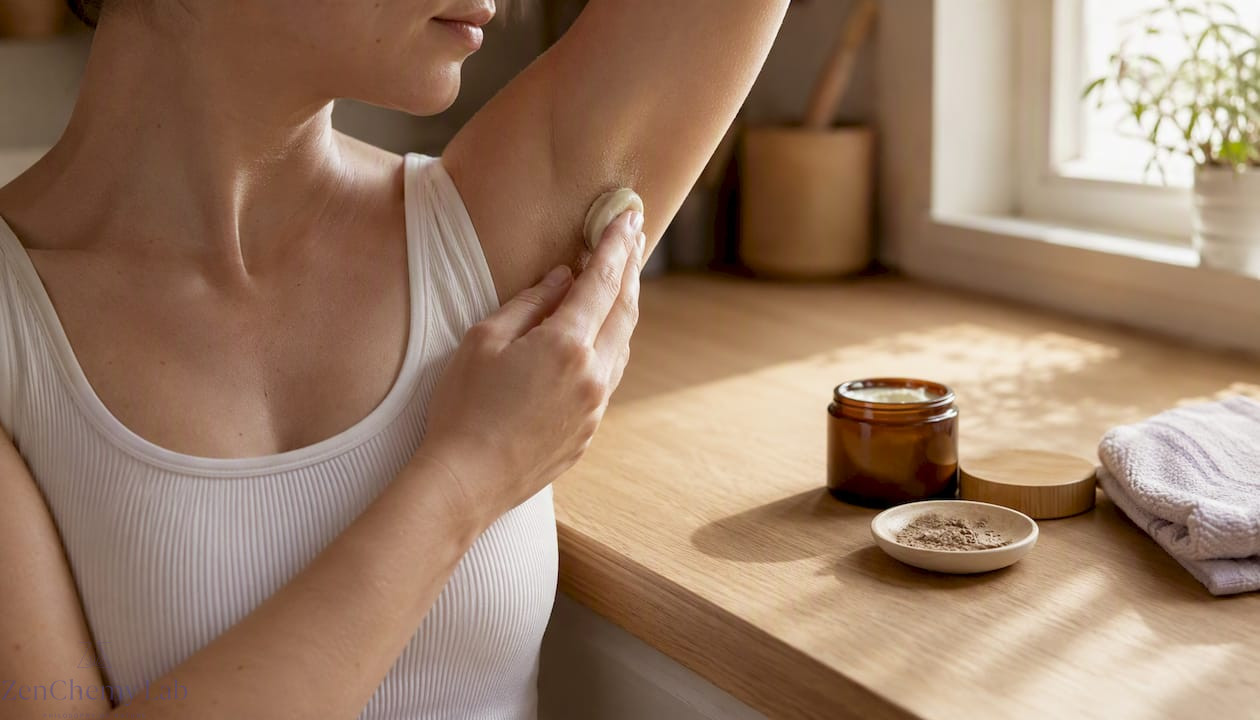
A “deodorant detox” is not a bodily cleanse. Your liver and kidneys handle systemic toxin removal, not your armpits. What the term does describe, usefully, is the microbiome adjustment period after you stop aluminium-based antiperspirants and switch to a natural deodorant. That transition is real, it can be smelly, and there are safe, evidence-backed ways to ease it.
Start here:
- ✅ Stop your antiperspirant and switch to a natural deodorant formulated for sensitive skin
- ✅ Wash underarms with a gentle cleanser morning and evening during the first two weeks
- ✅ Patch-test any new product or mask on your inner arm for 48 hours before applying to your pits
- ✅ Keep skin fully dry before applying natural deodorant
⚠️ Safety note: Stop any clay mask, acid, or apple cider vinegar application immediately if you notice burning, spreading redness, or a rash. Underarm skin is thin and folds easily, making it more vulnerable to irritation than most body areas.
Pro Tip: Start your switch on a Thursday or Friday so the first, smelliest days fall over a weekend when social pressure is lower.
Key takeaways
A successful deodorant detox is a microbiome adjustment, not a bodily purge: consistent hygiene, the right active ingredient, and two to six weeks of patience are what actually work.
| Point | Details |
|---|---|
| Detox is a transition, not a cleanse | Your body removes toxins via the liver and kidneys; the “detox” is a microbial rebalancing after stopping aluminium antiperspirant. |
| Expect 2–6 weeks | Most people adjust within 2–4 weeks; heavy long-term users may need up to six weeks before odour stabilises. |
| Choose the right active ingredient | Magnesium hydroxide or zinc ricinoleate causes far less irritation than baking soda, especially for sensitive skin. |
| Clay masks are optional, not mandatory | Weekly use of kaolin or bentonite clay can ease the transition; daily or aggressive use risks stripping the skin barrier. |
| Zenchemylab as a starter option | Zenchemylab’s aluminium-free, Canada-made natural deodorant is formulated for sensitive skin and fits the protocol above from Day 1. |

Table of Contents
- What does a “deodorant detox” actually claim to do?
- Why you often smell more right after switching to natural deodorant
- What are the realistic stages when you stop antiperspirant?
- What actually helps: safe methods to ease the switch
- Risks, red flags, and when to see a clinician
- How to pick a natural deodorant in Canada
- Your 7-step protocol and 7-day checklist
- Myths versus evidence: a quick science check
- The transition is worth it, but skip the dramatic protocols
- Zenchemylab’s natural deodorant: a Canada-made starting point
- Sources
What does a “deodorant detox” actually claim to do?
The term gets used loosely to describe everything from a single clay mask session to a weeks-long product-free reset. Typical methods include bentonite or kaolin clay masks, charcoal masks, diluted apple cider vinegar rinses, baking soda scrubs, and simply stopping all underarm products cold.
The claimed outcomes range from “drawing out toxins” to “resetting your sweat glands.” No solid medical or scientific evidence supports those systemic claims. Sweat is not a meaningful detox pathway. Any real benefit is local: removing product residue, shifting local skin pH, or temporarily changing the bacterial population on your skin.
Why do some people feel better after a “detox” period? Usually because they stopped using a product that was irritating them, because thorough washing removed waxy antiperspirant residue, or because their microbiome simply rebalanced with time. Soap and water alone will remove most antiperspirant buildup, and aggressive recipes are generally unnecessary.
Research on this topic is still limited in scale. Systematic reviews note a lack of large clinical trials, so cautious wording is warranted when describing what any specific method does.
Why you often smell more right after switching to natural deodorant
Aluminium salts in antiperspirants work by temporarily blocking sweat ducts. Less sweat means less moisture for bacteria to feed on, which means less odour. Over months or years of use, your underarm microbiome adapts to that low-moisture environment, favouring bacterial communities that thrive under those conditions.
When you stop antiperspirant, sweat flow returns quickly. The microbial community that was shaped by low moisture suddenly gets a flood of substrate to work with. Peer-reviewed studies document measurable shifts in underarm microbiota after antiperspirant use versus non-use, and the transitional bloom of odour-producing bacteria, particularly Corynebacterium species, is what causes that sharp, unfamiliar smell many people notice in the first one to two weeks.
The good news: clay or charcoal masks can bind residue and lower local pH, discouraging odour-causing bacteria, while the microbiome gradually rebalances toward milder communities. Think of it as a microbial adjustment, not a toxic purge. Targeting the local environment — pH, residue, moisture — is what actually speeds recovery. For a deeper look at how your skin’s microbial ecosystem works, the skin microbiome guide on Zenchemylab’s blog is worth reading alongside this article.
What are the realistic stages when you stop antiperspirant?
Most people adjust within a few weeks, with some heavy long-term users taking longer to transition. Here is what each stage typically looks like:
- Days 0–3 (wash-out): Sweat returns to normal flow. You may notice more wetness than usual but odour is often mild because the bacterial community hasn’t shifted yet.
- Days 4–14 (microbial rebound): The most challenging phase. Odour-producing bacteria bloom as they adapt to the new moisture environment. This is the stage most people misread as a sign that natural deodorant “doesn’t work.”
- Weeks 2–4 (stabilisation): Odour-producing species begin to lose their competitive advantage. Milder bacterial communities re-establish. Most people notice a clear improvement.
- Weeks 4–6+ (longer tail): Heavy, long-term antiperspirant users may need the full six weeks. Hormonal fluctuations, a high-protein diet, or a recent illness can extend this phase.
Factors that affect your timeline:
- 🌡️ Heat and humidity (Canadian summers, saunas, hot yoga) increase moisture and can prolong the rebound phase — plan for an extra application on hot days
- 🏃 High exercise frequency accelerates sweat output and may intensify days 4–14
- 🥩 Diet high in red meat, sulphur-rich foods, or alcohol can worsen transitional odour
- 💊 Hormonal changes (menstrual cycle, thyroid shifts) affect sweat composition
For work and social situations during days 4–14: wear natural, breathable fabrics (linen, cotton), carry a small travel-size natural deodorant for midday reapplication, and shower or rinse underarms at midday if possible.
What actually helps: safe methods to ease the switch
The most effective approach is layered: a solid daily hygiene baseline, one weekly mask, and targeted use of gentle acids or diluted apple cider vinegar when needed. Here is how to do each safely.
Daily hygiene baseline
- Wash underarms with a gentle, fragrance-free cleanser morning and evening.
- Pat completely dry — bacteria multiply faster on damp skin.
- Apply natural deodorant to clean, dry skin only. Applying over sweat or residue reduces efficacy significantly.
Weekly clay or charcoal mask protocol
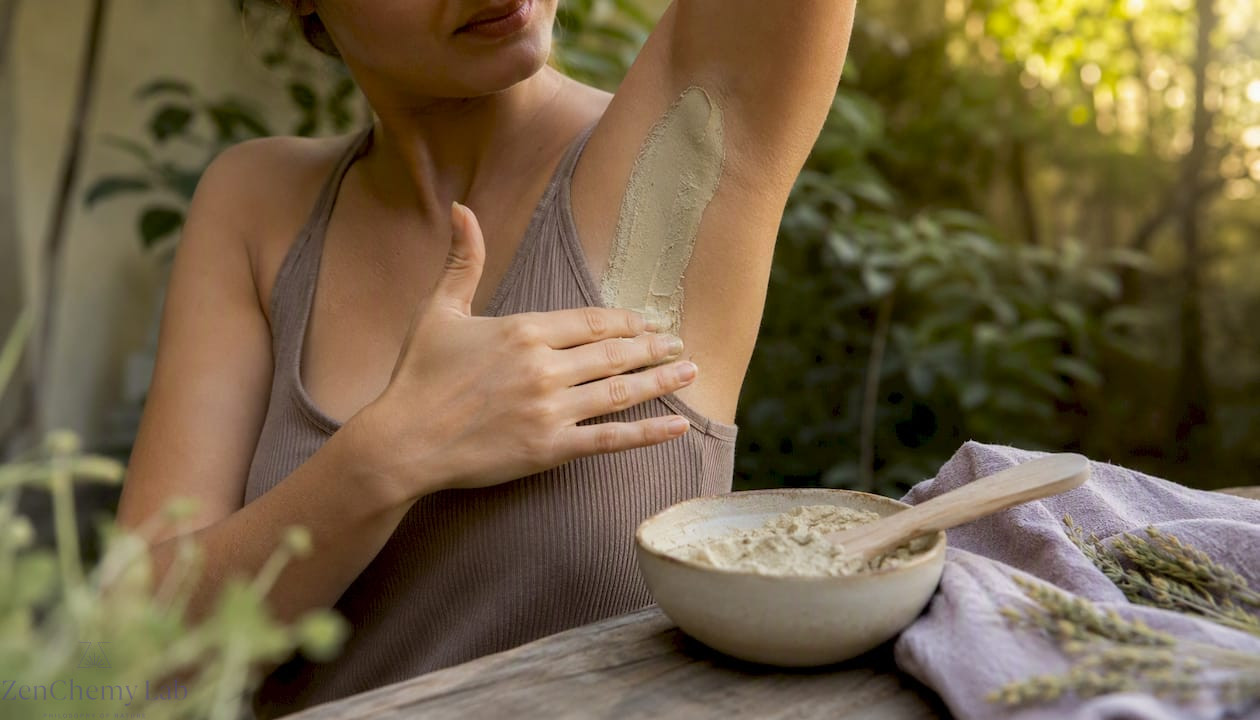
- Mix one tablespoon of bentonite or kaolin clay (such as Aztec Secret Indian Healing Clay) with enough water or diluted apple cider vinegar (one part ACV to two parts water) to form a smooth paste.
- Apply a thin, even layer to clean, dry underarms.
- Leave on for 10–15 minutes. Remove before it dries completely and tightens.
- Rinse thoroughly with warm water and pat dry.
- Limit to once per week. More frequent use strips the skin barrier. The Megababe Happy Pits Underarm Mask is a pre-formulated option that follows similar principles with added soothing botanicals, useful if you prefer a ready-mixed product.
Pro Tip: If you have sensitive skin, use plain water instead of ACV in your clay mix for the first two sessions. Introduce diluted ACV only once you’ve confirmed no irritation.
Gentle exfoliation
- Use a glycolic acid (5–10%) or salicylic acid (1–2%) product no more than twice per week.
- Apply after washing, before deodorant. Never apply acid immediately after shaving.
- Zenchemylab’s exfoliating body care range includes options formulated for delicate skin.
Apple cider vinegar rinse
- Dilute to one part ACV in three parts water minimum.
- Apply with a cotton pad, leave 30 seconds, rinse well.
- Skip entirely on freshly shaved skin or any broken skin. Undiluted ACV can alter skin pH and cause burns on thin axillary skin.
Topical probiotics and prebiotics
Early research suggests topical probiotic formulations may help rebalance underarm bacteria, but robust clinical evidence is still developing. If you choose to try one, treat it as a complement to the hygiene baseline, not a replacement.
Patch-test instructions
Apply any new ingredient to your inner forearm. Wait 48 hours. If you see redness, swelling, or itching, do not use that ingredient on your underarms.
For sensitive skin: choose a natural deodorant with magnesium hydroxide or zinc ricinoleate as the active ingredient rather than sodium bicarbonate (baking soda). Magnesium hydroxide neutralises odour without the high pH that makes baking soda irritating for many people. Zinc ricinoleate physically binds odour molecules without shifting skin pH at all.
Canada-available products to consider:
- Aztec Secret Indian Healing Clay — widely available at Canadian health stores and online; mix with water or diluted ACV for the weekly mask
- Megababe Happy Pits Underarm Mask — pre-formulated, available through Canadian beauty retailers
- Zenchemylab natural deodorant — aluminium-free, formulated and produced in Canada, with a sensitive-skin-friendly active; see the product page for current availability
Risks, red flags, and when to see a clinician
Most irritation from a natural deodorant detox is mild and resolves within 48 hours of stopping the offending product. Some reactions require medical attention.
Stop immediately and see a clinician if you notice:
- 🔴 Severe burning or stinging that doesn’t ease after rinsing
- 🔴 Blistering or skin peeling
- 🔴 A spreading rash beyond the underarm area
- 🔴 Swelling, warmth, or pus (signs of possible infection)
- 🔴 Fever or systemic symptoms alongside skin changes
If mild irritation (redness, minor itching) doesn’t resolve within 48–72 hours of stopping the product and washing the area gently, book an appointment with your family doctor or a board-certified dermatologist.
For persistent sweating or severe odour that doesn’t improve after six weeks, clinical options exist: prescription-strength antiperspirants (aluminium chloride hexahydrate), topical glycopyrronium, botulinum toxin (Botox) injections for hyperhidrosis, or a medical evaluation to rule out underlying conditions like bromhidrosis or skin infection. A dermatologist can also perform formal patch testing to identify specific ingredient allergies if reactions keep recurring.
How to pick a natural deodorant in Canada
The ingredient list tells you almost everything you need to know. Here is what to look for based on your skin and sweat profile:
- ✅ Magnesium hydroxide — gentle pH-neutralising action; best for sensitive skin or baking-soda reactors
- ✅ Zinc ricinoleate — odour-binding without pH shift; good for tolerant skin and moderate sweaters
- ✅ Kaolin or activated charcoal — absorbs moisture and residue; useful for heavier sweaters
- ✅ Low or no fragrance — synthetic fragrance is a common irritant during the transition phase
- ❌ Sodium bicarbonate (baking soda) — effective but high pH causes rash in a significant portion of users; avoid if you have sensitive skin or a history of reactions
- ❌ Undisclosed “fragrance” blends — can mask dozens of potential allergens
For light sweaters with sensitive skin, a magnesium hydroxide cream formula in a low-fragrance base is the safest starting point. For heavier sweaters with tolerant skin, a zinc ricinoleate or charcoal-based stick tends to perform better through a full workday.
Check the label for: the active ingredient (listed first or second), fragrance level (ideally “unscented” or essential-oil only), base format (cream vs. stick — creams are gentler on irritated skin), and country of production.
Zenchemylab’s natural deodorant is aluminium-free, formulated and produced in Canada, and designed specifically for sensitive skin. It’s available directly through the Zenchemylab online shop with Canadian shipping. For readers who want to explore the broader natural body care range, the site lists complementary products that support the transition.
Your 7-step protocol and 7-day checklist
7-step quick protocol
- Stop antiperspirant completely — partial use prolongs the adjustment.
- Switch to a magnesium hydroxide or zinc ricinoleate natural deodorant on Day 1.
- Wash underarms with a gentle cleanser morning and evening for the first two weeks.
- Pat skin fully dry before every deodorant application.
- On Day 7, do your first clay mask (10–15 minutes, rinse well, once weekly).
- If odour peaks around Days 7–10, add a midday rinse and reapplication.
- Track your skin’s response daily — if irritation appears, simplify back to washing only.
7-day checklist
Managing work and social situations on peak odour days (Days 7–10): keep a travel-size natural deodorant in your bag, wear loose-fitting cotton or linen, and rinse underarms at midday if you have access to a washroom. A light, breathable undershirt can also absorb moisture without trapping heat.
Myths versus evidence: a quick science check
Myth: Clay masks remove systemic toxins from your body.
Evidence: No clinical support exists for this claim. The liver and kidneys are your body’s detox organs. Sweat contains trace amounts of some compounds, but it is not a primary elimination pathway. Medical consensus is clear on this point.
Myth: The smell means your body is releasing toxins.
Evidence: The smell is microbially driven. Peer-reviewed research shows antiperspirant use measurably shifts underarm bacterial communities, and stopping antiperspirant allows odour-producing species to temporarily dominate. It’s a bacterial bloom, not a purge.
Myth: You need an aggressive detox protocol to reset.
Evidence: Simple washing removes most antiperspirant residue. Clay masks and gentle acids can provide symptomatic relief and are worth trying, but they are optional additions, not requirements.
What the evidence does support:
- Local residue removal via washing or clay masks ✅
- pH shifts from diluted acids that discourage odour bacteria ✅
- Microbiome rebalancing over 2–6 weeks with consistent hygiene ✅
- Ingredient choice (magnesium hydroxide, zinc ricinoleate) reducing irritation risk ✅
- Topical probiotics as a promising but still early-stage approach ⚠️
The practical conclusion: time, gentle hygiene, and the right ingredient choice are the real drivers of a successful transition. Aggressive detox recipes add risk without adding meaningful benefit.
The transition is worth it, but skip the dramatic protocols
Most articles about the natural deodorant detox either oversell the “toxin purge” narrative or dismiss the whole thing as pseudoscience. Neither is quite right.
The transition is genuinely uncomfortable for some people, particularly during that Days 4–14 window. Dismissing that discomfort doesn’t help anyone. At the same time, the idea that you need a weeks-long intensive protocol involving daily clay masks, baking soda scrubs, and undiluted vinegar is not only unsupported, it’s how people end up with chemical burns on their underarms.
What actually works is simpler: stop the aluminium product, wash well, choose a natural deodorant with a skin-compatible active ingredient, and give your microbiome time to rebalance. A weekly clay mask is a reasonable optional addition. Gentle acids, used sparingly, can help. Everything else is largely noise.
The one thing most guides underemphasise is ingredient selection. Baking soda is in a huge number of natural deodorants because it works, but it works by raising skin pH dramatically, and a meaningful portion of people react to it with a rash that gets blamed on “detox” when it’s actually a pH burn. Choosing magnesium hydroxide or zinc ricinoleate from the start avoids that entirely. That single swap prevents more failed transitions than any mask protocol.
Zenchemylab’s natural deodorant: a Canada-made starting point
Skipping the aluminium is the right call. The harder part is finding a natural deodorant that actually holds up through a Canadian summer or a full workday without irritating already-sensitive transitioning skin.
Zenchemylab’s aluminium-free natural deodorant is formulated and produced in Canada, built specifically for sensitive skin, and free from the baking soda that causes so many people to give up on natural options too soon. It fits directly into the protocol above: apply to clean, dry skin each morning, reapply midday during peak transition days, and pair with the weekly clay mask on Day 7. Canadian shipping is available through the Zenchemylab online shop. For readers who want to build a fuller natural routine alongside the switch, natural skincare routine tips on the Zenchemylab blog covers complementary steps.
Sources
These are the primary sources behind this article’s claims. Each is worth reading if you want to go deeper on a specific point.
- Armpit detox: What is it, and does it work?
- Armpit Detox: Does It Really Work? (Cleveland Clinic)
- Should I detox my armpits? (The Cut)
- PMC4741080 (skin microbiome / deodorant studies)
- Switching to natural deodorant — detox and smell explained (Glamour)
This article is for general informational purposes only and is not a substitute for professional medical advice. If you experience persistent skin reactions or unusual symptoms, consult a board-certified dermatologist or your family doctor.


3 Comments